
The Distance Debate – Rolling Back the Golf Ball

In march the USGA suggested a “Model Local Rule” (MLR) that could be used to address the distance issue in golf; specifically male pro golfers overpowering golf courses. Now the USGA has come out with a statement that the golf ball roll back will not be an MLR specifically used for elite tournament golf but instead they will require all golf balls conform to new specifications. All golf balls are measured to meet specific standards with a set swing speed, spin, and launch angle so the new specifications are designed to limit the distance a ball travels.

Side Bar: Did you know the USGA tests golf balls after they have been used in a tournament to make sure they are conforming. They will randomly ask Pros for the balls after a round and test them. I know this because I have seen the rows and rows of cabinets storing the balls in the test center at USGA headquarters.

According to articles I have read the reason for this move away from the MLR to a new conforming ball specification for all balls is because of the push back from the PGA Tour. In other words, the tour would not implement a ball MLR. If that is true, then in my opinion, the USGA and R&A’s new conforming ball strategy is not really about “protecting the future of the game” but it is about protecting the historic venues that the USGA and R&A want to continue to use for championships.

The USGA states that amateur golfers will only lose a few yards (based on studies on swing speed). They also state that approximately thirty percent of 2023 golf balls would pass the tests in 2030 (examples I found in other articles mention balls like the Callaway Supersoft – basically balls designed for lower swing speeds). Below is the chart the USGA has shared and you can read their formal announcement on the USGA Website.

This chart only shows the few yards lost on a drive but a ball roll back will impact every club in the bag (expect the putter) so on every shot distance is less which means it’s really more than 3 yards.

If you want to see statistics that counter the USGA data follow an analyst from Arccos, on twitter, named Lou Stagner He has multiple Tweets on this issue.

This change will take place for Professional/Elite competition golf before it impacts the recreational amateur golfer in 2030. I have seen some funny comments on social media from golfers saying now is the time to hoard balls. The best comment was that the average golfer will just play non-conforming balls because golfers really don’t do what the governing bodies tell them to do anyway.

My thought on this is that the USGA and R&A should have stayed with the plan to use a Model Local Rule and if the Tour does not want to implement it for their events that’s there choice. Of course, the USGA and R&A could implement a specific ball for the majors. Given how important the majors are to the Pros, they would probably start playing the “major approved ball” all the time to get use to it – problem solved. :-)

The issue is also impacted by The USGA’s position that golfers don’t want “bifurcation” and that amateurs want to play the same equipment and game as the professionals. But the reality is golf already has “bifurcation” based on the simple facts that (1) amateurs don’t play the same equipment because the Pros have so many “tweaks” made to their equipment that their clubs are a far cry from the “off-the-shelf” standard club offerings; and even if amateurs get a custom clubs fitting it is nothing like what a pro might have with special grinds for bounce, etc.. (2) There is a “category” of golf balls called “Custom Performance” which includes a ProV1 left dot, a ProV1 left dash and other balls played by the Pros that are not readily available to the average golfer via retail markets. (3) the courses that the professionals play are on a different level when it comes to setup – fairways so manicured that it’s like carpet, greens that are lightening fast. The majority of amateurs will never play on the same quality “playing field” as pros because even if you do a “bucket list trip to Pebble Beach or Pinehurst” they are not “setup” for a major; and (4) the tours already implement MLRs in their tournaments that most amateurs aren’t even aware of in their recreational play. Plus golf courses can implement MLRs that elite competitions would never use. For example, MLR: E-5 “Alternative to Stroke and Distance for Lost Ball or Ball Out of Bounds” which basically gives the player the option to take relief in the fairway and take a two-stroke penalty rather than going back to the tee (or where they last played the ball). This local rule was designed to address slow play.

Only time will tell if these new standards in 2030 for conforming golf balls will actually negatively impact the regular amateur golfer but just the fact that the USGA and R&A are so blind to the impact this policy has on the perception of the governing bodies is disconcerting. The majority of comments I have read online are filled with complete disrespect for the governing bodies. Basically, golfers express a view that the USGA and R&A are a bunch of “old guys stuck in another era.” It is interesting that even Tiger Woods has stated that he believes bifurcation is the way to go (and he gives the example of different bats used in professional baseball).

My reaction to the announcement was disappointment. I want to respect the governing bodies but time and time again they take actions that reinforce a lack of awareness of how golfers feel about the sport they love. On a strictly personal level, the idea that there might be the slightest possibility that I will lose distance in the future due to manufacturing limitations is very annoying. I am already losing distance as an “aging” golfer and need all the help I can get from forgiving equipment and golf balls made to travel far.

Now that I have had a few days to get over my gut reaction, I just hope that it really will be a non-issue for amateur golfers in 2030. For now, I’m not going to follow any more stories on rolling back the ball and I’m just going to focus on my game and get ready for the 2024 golf season.
AIG Women’s British Open Purse Increase

AIG and The R&A “put their money where they mouth is” with a new record overall purse for a women’s golf major. The purse total is $5.8 million with $870,000 for the winner. And they announced they are committed to raising the 2022 purse by a million to $6.8 million. The purse increase announced by AIG and The R&A is great news for women’s professional golf.

At least for the majors, I’m happy to see in 2021 things are moving in the right direction. For example, back in 2012 the USGA’s purse for the U.S. Women’s Open was $3.25 million with $585K going to the winner and in 2021, the U.S. Women’s Open purse total was $5.5 million with $1 million to the winner.

I do find it interesting that sponsors for the women’s majors get to associate their name with the major. For example the KPMG Women’s PGA Championship versus the men’s PGA Championship. But if that is the price to pay for higher pay for the women the so be it.

The USGA has a history of having the highest purses for the majors and with Mike Whan, former commissioner of the LPGA as the new CEO of the USGA, I’m hoping that he makes a big statement for women’s golf in 2022. I would love to see the governing body be the first golf organization to have the men’s and women’s purses be the same amount — a girl can dream!

The chart below lists the purses for both the women’s and men’s majors for 2021. I do care about pay equity and wrote about it in my 2012 blog “The Gender Gap in Golf Prize Money”. I’m not going to go in to deep comparison because that would require looking at regular season tour events (as I did in 2012). My hope would be that perhaps one day sponsors will see the value of women’s golf equal to men’s golf and the money will follow.

I am providing a chart because I know readers (as I did) will wonder what the payouts were in 2021 so I did the research for anyone taking the time to read my blog.

Women’s MajorsTotal PurseWinner’s ShareMen’s MajorsTotal PurseWinner’s Share
U.S. Women’s Open$5.5 Million$1 MillionU.S. Open$12.5 Million$2.25 Million
AIG Women’s British Open$5,8 Million$870KBritish Open$11.5 Million$2.07 Million
KPMG PGA Championship$4,5 Million$675KPGA Championship$12 Million$2.16 Million
ANA Inspiration$3.1 Million$465KThe Masters$11.5 Million$2.07 Million
Evian Championship$4.5 Million$675K   

Major Losses Overshadowing Victories

As I watched the television coverage from the Masters I noticed that when analysts recalled the 2016 Masters, they did not speak of Danny Willett’s win, they focused on Jordan Spieth’s meltdown. Spieth had a five shot lead when he came to the back nine then disaster — bogeys on 10 and 11 followed by a quadruple-bogey (seven) on hole 12. Willett shot a bogey free 67 but that doesn’t matter because most golfers remember Spieth losing the Masters. Plus, it doesn’t help that Willett has played horribly since winning.

The ANA Inspiration is another example. Can you name the winner of the 2017 ANA? I bet if you are a golf fan you vividly remember that Lexi Thompson was assessed a four-stroke penalty due to a Rules infraction that occurred during Saturday’s third round which was “phoned-in” by a fan watching the broadcast. Thompson played through tear-filled eyes to give herself a chance in a playoff against So Yeon Ryu and Ryu won.

As with the Masters, much of the golf coverage leading up to the 2018 ANA championship focused on what happened to Lexi Thompson in 2017 thus taking away from the normal focus on the previous winner.

I cannot remember who won the  2012 Kraft Nabisco (now called the ANA Inspiration) but I remember the image of I.K. Kim missing a one-foot putt for the win. I had to look up the winner – I.K. Kim lost to Sun Young Yoo. Or should I say Sun Young Yoo won the 2012 Kraft Nabisco in a playoff.

I would guess most golf fans cannot tell you who won the 2017 U.S. Women’s Open but they will remember Anna Nordqvist was assessed a two-stroke penalty because a television viewer “phoned-in” that her club had grazed the sand in the bunker. This did impact the championship outcome with Brittany Lang coming out on top.

A true golf fan will know the name Jean Van de Velde. Van de Velde is famous for his meltdown at the 1999 British Open. Every year the video of Van de Velde’s meltdown is shown sometime during the week of the British Open. I had to look up the winner, it was Paul Laurie.

Even Jordan Spieth’s 2015 U.S. Open win at Chambers Bay will always have an asterisk noting Dustin Johnson’s 3-putt on the 18th hole causing him to lose the championship. Most golf fans were not shocked that Spieth won but how he won was shocking. Of course, redemption came when DJ won the 2016 U.S. Open at Oakmont.

The bottom line is “a win is a win” (as the saying goes) but it must be frustrating for a winner who’s victory will always be overshadowed by the story of the person that lost.

Music on the Golf Course

Remember the funny Caddyshack music scene?

In 1980, when Caddyshack was released, music on the course would have been unheard of but now with smartphones and portable mini-speakers music is an option some golfers embrace.

And as I was writing my blog post and watching the QBE Shark Shootout on the Golf Channel there was Greg Norman promoting his business, Shark Enterprises, that has a new technology product to transform the golfer experience with “web-connected golf carts that enable streaming music and entertainment.”

I love music! I listen to music in my car, while working out, and in my home. However I am not one of those golfers that wants to listen to music while I play golf. In general, I enjoy the sounds of nature and the conversation with the other golfers in my foursome.

I have no problem if other golfers want to listen to music as long as they are respectful of others but that’s the crux of the matter. Just as in other aspects of life, there are those that are considerate of others and those that are clueless when to comes to being a considerate individual.

I have had one good experience and one bad experience on the course. The good experience was with a player that liked music and wore ear buds. He enjoyed his music without the rest of us in the foursome having to listen to it. He also had the music low enough so that he was aware of what was going on in the group and on the course.

The “bad” experience was in a work golf event. It was an after work nine-hole scramble and one group had music blaring. Another person in my group yelled at them to turn it down but of course they could not hear him. Apparently my foursome was not the only group annoyed because the next day a co-worker sent a very funny email to staff making the case, using The Rules of Golf, for the foursome to return their prize and be disqualified (yes, it was a competition).

So who determines if the music is too loud on the course? My opinion is if another golfer asks you to turn the music down, that pretty much indicates that your music is too loud. But this is my opinion and so I decided to search the internet to look for “official” data on how loud is “too loud.” I was not surprised that I could not find any volume standards. I did find the following advice in a Golf Digest article from 2014, “Take 15 paces from your cart. If you can still hear the guitar riff from “Welcome to the Jungle,” you should probably reduce the volume.” Sounds like great advise to me!

Now if you want official rules you can go to the USGA website to search the Rules of Golf and in section I (which covers etiquette and behavior on the course) it clearly states, “Players should ensure that any electronic device taken onto the course does not distract other players.” Or if you are a Rules geek then an FAQ on Rule 14-3a is more up your alley because it reads:

“A player may not use any artificial device or unusual equipment that might assist him making a stroke or in his play. Listening to music or a broadcast while making a stroke or for a prolonged period might assist the player in his play, for example, by eliminating distractions or promoting a good tempo. Therefore, the use of an artificial device to listen to music or a broadcast, whether or not through headphones, while making a stroke or for a prolonged period of time during a stipulated round is a breach of Rule 14-3…”

What’s a golfer to do? I prefer the simple answer — be considerate of other golfers on the course. Unfortunately not all golfers are considerate of others. It’s sad to say but as music becomes more popular on the course, golf courses operators may need to consider posting a music policy at the first tee. You may be thinking, we don’t need another policy that inconsiderate golfers won’t obey. My response, it’s not the policy that is the issue, its how the policy is implement that has an impact on experience. For example, if a golf club has a four hour pace of play policy then good courses have rangers out on the course evaluating pace of play and moving slow golfers along.

Here’s an idea for golf course managers to decide if they need a music policy. For one week have starters ask the question “Do you listen to music while playing golf?” It won’t burden the starter to keep a tally of a yes/no answer. The starter may even get some interesting anecdotes he can pass along to his boss. The value to the course manager is data about your customers! Maybe based on the answers the course decides they need a music policy. Or maybe the course manager decides to embrace the music loving golfers and offers a “music golf nine-hole party” after work on a night where business is slow. I might even try a music golf party! But I digress.

As a golfer, I want to enjoy my time on the course and I want other’s to enjoy their round of golf; and golf courses with great starters are the first step to making everyone’s round enjoyable. Would it be so hard to train starters to talk about music when the give their spiel on pace of play, carts on the course, or any other course specific policies they doll out?

Finally should traditionalists worry about Greg Norman’s web-connected golf carts coming to their course? No, in a Golf World article about Shark Enterprises it states, “The best feature of the cart are two speakers whose cones are designed and angled to project sound directly at the center of the bench. The tone is loud and rich, but diminishes to a point of near inaudibility 40 feet from the cart. Which is a key feature to respect the sacred space of golfers who want only birdsong and babbling creeks.”

Communicating Change – USGA not so “old school”

The golf industry has been anticipating the ruling on long putters all year and finally the announcement came that the governing bodies of golf, the USGA and The R&A, are proposing a ban on “anchoring” the putter against the body.

I was not planning on writing about this announcement because I use a traditional putter and I don’t have an issue with the rule.  What I found interesting and what has compelled me to write is my surprise at how well the USGA and The R&A disseminated the information!

Obviously if you are a golf geek (as I am), you expected the news to unfold on the Golf Channel.  Both Mike Davis, USGA Executive Director and Peter Dawson,  The R&A Chief Executive were on TV.

What I did not expect was the variety of materials created to communicate and explain the proposed rule change, and the fact that they are promoting a 90-day feedback period to allows stakeholders to share their opinion on the proposed change.

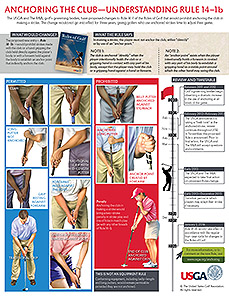
INFOGRAPHIC

Proposed rule 14-1b Infographic USGA Infographic Anchoring Putter, Proposed Rule-14-1b

Infographics are a great tool for visually explaining the rule.  I’m a visual person so I love infographics.

From a communication perspective, the use of infographics in business is becoming more common but is still not really widely used and is not considered a “standard” in the communication toolbox. Therefore, it is nice to see the forward thinking of the communications folks (at the USGA and R&A) using an infographic to support the explanation of the rule change.

Video Explanation

The other visual I did not expect was the in-depth video explaining the reason behind the decision and demonstration of the putting options.  Yes, many videos are done but not all of them are done well or posted in a timely manner.  The USGA and R&A had the video posted on the websites and on YouTube ready for consumption and sharing.  I cannot tell you how many times I’ve seen a major company (or brand) announce a new product and not have a decent video demo posted to YouTube.  And, demo videos are a standard in communication toolboxes in business today.

Email and Social Media

The next thing that impressed me was the email I received from the USGA.  I am a member (just a regular golfer membership for $25/annual fee) so I was not surprised to receive an email, but once again the timing of the email was impressive.  It came at 8:52 a.m. (I was literally watching the golf channel listening to the live press conference at that time).  Again, this simple act of sending an email early to the members is “first-class.” The email included a link to the rules explanation on the USGA website and encouraged feedback via the website feedback tool.

I was not surprised at the USGA’s use of social media (Twitter and Facebook) because they have been using those channels; and the status updates on twitter and Facebook are always timely.  Of course, one key to successful social media is to have great photos or images to share so the infographic and video play nicely into the social media communication channel.

Impact on Reputation

Finally, I think many golfers think the USGA and R&A are “old school” with a bunch of “old boys” and “old traditions.”  I’m sure there are golfers that will view the decision on anchoring the putter as wrong and view the USGA and R&A leaders as hurting the game.

However, based on the execution of the communication of the proposed rule change, the USGA and R&A have shown that although they are protecting the traditions of the game of golf; they are modern in their transparency and communication of their initiatives.