
Stroke and Distance Relief – Putting Greens and Bunkers, Model Local Rule E-5

Ask the average golfer about “stroke and distance” and they will mostly likely tell you that stroke and distance is what you must take for a lost ball or a ball out of bounds; and you incur a one stroke penalty. And some golfers may explain that it is a relief option when your ball is in a penalty area (Rule 17) and a relief option when a golfer declares a ball unplayable (Rule 19). But not many golfers will cite Rule 18.1 which is a governing rule that states that the player can proceed under stroke-and-distance at any time.

Most golfers don’t realize when you take stroke and distance relief under Rules 17.1, 19.2 and 19.3 they could also be correct to say that Rule 18.1 applies. And, most golfers don’t realize how to take advantage of the rules when on a putting green or in a bunker.

Putting Green – Here is the basic scenario. You are on the putting green and you hit your putt which roles off the green and comes to rest perhaps by a tree, or in mud, or even in a penalty area at the back of the green. What is the stroke and distance option? You can declare you ball unplayable (Rule 19.2) any where on the course expect in a penalty area. Declaring your ball unplayable allows you to take stroke and distance with one penalty stroke. Technically if you were asked by another player to state the Rule you could state Rule 18.1 or Rule 19.2.

This rule is useful when you really don’t have a shot or don’t feel confident in the shot you would need to make, etc. So let’s say my ball rolls off the green and is by a tree behind a root; I don’t want to risk hurting my wrist so I declare my ball unplayable and go back on the green and hit from the previous location of the putt that I just hit. And yes, I have a one stroke penalty; but a second putt (with a one stroke penalty) in many cases is better than taking a drop by the tree (again with a one stroke penalty for lateral relief), and trying to get up and down.

Now if your putt roles off the green into a penalty area, you again have the stroke and distance option as one of your relief options for a one penalty stroke under Rule 17.1. Or again, if asked you could state Rule 18.1. But in general, most golfers state they that they are taking relief under Rule 17 (penalty areas) although it is the same option as an unplayable (but remember, you can’t declare your ball unplayable in a penalty area).

I know, the rules can seem overly complicated when you are taking the same action and different rules can be stated but that is just one of the nuances of the Rules of golf; where Rules often repeat instructions.

For me, if I am not confident in making the next stroke from off the green, I’m taking stroke and distance every time and putting again (with the knowledge of what I learned when I hit the previous putt).

If you would like to watch a video on stroke and distance and the putting green, view this Golf Rules YouTube Video.

Some interesting golf trivia – Tiger Woods used stroke and distance at The Masters after a putt rolled off the green into Rae’s Creek. People thought he was wrong but he knew that stroke and distance was an option!

Bunkers – When the Golf of Rules were revised in 2019, the USGA and R&A added a relief option for golfers when they declare the ball unplayable (Rule 19.3). The additional option was to take “back-on-the-line” relief outside the bunker for two penalty strokes. But don’t jump to this option to get the ball out of the bunker; consider the stroke and distance option.

If you declare you ball unplayable in the bunker, for one stroke you can take stroke and distance. Or again you could also state Rule 18.1. Again, you are going back to where you last played the ball but it saves one penalty stroke (versus the back-on-the line option outside the bunker).

I think most golfers would be worried about irritating the other golfers in their group if they take stroke and distance (and have to walk back 100 or more yards). I get it and in general casual play maybe take the two stroke option; but if you are in a competition you should do what is best for you. Personally, if I take an unplayable in the bunker and I can get a decent lie with lateral relief that is what I do. However, if I had no shot at all, I would seriously consider stroke and distance.

I have been asked by a high-handicap player what to do (usually they really have trouble getting out of bunkers even with a good lie). Frankly I tell them in casual play, just take the two stroke option. In league play or a competition; if they are already struggling and 2 strokes won’t impact the outcome then just take the back-on-the-line two strokes; but if they are playing well and think a stroke will make a difference then they have the right to take stroke and distance. It’s a personal decision. I remind them, when they enter their hole-by-hole in GHIN, it will adjust to their max score. Also, if they are new to a league, I tell them to ask if there is a max score for pace of play because that may impact their choice too.

One scenario that always surprises me is when a golfer is a short distance from the green (maybe 5 or 10 yards) and they chunk a shot into the bunker guarding the green. Then they take the back-on-line outside the bunker with two penalty strokes; without even a thought about going back the 5 or 10 yards to where they last hit the ball.

If you’d like to watch a video, you can view this from the USGA. For those that like diagrams, below is the USGA diagram for the relief options for an unplayable ball in a bunker:

Bottom line: It’s never a great feeling to take a penalty stroke but sometimes stroke and distance can be your friend on the golf course.

Model Local Rule E-5

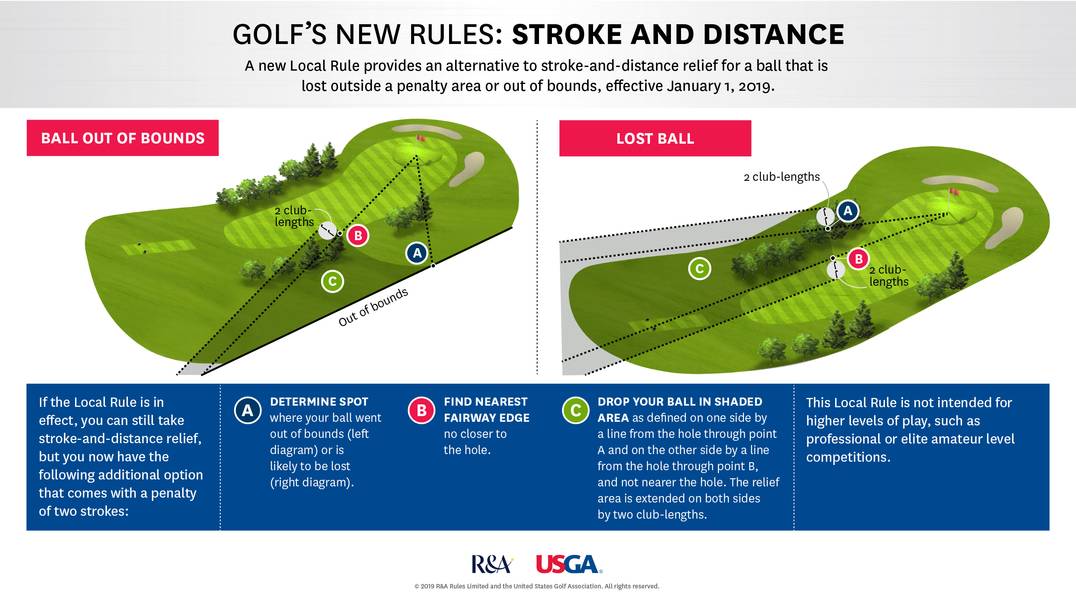
A Model Local Rule is a modification to a rule that “the committee adopts for general play or a particular competition.” The new stroke and distance model local rule is MLR E-5. This is an alternative to stroke and distance for a ball that goes out of bounds or a lost ball. You cannot use this rule if you played a provisional or your ball is lost in a penalty area.

Basically, when you are OB or have a lost ball, in stead of going back to where you last played your ball, you figure out where your ball came to rest (and imagine a line to the flag) and then you find the nearest fairway edge (imagine a line to the flag); from the edge of the fairway you get two-club lengths (along with the imaginary lines from the flag) to create your relief area. This model local rule comes with a 2-stroke penalty.

I believe courses implement MLR -E5 hoping it will help with pace of play. Of course whether or not golfers will use it is debatable because it does have a two stroke penalty. In a casual round I think many golfers would be open to using MLR E-5 but in competition I would guess no one would want to use it unless they were already feeling they were out of the money.

You can watch the USGA video or below is a diagram of the Rule:
Bonus Info:

Lost Ball in Abnormal Course Condition: Some golfers think you must take stroke and distance for ALL lost balls but remember that if it is known or virtual certain that you lost your ball in an abnormal course condition (the abnormal course condition must be in bounds and not in a penalty area); including animal hole, ground under repair, immovable obstruction or temporary water, you get free relief under Rule 16; you do not have to take stroke and distance.

For example, there is a pile of storm debris (in the general area, not OB or in a penalty area) that you know the maintenance crew will be removing from the course. The pile of debris is considered ground under repair even if not mark. So, if you are virtually certain (95% likely) you ball is in the pile of debris but you can’t find it, you can take free relief.

Ball in Water in a Bunker: Another example when it’s good to know the rules. It rained the night before and there is temporary water in a bunker. You hit your ball in the bunker and find it in the temporary water. Some golfers will think they need to take an unplayable but that is not correct. Under Rule 16 (Relief from Abnormal Course Conditions) you get free relief from the water but you must stay in the bunker taking free relief (one club length from nearest point of complete relief). So, again, if you want out of the bunker then you can use Rule 18.1 (stroke and distance) or Rule 19.3 (unplayable).

Water on the Green but Ball is Off the Green: Sorry, you don’t get free relief if you want to putt your ball from off the green and there is water on your line on the green. To get free relief from temporary water on the green your ball must also be on the green. Here is a great short video from Jay Roberts.

Do you know how to properly find the nearest point of complete relief? If you want a refresher there is a good video from the USGA.

Crazy Rules Issues at the Amundi Evian Major Championship

First, Congratulations to Celine Boutier for winning a major in her home country of France. Boutier, is 29 years old, joined the LPGA in 2019. Winning the Evian she jumps from 15 to #4 in the world golf rankings. She became “well-known” with LPGA fans because of her performance at the 2019 Solheim Cup at Gleneagles in Scotland as a standout on the European team with a 4-0-0 record.

Set aside Boutier’s win by six strokes and what else was news worthy at the 4th major of the year for the LPGA – the crazy rules issues that happened.

Rules Issue – Slow Play and Signing an Incorrect Scorecard

Carlota Cinganda from Spain received a 2-stroke (general penalty) for slow play on Friday. Cinganda’s group was given a warning, then put on the clock (which is the standard procedure after a warning if the group doesn’t get back in position with the group in front of them). So she was well aware that she was being timed; and ultimately she was deemed to be over the allotted time. She protested the ruling stating the penalty was on her last hole, her last putt and there was no way she took as long as the rules official stated. Cinganda was denied a reversal and the 2-stroke penalty was final.

The big headlines on social media implied that she was disqualified (DQ) for slow play; which was very misleading. She was DQed because she chose not to add the 2-stroke penalty to her scorecard and signed her scorecard without the penalty; thus signed an incorrect scorecard, with a lower score, see Rule 3.3b(3), which is what triggered the disqualification.

This penalty had a big impact on Cingada because without the 2-stroke penalty she was on the cut line and probably would have made the weekend; but with the 2-stroke penalty she was clearly outside the cut and would miss the weekend.

Cindgada is known to be a slow player and has been assessed slow play penalties in the past. She indicated in a statement she felt she was being singled out. My opinion is that she was given a warning, then told she was on the clock and given her past experience I would have thought she would have been aware of how fast she needed to pick up her pace to guarantee she was under the time allotment.

Rule Issue – Unplayable Ball from a Bunker

On Saturday, Gabby Lopez decided to take an unplayable in a bunker which is allowed; however, she clearly did not know the relief options available to her because she just took relief outside the bunker but not with the stroke and distance option (for one stroke). The rule gives the player 4 options (see diagram below)

It’s clear that Lopez needed to go with Option#1 if she wanted to play outside the bunker for one stroke. She took the option that had a 2-stroke penalty because of where she played from outside the bunker. The television analysts were shocked that Lopez did not have a Rules Official come over and give her the options once she decided to take an unplayable. What I would love to know is if she didn’t know the rule or if she just had a “brain fart” during the competition.

I’m also surprised her caddie didn’t stop Lopez from picking up her ball until they got a rules official over to help discuss her options. The fact that he did not intervene meant either he also didn’t know the rule (and therefore didn’t know to correct what his player was about to do) or he felt his player knew what she was doing so he did not question her actions.

Most of the time, I find it amusing how professionals on the PGA and LPGA call over rules officials for the most common rules (which seems to add to the already long rounds of golf on tour); but if you have the option to have an official walk you through the rule, why not. I’m guessing Lopez will always use a rules official in the future.

Unlike the Cingada situation, Lopez just took her 2-stroke penalty (once informed of her error) and signed her card and moved on to Sunday. I actually think she was motivated to play her best golf. On Sunday Lopez shot a 68 (-3); finishing tied for 3rd with a total score of 277 (7 under par) winning $283,278. And, the T-3 was her best finish this year.

Overall Reaction to the Rules Issues

First, I am very glad the LPGA actually takes actions addressing slow play on tour. I wish the PGA Tour would time more players and have a 2-stroke penalty as the consequence on their tour.

Also, I know that Cingada was “making a stand” by not signing her card but later on social media she stated, “Very poor performance from the LPGA rules official, they don’t understand what professional golf is about, they only look at their stopwatch like if 20 seconds is going to make a difference.” Now that seems like a ridiculous statement given she clearly knew she was on the clock. She takes zero responsibility for her actions. Unfortunately, Cingada’s response does not reflect well on her.

As for Gabby Lopez, I bet she will never forget the options for taking an unplayable from a bunker again!

Time to Review the Rules of Golf

How confident are you in the Rules of Golf? I am not an expert in the Rules of Golf so I make sure I review the most common rules at the start of each golf season to get my “golf brain” ready for golf league season.

I also want to know the rules that can help me! Plus, I don’t want a penalty because I didn’t know the governing bodies (USGA and R&A) changed a rule. For example, did you know the governing bodies announced five rules changes in 2023. The two changes that caught my eye are the “ball moved by natural forces” and the “back-on-the line” relief change.

Ball Moved by Natural Forces (or the Rick Fowler Rule)

A new exception provides that a ball at rest must be replaced if natural forces moves it to another area of the course or comes to rest out of bounds after being dropped, placed or replaced. Some call this the “Rick Flower Rule” because of what happened to him at the 2019 Waste Management. This exception is to protect the player from getting unfair penalties. Ricky had a five shot lead before the debacle on the 11th hole when Ricky had multiple penalties because a “natural force” (wind, water, gravity) kept moving his ball from the general area back into the penalty area. Here is the video of the event.

This 2023 change is an “exception” and doesn’t change the rule that if your ball is in the general area and moved by natural forces that there is no penalty and you play from the new spot. For example, you hit your ball in the fairway, a gust of wind moves your ball while you are deciding what club to hit, you now must hit from the new spot (no penalty). The other exception to ball moved by natural forces deals with the putting green (see Rule 9.3 Exception 1) which basically states that if you marked it, you own that spot and you replace the ball but remember, if it is not marked and it moves (even if it is off the green) you play from where it ends up.

It’s really important to know what to do when your ball moves (especially in the general area) because if you play from the wrong spot it is a 2-stroke penalty. Here is a good video from GUR LLC Golf on various situations when your ball moves in the general area (note: it does not include the new rule).

Back-on-the-line Relief Change

You must drop on the line now and the ball can roll within one-club length in any direction (basically, think of the relief area as a one club-length circle around the ball). What makes this interesting is that the ball could roll forward and come to rest closer to the hole; which is usually not allowed when taking relief. At first I thought this was so odd since, as golfers, it is drilled into us that the ball cannot be “closer to the hole” when taking relief. As I thought about the logic for this new rule, I rationalized it as follows – because the drop is “on a line” a golfer could have chosen to drop closer on the line so it’s not an advantage to have it roll closer to the hole. I have no idea if this is the reasoning but it was how I came to terms with the new rule.

I saw a video by GIR Golf LLC explains the difference between the new rule requiring you drop on the line versus the old procedure which let you drop within one club-length of the line. The old drop process gave you a bit more “wiggle room” to try and create a better out come. For example, you could perhaps have a better line to the green by being allowed to drop one club length to the left of the line. That’s not an option now. The ball must be dropped on the line.

Also, most golfers know if the ball rolls outside the penalty area, you re-drop the ball. With this new rule you must re-drop on the line but you don’t have to drop on the exact same spot on the line as the first drop, you can drop on a different location on the line (see definition of relief area for more detail).

Other Rules I Find Useful to Know

I am also always amused each year how many golfers I play with don’t use rules to their advantage. Sometimes they don’t know about the rule and most often times they use the rules incorrectly. Here are a few that come to mind…

Embedded Ball (Rule 16.3)

Basically, if your ball is embedded in its own pitch mark in the general area you can take free relief. To be “embedded” part of the ball must be below the level of the ground. If the ball is embedded you can remove the ball from the pitch mark, relief reference point is directly behind where the ball was embedded, determine relief area (one club-length, in general area, no nearer the hole) and drop the ball.

It can be very wet in Greenville so it always surprises me when I play with a golfer that doesn’t know this rule. They also don’t seem to know how to take relief, or know that they can clean their ball, and don’t know they can also substitute the ball.

Cleaning (Rule 14.1.c) or Substituting a Ball

Everyone knows you can clean your ball when you mark and lift it on the putting green but a lot of times I’ll be in a group and someone will ask, as they pick up their ball, “can I clean my ball?” One way to think about it is that you always can clean or substitute your ball when you are taking relief (free relief or for a penalty).

The surefire way to know when you can clean your ball is to know the four exceptions (or when you cannot clean your ball). You cannot clean your ball when:

  1. You are trying to Identify the ball – the exception here is you can clean it just enough to identify your ball.
  2. You are asked to mark your ball because it interferes with play of another golfer.
  3. You want to determine if your ball is damage (e.g., cracked or cut is the only time a ball is “damaged”).
  4. You want to see if your ball lies in a condition that allows relief. For example, to determine if a ball is embedded. If you determine you do get relief then you can clean your ball (but don’t clean it before you make the determination).

You can always substitute a ball when you are between holes but when else can you substitute a ball? It is tricky to find in the rules but the key is to look for the words “or another ball.” For example, if you read Rule 6.3 (ball used in play of hole), the language for taking relief reads “the player may use either the original ball or another ball (Rule 14.3a).

It is important to know that you cannot just decide to substitute a ball during the play of the hole. If your ball gets scuffed from hitting the cart path or you get a mud ball on a wet course that’s just bad luck. You must play the hole with that ball. You can put a new ball in play on your next hole.

What is a damaged ball? I play with many golfers that think a scuffed ball is a “damaged ball” – it is not. Per the Rules of Golf only a cut or crack in a ball qualifies as a damaged ball (Rule 4.2.c).

Restoring a “Worsened Condition” Rule 8.1.d

Rule 8 is “Course played as it is found.” Golfers all know they are to play the course as they find it but there is a clause that a lot of golfers don’t know. This clause is fascinating to me and you may never need it but it’s good to know (especially around the green). Rule 8.1.d addresses the situation when the course is not in the same condition as you found it. Specially, Rule 8.1.d says that if the course condition is worsened by another player (or animal, artificial object) after your ball comes to rest you can restore the “worsened condition.”

The most common example given is that your ball is at rest close to the green (but not on it) and another player hits their ball in front of your ball which makes a pitch mark right in front of your ball. So, the condition of the course was made worse in front of your ball and you can now restore the area back to it’s original condition (i.e. repair that pitch mark). However, if the pitch mark was already there when your ball came to rest that’s just bad luck.

Another example is if your ball is near a bunker and a player hits out of the bunker and sand lands on (or in front of) your ball. Assuming the sand was not on your ball when it came to rest, you can clean your ball and brush the sand off the ground in front of your ball.

You also can mark and clean your ball when you restore a worsened condition; and if you can’t restore the area, you get a one club-length relief area.

Abnormal Course Condition “Relief Area”

It drives me crazy when someone tells me I must take relief in the “same condition” when taking relief from an abnormal course condition. The clarification of the rule states “There is nothing in Rule 16.1 that requires them to maintain the identical condition.” You can read the full explanation in the clarifications for Rule 16.1. but basically your ball must stay in the same “area of the course” and there are five areas of the course: teeing area, putting area, penalty area, bunkers, and general area – so there is no distinction between rough and fairway in this instance because they are in the same general area. That’s why when you take free relief in a bunker for temporary water, or a dangerous animal you must drop in the bunker because you must be in the same “area” (not condition). If you take relief in a different “area” it comes with a penalty.

There are options that allow you to take relief in a different “area of the course” (remember there are five areas of the course) but you don’t get free relief. For example, using the bunker, let’s say you take free lateral relief (2-club lengths) in the bunker from a fire ant hill (dangerous animal condition, Rule 16.2) but you still don’t feel comfortable in the bunker with the ants. You want out of the bunker so your next option is basically to take “stroke and distance” relief with a one-stroke penalty to get out of the bunker or take a 2-stroke penalty (back-on-the-line) outside the bunker. There are four options for taking an unplayable ball in the bunker (see rule 19.3b which has a diagram of the options).

There’s a good video from GIR golf on YouTube that walks through various dangerous animal situations including when your ball lands in a penalty area and there is an alligator (watch at around 8 mins). Basically, if you determine you would play the ball as it lies in the penalty area (if the gator was not there) you can take free relief in another part of the penalty area (if you think it is safe); otherwise, you can take relief outside the penalty area for a one-stroke penalty (using one of the various options of the penalty relief procedure).

One Club Length Versus Two-Club Lengths When Taking Relief

“How many club lengths do I take?” There are only two instances when 2-club lengths are used to determine a drop area. They are unplayable ball and lateral relief. A bit more about each:

  1. Unplayable ball – A player can declare the ball unplayable any where on the course except penalty areas. The USGA has a good diagram for unplayable options in the general area in Rule 19.2 Some golfers I have played with do not realize you can declare you ball unplayable in a bunker which gives you four options . For example, did you know you can take stroke and distance for one penalty stroke? The USGA has a good unplayable ball video on YouTube and there is a good review from the USGA FAQ section.
  2. Lateral Relief – The red penalty relief procedure allows you to take 2-club lengths to determine the drop area. As a review, the penalty areas have the following relief options:
    • Yellow and Red: play the ball as it lies which has no penalty
    • Yellow and Red: stroke and distance for one penalty stroke
    • Yellow and Red: back-on-the-line for one penalty stroke
    • Red only: Lateral relief – 2-club lengths from where the ball last crossed the penalty area. One penalty stroke.

Relief from a Cart Path

We would all love to take relief from the side of the cart path that gives us the best shot but that isn’t how the rules works. It’s another procedure many golfers get wrong because they don’t take the nearest point of complete relief. The USGA video is a good refresher. And, You must also stay in the same “area” of the course so what happens when the relief area you think is correct is not in the same area. Jay Roberts has a great Cart Path Relief video with this situation (and Jay demonstrates it could be to your advantage). Jay Roberts also has a great video titled “4 Mistakes when Taking Free Relief from a Cart Path.” For example, don’t take your ball off the cart path until you make a decision on what you want to do!

Final Thoughts

You may have read this post and thought to yourself that you know all these rules so no need for a review. If yes, that’s great! I always seem to feel the need to review even simple rules at the start of golf season.

If you are looking for sources of rules reviews (other than the USGA and R&A), I usually learn about interesting Rules situations from following some of my favorite Rules guys on Instagram or YouTube. They include: Jay Roberts Golf, GolfRules Question, and GIR LLC Golf, Jay Roberts is really good at making rules simple and he is so good that the USGA recently hired him.

As I said I am not an expert, but I try to do my best. When playing with friends for fun I really don’t care how closely anyone follow the rules. In league or in competition, it gives me peace of mind to know rules so that I don’t get overly stressed when I find myself in a sticky situation on the course.

Happy golfing in 2023 and may the golf rules be kind to you!

Communicating Change – USGA not so “old school”

The golf industry has been anticipating the ruling on long putters all year and finally the announcement came that the governing bodies of golf, the USGA and The R&A, are proposing a ban on “anchoring” the putter against the body.

I was not planning on writing about this announcement because I use a traditional putter and I don’t have an issue with the rule.  What I found interesting and what has compelled me to write is my surprise at how well the USGA and The R&A disseminated the information!

Obviously if you are a golf geek (as I am), you expected the news to unfold on the Golf Channel.  Both Mike Davis, USGA Executive Director and Peter Dawson,  The R&A Chief Executive were on TV.

What I did not expect was the variety of materials created to communicate and explain the proposed rule change, and the fact that they are promoting a 90-day feedback period to allows stakeholders to share their opinion on the proposed change.

INFOGRAPHIC

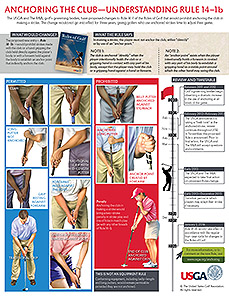
Proposed rule 14-1b Infographic USGA Infographic Anchoring Putter, Proposed Rule-14-1b

Infographics are a great tool for visually explaining the rule.  I’m a visual person so I love infographics.

From a communication perspective, the use of infographics in business is becoming more common but is still not really widely used and is not considered a “standard” in the communication toolbox. Therefore, it is nice to see the forward thinking of the communications folks (at the USGA and R&A) using an infographic to support the explanation of the rule change.

Video Explanation

The other visual I did not expect was the in-depth video explaining the reason behind the decision and demonstration of the putting options.  Yes, many videos are done but not all of them are done well or posted in a timely manner.  The USGA and R&A had the video posted on the websites and on YouTube ready for consumption and sharing.  I cannot tell you how many times I’ve seen a major company (or brand) announce a new product and not have a decent video demo posted to YouTube.  And, demo videos are a standard in communication toolboxes in business today.

Email and Social Media

The next thing that impressed me was the email I received from the USGA.  I am a member (just a regular golfer membership for $25/annual fee) so I was not surprised to receive an email, but once again the timing of the email was impressive.  It came at 8:52 a.m. (I was literally watching the golf channel listening to the live press conference at that time).  Again, this simple act of sending an email early to the members is “first-class.” The email included a link to the rules explanation on the USGA website and encouraged feedback via the website feedback tool.

I was not surprised at the USGA’s use of social media (Twitter and Facebook) because they have been using those channels; and the status updates on twitter and Facebook are always timely.  Of course, one key to successful social media is to have great photos or images to share so the infographic and video play nicely into the social media communication channel.

Impact on Reputation

Finally, I think many golfers think the USGA and R&A are “old school” with a bunch of “old boys” and “old traditions.”  I’m sure there are golfers that will view the decision on anchoring the putter as wrong and view the USGA and R&A leaders as hurting the game.

However, based on the execution of the communication of the proposed rule change, the USGA and R&A have shown that although they are protecting the traditions of the game of golf; they are modern in their transparency and communication of their initiatives.

Grow the game of golf by being kind to a new golfer

In the past ten days I have played two rounds of golf  in which one of the other golfers was a new golfer.  At the first tee, new golfers often and nervously explained their lack of skill, sheepishly saying, “I’m just starting out, I’m not very good, etc.”

My response was to smile and tell them it’s a great day for golf.  I told them if they have any questions about the game, ask away — I’m happy to help.  You could literally see their whole bodies relax when they realized I was not annoyed with the fact that they were beginners.  I also asked them if they would like me to let them know if they are about to break a basic rule of the game or if they would like me to give them pointers on golf etiquette.  Both said they would love the help.

Now, for me, this is the key to playing with new golfers; help them relax and let them know we are in this wonderful round of golf together.  By asking them if they would like assistance, I am creating a win/win.  They agree to the help and I can offer assistance to keep me from going crazy if they do something truly annoying (like talking in my back swing).  I look at it this way, the more relaxed they are the better the chance they will play well.

Each new golfer had their own set of questions, ranging from how high to tee the ball to how to read a putt, but the most valuable tips I shared with them allowed them to keep up with the pace of play.  I told them that it doesn’t matter how bad they think they play; what they need to avoid is playing too slowly.  The advice I shared was simple:

  1. Don’t think too much about your swing.  Take one practice swing and then go for it.  If you take too many practice swings or stand over your ball thinking about all the things you learned, it will slow things down (and it will tire you out both mentally and physically).
  2. Be aware of what the other golfers are doing. Watch them hit the ball off the tee so that if they do not see where their ball landed, you can save them time finding their ball.
  3. Be ready when it is your turn — as soon as you see the other person hit their ball (hopefully from the fairway) be ready to hit your ball.  In other words, you can be thinking about what club to use and where you want to aim when they are getting ready to hit their ball.
  4. Pick up your ball if you are struggling on a hole — don’t take 15 strokes on a hole. If you are not in a tournament,  just pick up the ball and take it up to the fringe and hit a chip and putt.  No one will think less of you, and in fact, will respect that you are aware of the pace of play and making a decision that will keep things moving along.
  5. Always put your clubs between the green you are putting on and tee for the next hole.  Then when you walk off the green you can pick up a club that you might have left on the fringe and get your bag on the way to the next tee.  If you don’t know where the next tee is, ask your playing partner (as you are walking up to the green.)

The other area in which they needed a lot of advice was on the green.  Both of the beginners had putting lessons, but the lessons only explained the putting stroke, so we had a quick class on managing the green. Advice included:

  1. Make sure you have a ball marker to mark your ball — one of them didn’t even know that their glove had a built-in ball mark.  Always ask if you need to move the mark for someone else putting.
  2. Repair ball marks — I showed them how to lift the grass and tap it down with the putter.
  3. Tending the Flagstick — I explained they must remove the flagstick when their ball is on the green (or it’s a penalty).  If you can’t see the hole, you can have someone tend the flag.  I tended the flag, giving them little pointers, like if their body casts a shadow, stand so the shadow is not over the hole. Or, if it is a windy day, hold the flag against the pole so it does not flap in the wind.
  4. Never walk in between the hole and another players ball mark — explaining that you want to always know where the other ball marks are so you avoid making any footprints in another golfers putting line.
  5. Ask if you can finish out your putt. Don’t just assume you can “tap it in”…make sure your playing partner doesn’t mind if you tap in before he takes his/her turn.

Both rounds of golf where enjoyable and the new golfers were very happy when I left them in the parking lot.  I felt good about helping them and remembered friends that had helped me when I was a beginner.

A lot of seasoned golfers dread being put with beginners. This always amazes me because we were all beginners at one time, and let’s face it, on any given day our golf swing can let us down and our game can “look and feel” like we have never held a club in our hands.  So if you love the game of golf and want golf to grow and prosper — do your part to help grow the game of golf by being kind to a new golfer.

Moments of glory in golf – some forever and some fleeting

The best advice my mother ever gave me is that life can be tough (with lots of ups and downs) and we live through the tough times to experience “the moments” that make life worth living.  So here are two stories that are perfect examples of the ups and downs of life as a golfer.  One story of a golfer making history and the other who should have made history except for a heartbreaking lapse in concentration.

Let’s start with the moment of glory for Rhein Gibson.  Gibson is not someone you should know.  He plays on the Golfweek National Pro Tour (frankly, a mini-tour I have never heard of before now).  So what did Gibson do for his moment of glory?  He recorded a 55 (or 16 under par) at his home course, River Oaks, in Edmond, Oklahoma.  His scorecard is all over the internet but if you have not seen it here is a great shot of it from the Australia Broadcasting website article (Gibson lives in Oklahoma but is Australia).

Australia Broadcasting Company Image of Rhein Gibson Scorecard

How good is a 55?  The world’s best female golfer is known for shooting a 59 (in tournament play) and her nickname is Annika59 (yes, Annika Sorenstam).  She often talked about her personal goal to shoot a perfect round — the elusive score of 54 (which would be a birdie on every hole).  But this has never happened for any golfer.

Now, Gibson was not playing in a tournament but Gibson’s score of 55 could still go into the Guinness Book of World Records.  We will have to wait and see if it accepted; but what an amazing site to see.  Six birdies on the front nine for a 29; followed by 2 eagles (the triangles) and 6 more birdies for a back 9 score of 26.  Will Gibson ever make it to the PGA?  Who knows, but he has his 15 minutes of fame and a moment in his life that he will never, ever forget.

Now to a story that should have been history making for a young high school female golfer.  Caroline Inglis was on her way to winning the Oregon state tournament for the 4th year in a row. She finished with a 3-under 69, a score that was nine shots better than anyone else in the tournament.  But she was disqualified and lost her title.  How?  Read on…

In golf, a player must sign the scorecard at the end of the round and if the player signs an incorrect scorecard they will be disqualified.  This is what happened to Inglis.  According to news reports, her playing partner recorded a par for Inglis on the final (18th) hole but Inglis shot a bogey (1 over par); and Inglis did not catch the error and signed the card.  You can see the disbelief in the young golfer’s face in the photo below.

Churchill golfer Caroline Inglis after being disqualified for a scorecard violation — Jesse Skoubo/AP/Corvallis

(Photo by Jesse Skoubo/AP/Corvallis).

You wonder how could this happen; but according to an article written by Mike Tokito of The Oregonian, it happens more that you think.  He interviewed the University of Oregon women’s golf coach Ria Scott.  Inglis will play college golf for the University of Oregon next year. The quote from the article is:

“From my experience, it seems to happen when people are really emotional about their round, one way or another,” Scott said. “Either you’re really frustrated or really excited.”

In other words, the young player was so excited that she lost her concentration and did not focus on making sure the card was correct.  That’s a tough golf (and life) lesson to learn.

I’m sure Caroline Inglis will recover and go on to bigger and better things in golf.  Although we can’t predict her future; I think we can predict she will always double check her scorecard.