Major Winners on the PGA Tour and LPGA Tour – A Review of Their Play in All Majors in 2023

We all can remember the winners of the majors but I was curious how a major winner plays in all the majors for a year. It doesn’t feel like we have had a dominant player in majors for a number of years. Will we see another like Tiger, Jack, Annika, or Inbee dominate their tour’s majors?

This year only one player won multiple majors, Lila Vu on the LPGA won the first (Chevron) and last (AIG Women’s Open) major of the 2023 for the ladies. So I was curious how did major winners fare in all majors in a given year.

Below are two charts showing the winners for each major and how they played the other majors.

After a player wins a major we often hear the golf analysts make statements about the golfer being the next “big thing” or will now win multiple majors but the charts shows how hard that is to do in the same year. Lilia Vu has added her name to a very special list. So who else is on the list of multiple major winners in a single year? Here are some recent (within 10 years) stats:

(1) On the PGA tour Jordan, Rory, and Brooks have won multiple majors in a year.

  • 2014, Rory McIlroy: British Open, PGA Championship
  • 2015, Jordan Spieth: Masters, U.S. Open
  • 2018, Brooks Koepka: U.S. Open, PGA Championship

(2) On the LPGA tour Inbee Park, Jin Young Ko and Lila Vu

  • 2013, Inbee Park: Kraft Nabisco Championship (now, Chevron), U.S. Women’s Open, LPGA Championship (Now LPGA/PGA Championship)
  • 2015, Inbee Park: LPGA/PGA Championship, Women’s British Open (Now AIG Women’s Open)
  • 2019, Jin Young Ko: ANA Championship (now Chevron), Evian Championship
  • 2023, Lilia Vu: Chevron and AIG Women’s Open

To see the lists of multiple winners (by year) go to Golfer Compendium which lists multiple major winners in a single year for LPGA since 1946 and multiple major winners in a single year since 1922 for the PGA tour.

Lilia Vu – a New World #1 on the LPGA

Congratulations to Lilia Vu winning the AIG Women’s British Open by six strokes! An even more impressive feat given she was six back of the leader when she started her round on the weekend. Vu is now a two-time major champion in a single year and the new #1 player in women’s golf. Another way to think of it, Vu has three wins in eight months and two of those wins are majors.

I doubt many had Vu on their radar to win the last major of the season given she has played spotty since her win at Chevron in April but her record on the Epson tour and her top 10s in 2022 on the LPGA tour were clear indicators of her talent.

If you don’t know much about Vu, she is 25 years old, is American (born in California) but her family comes from Vietnam (Grandfather moved family to USA in 1982). She played her college golf at UCLA and was on the winning Curtis Cup team in 2018. She graduated in 2019 and started her rookie year on the LPGA. Her rookie year was a disaster with 7 missed cuts out of 8 tournaments; only making $3,830. She almost quit but her mother encouraged her to stay the course and so she went to the Epson tour in 2020 where her journey to outstanding golf started to take shape.

Lilia Vu was a standout on the Epson tour (feeder tour for LPGA) in 2021 with four wins and 10 top 10 finishes; then transitioned to the LPGA tour in 2022 and she recorded eight top ten finishes.

Vu appeared to be on the way to great things when she won the first major of the year, The Chevron. However, after Vu’s win at Chevron, she missed the cut at the next two majors (The KPMG PGA Championship and the US Women’s Open) and had a T42 at the Evian.

During various press conferences, when asked about her game, She mentioned she was struggling with some back issues; and she also was learning how to juggle demands after winning a major because so much more is expected of winners with the sponsors, etc. For instance, before her win at Chevron she didn’t even have an agent. Now she has an agent to deal with all the requests of her time outside the ropes.

Prior to the win at the AIG Women’s Open, Vu’s world golf rank was 6 (Race to CME rank 7). Vu is now ranked the #1 player in the world (Race to CME rank 1). This season on the LPGA, Vu has 4 top 10 finishes and 3 wins (including two majors). That’s a very impressive 2023.

While being interviewed after winning the AIG Women’s Open Vu said she had felt (at times) like her first two wins in 2023 were a fluke. When asked if she believed in herself after winning the AIG Women’s Open, she said “Yes. And she mentioned that “the only thing that get’s in her way of winning is herself.” The players on the LPGA should watch out for a Vu who now believes in herself.

She is a talented golfer and deserving of her wins. You can read all about Vu on the LPGA website Player Profile

Crazy Rules Issues at the Amundi Evian Major Championship

First, Congratulations to Celine Boutier for winning a major in her home country of France. Boutier, is 29 years old, joined the LPGA in 2019. Winning the Evian she jumps from 15 to #4 in the world golf rankings. She became “well-known” with LPGA fans because of her performance at the 2019 Solheim Cup at Gleneagles in Scotland as a standout on the European team with a 4-0-0 record.

Set aside Boutier’s win by six strokes and what else was news worthy at the 4th major of the year for the LPGA – the crazy rules issues that happened.

Rules Issue – Slow Play and Signing an Incorrect Scorecard

Carlota Cinganda from Spain received a 2-stroke (general penalty) for slow play on Friday. Cinganda’s group was given a warning, then put on the clock (which is the standard procedure after a warning if the group doesn’t get back in position with the group in front of them). So she was well aware that she was being timed; and ultimately she was deemed to be over the allotted time. She protested the ruling stating the penalty was on her last hole, her last putt and there was no way she took as long as the rules official stated. Cinganda was denied a reversal and the 2-stroke penalty was final.

The big headlines on social media implied that she was disqualified (DQ) for slow play; which was very misleading. She was DQed because she chose not to add the 2-stroke penalty to her scorecard and signed her scorecard without the penalty; thus signed an incorrect scorecard, with a lower score, see Rule 3.3b(3), which is what triggered the disqualification.

This penalty had a big impact on Cingada because without the 2-stroke penalty she was on the cut line and probably would have made the weekend; but with the 2-stroke penalty she was clearly outside the cut and would miss the weekend.

Cindgada is known to be a slow player and has been assessed slow play penalties in the past. She indicated in a statement she felt she was being singled out. My opinion is that she was given a warning, then told she was on the clock and given her past experience I would have thought she would have been aware of how fast she needed to pick up her pace to guarantee she was under the time allotment.

Rule Issue – Unplayable Ball from a Bunker

On Saturday, Gabby Lopez decided to take an unplayable in a bunker which is allowed; however, she clearly did not know the relief options available to her because she just took relief outside the bunker but not with the stroke and distance option (for one stroke). The rule gives the player 4 options (see diagram below)

It’s clear that Lopez needed to go with Option#1 if she wanted to play outside the bunker for one stroke. She took the option that had a 2-stroke penalty because of where she played from outside the bunker. The television analysts were shocked that Lopez did not have a Rules Official come over and give her the options once she decided to take an unplayable. What I would love to know is if she didn’t know the rule or if she just had a “brain fart” during the competition.

I’m also surprised her caddie didn’t stop Lopez from picking up her ball until they got a rules official over to help discuss her options. The fact that he did not intervene meant either he also didn’t know the rule (and therefore didn’t know to correct what his player was about to do) or he felt his player knew what she was doing so he did not question her actions.

Most of the time, I find it amusing how professionals on the PGA and LPGA call over rules officials for the most common rules (which seems to add to the already long rounds of golf on tour); but if you have the option to have an official walk you through the rule, why not. I’m guessing Lopez will always use a rules official in the future.

Unlike the Cingada situation, Lopez just took her 2-stroke penalty (once informed of her error) and signed her card and moved on to Sunday. I actually think she was motivated to play her best golf. On Sunday Lopez shot a 68 (-3); finishing tied for 3rd with a total score of 277 (7 under par) winning $283,278. And, the T-3 was her best finish this year.

Overall Reaction to the Rules Issues

First, I am very glad the LPGA actually takes actions addressing slow play on tour. I wish the PGA Tour would time more players and have a 2-stroke penalty as the consequence on their tour.

Also, I know that Cingada was “making a stand” by not signing her card but later on social media she stated, “Very poor performance from the LPGA rules official, they don’t understand what professional golf is about, they only look at their stopwatch like if 20 seconds is going to make a difference.” Now that seems like a ridiculous statement given she clearly knew she was on the clock. She takes zero responsibility for her actions. Unfortunately, Cingada’s response does not reflect well on her.

As for Gabby Lopez, I bet she will never forget the options for taking an unplayable from a bunker again!

Five Things I Loved about the U.S. Women’s Open at Pebble Beach

It goes without saying the significance of a women’s major at Pebble Beach. The media has discussed it at great length so that is not the focus of this blog post. This post is just a quick commentary on what I, as an avid golf fan, enjoyed about watching the U.S. Women’s Open this week.

  1. The Course – There is no more beautiful course than Pebble Beach. I always enjoy watching the AT&T Pro Am each year just to see the beautiful views as I sit in my home in the middle of winter on the east course. I think every golfer “knows” the course (even if they have never been to Pebble Beach) just from the broadcast of course for so many years. Here is a flyover of every hole from the USGA.
  2. Reliving My Golf Experience – I had my “bucket list” golf trip to Pebble Beach in 2021 and watching the women play the course and knowing each hole and how I played it made watching the championship that much more enjoyable and exciting for me. My best hole at Pebble Beach was a par on the 6th hole (Par 5) so that hole in particular was fun to watch. But I also remember my friend’s great play on hole #7, and can say with certainty that the cliff on hole 8 (or the Speith hole as it is now known) is really scary when standing by the edge.
  3. Charley Hull’s Charge on Sunday – Corpuz was an example of what many call boring golf meaning “fairways and greens.” Charley Hull gave us the excitement we want on the final day of a major. She was fearless and the number of long putts she made was amazing. Her final round of 66 was just awesome.
  4. The Steller Play of Allisen Corpuz – I do not enjoy seeing a player in the lead blow up. I want them to play their best golf and if someone beats them it’s because the other golfer player better (not because the leader fell apart in the final round). Corpuz played her best golf.
  5. Prime Time Golf – The bonus of having the U.S. Women’s Open on the west coast was that it was prime time coverage. Not only prime time but live coverage!

Overall I really enjoyed this U.S. Women’s Open and I am excited for “major season” to continue with the next golf major from across the pond; which will be the men playing The Open at Royal Liverpool Golf Club July 20 through 23. The Open is the final major for the men but we have two more majors for the women. The Evian Championship July 27 through 30 and the final major of the year will be the Women’s British Open at Walton Heath Golf Club August 10 through 13.

Scottie Scheffler Doesn’t Let the Media Get in His Head

I’m always amused at how so many golf analysts focus on the bad. Even when they acknowledge the great aspects of a player’s game, they quickly pepper the player with questions about their weakness. Point in case was this past week when Scottie Scheffler finished in second place at the Memorial Tournament with the best tee to green play of any player in the field; and that is saying a lot given how hard Muirfield Village played.

There is so much data now in golf. You can look at your favorite golfer’s profile and see all the stats. For example, Scottie Scheffler (by the way is the #1 golfer in the world) has amazing stats when you review his profile on the PGA Tour site. Scheffler’s PGA Tour Stats (SG = Strokes Gained) include:

Scottie Scheffler’s Stats as of 6/7/2023

Now you would think with being #1 in strokes gained in Total, Tee-to-Green, and Off-the-Tee; as well as, #2 in Approach to the Green that he would win every week; but then you see his putting has been off. But overall his consistency is incredible. He has made every cut, has won twice, and has 11 top 10 finishes. See the screenshot below of his performance as of June 7,2023.

Scottie Scheffler’s record as of 6/7/2023

So when the golf media decides to focus on what’s not going right instead of what is amazing consistency; I love the fact that Scottie Scheffler basically ignores all the “talk” and just plays his game. And he doesn’t let the media get in his head. His reply to his poor putting “Sometimes it goes in and sometimes it doesn’t.” Now he did go on to say it is frustrating but he then said “If I was putting my best this week, I would have won by a crazy amount.” He also said that he and Jon Rahm were joking about how the putts weren’t falling this week.

Even though he knows he has an issue with his putting. He has been asked about his putting every week for a few weeks; he acknowledges it but doesn’t let the media “poke the wound” and get upset about it.

I have admired Scottie Scheffler since his Master’s win not just because of his play but also because of his easy going personality with the media. Some of the players that show their irritation with the media (when the golf analysts question their weaknesses) need to take a lesson from Scheffler – don’t give the media fuel for the fire by letting them get into your head.

Rose Zhang and Sam Bennett make their Professional Debuts

After the completion of the NCAA D1 Championships, two notable amateur golfers turned professional. Rose Zhang the #1 female amateur golfer in the world and Sam Bennett the #5 ranked male golfer in the World Amateur Golf Rankings.

Rose Zhang

You cannot call yourself a golf fan if you do not know about Rose Zhang. She won the 2023 Augusta National Women’s Amateur, she has been ranked the #1 female golfer in the world for a record 141 weeks, she has won the D1 Individual NCAA Championship title back-to-back (2022 and 2023). Other notable wins in her amateur career include the U.S. Girls Junior (2021) and the U.S. Women’s Amateur (2020). Her other amateur accomplishments are too long to list.

She had all eyes on her at the LPGA’s Mizuho American Open (at Liberty National in New Jersey where the President’s Cup was held in 2017). How did she do? She WON!!!

It’s incredible that Rose Zhang won her 1st LPGA professional event. Her scores were:

Round One: Tied 12th at 2-under par

Round Two: Tied 4th at 5-under par

Round Three: Leader at 11-under par

Round Four: Tied 1st at 9-under. Won in playoff.

It was an exciting ending for fans (probably very stressful for Zhang) because she was in a playoff against Jennifer Kupcho. Zhang won on the 2nd playoff hole.

It really is remarkable what she has accomplished. The last player to win in her debut on the LPGA was in 1951.

Sam Bennett

Although Sam Bennett was not the #1 amateur in the world; he became an amateur darling with his stellar performance at the 2023 Masters taking home the low amateur honors but more impressive was his T16 (2-under) finish. Of course, he was invited to the Masters as the reigning U.S. Amateur.

Bennett made his professional debut at the Memorial Tournament (notable for being hosted by Jack Nicklaus at his course at Muirfield Village in Ohio). So how did Bennett fare:

Round One: 1-under

Round Two: Even

Round Three: Even

Round Four: Tied 63rd, +12 (an 84 on the last day was not a great finish)

Final Thoughts

Sam Bennett had a very respectable showing for his first PGA Tour event. Just making the cut in your debut on tour would be considered a major accomplishment.

As for Rose Zhang – she has once again shown the golf world what a special golfer she truly is by winning her first professional tournament. Keep an eye on her at the U.S. Women’s Open because she holds the course record (63) at Pebble Beach. And even better is that she is now eligible for The Solheim Cup this fall. I would bet my house on Zhang being a captain’s pick by Stacey Lewis.

2023 NCAA Men’s Golf Championship on Golf Channel

Last week was the Women’s NCAA championship and Wake Forest won. This week the men compete for the national title. The competition began on Friday with rounds determining the cut for individual stroke play and also the final teams for match play.

Days and Format of Play:

Same format as the women. Below is the stroke play and match play information:

  • Friday, May 26 | Stroke play (All 156 participants)
  • Saturday, May 27 | Stroke play (All 156 participants)
  • Sunday, May 28 | Stroke play ( All 156 participants)
  • Monday, May 29 | Stroke play (Top 15 teams, top nine individuals)
  • Tuesday, May 30 | Match play (Top eight teams, Individual champion crowned)
  • Wednesday, May 31 | Match play (Team champion crowned)

How to Watch:

Same timeline as the women’s last week. The Golf Channel Broadcast times (in the USA):

May 29 (Monday) at 5 pm: Final Round Individual Stroke Play
May 30 (Tuesday) at Noon: Quarter Finals, Team Matches
May 30 (Tuesday) at 5 p.m.: Semi-Finals, Team Matches
May 31 (Wednesday) at 5 p.m.: Final Team Match
streaming is also available on Peacock

You can follow the live scoring online at Golf Stats website

Defending Champions:

Individual Stroke Play: Gordon Sargent, Vanderbilt University

Team Match Play: Texas University

Top 5 Individuals (going into the final round of Stroke Play)

  • Ross Steelman (-9), Georgia Tech
  • Neal Shipley (-5), Ohio State
  • Dylan Menante (-5), North Carolina
  • Barclay Brown (-4), Stanford
  • Fred Biondi (-4), Florida

You may be wondering about Gordon Sargent #1 ranked college player. Sargent is currently T59 at 7 over par. In fact, none of the top five ranked college players have played well in the first few rounds so they have work to do to win the national championship.

For those that remember Sam Bennett from his wonderful performance at The Masters, he sites T89 at +10.

Top Five Teams of the 15 remaining in stroke play

Note: Of the 15 the top 8 will move to match play.

  • University of Illinois
  • Pepperdine
  • Florida
  • North Carolina
  • Georgia Tech

The big shock was that Texas Tech, with Ludvig Aberg did not make the 15 teams for Monday. They were tied 15 with Ohio State and Ohio advanced.

Background on Team and Players

Rankings of the College Teams

You can check out all the rankings for college golf teams on the GolfWeek website but the top teams are currently:

  1. Vanderbilt University
  2. North Carolina
  3. University of Illinois
  4. Arizona State University
  5. Texas Tech
  6. Stanford University

Rankings of College Players

These rankings are college rankings which are different from the WAGR (World Amatuer Golf Rankings). I have listed the WAGR rankings below.

  1. Gordon Sargent, Vanderbilt
  2. Ludvig Aberg, Texas Tech
  3. Michael Thornbjorsen, Stanford
  4. Adrian Dumont de Chassart, Illinois
  5. Preston Summerhays, Arizona State

World Amateur Golf Rankings

  1. Ludvig Aberg
  2. Gordon Sargent
  3. Michael Thornbjorsen
  4. David Ford
  5. Sam Bennett

2023 NCAA Women’s Golf Championships on Golf Channel

I love watching college sports and it’s great that Golf Channel broadcasts the NCAA D1 Championship played at Grey Hawk in Arizona. The competition began on Friday with rounds determining the cut for individual stroke play and also the final teams for match play.

Stroke Play: Monday an individual champion will be determined. After three rounds, the individual stroke top five players are:

  • Catherine Park, Southern California (-10)
  • Luica Lopez-Ortega, San Jose State (-7)
  • Ingrid Linblad, LSU (-6)
  • Rose Zhang, Stanford (-6)
  • Maddison Hinson-Tolchard, Oklahoma State (-6)

Match Play – 15 College Teams advancing to play one more day of stroke play on Monday to determine the final eight teams advancing to match play. To see scoring for all 30 collages go to the Golfstat leaderboard but the top six top teams of the 15 competing on Monday are:

  1. Stanford
  2. Wake Forest
  3. Texas
  4. Southern California
  5. Florida State
  6. South Carolina

The Golf Channel coverage begins with the final round stroke playe to determine the overall individual NCAA D1 Champion and eight teams that will move forward for match play. The team scores are calculated by taking the best four individual scores (called “counting scores”) of the five golfers playing for their college.

How to Watch:

The Golf Channel Broadcast times (in the USA):

May 22 (Monday) at 5 pm: Final Round Individual Stroke Play
May 23 (Tuesday) at Noon: Quarter Finals, Team Matches
May 23 (Tuesday) at 5 p.m.: Semi-Finals, Team Matches
May 24 (Wednesday) at 5 p.m.: Final Team Match
streaming is also available on Peacock

Format of play:

(1) Individual Championship is stroke play.

(2) Team Championship is match play. The team championship used to be stroke play but was changed to match play in 2015.

Colleges Participating:

30 colleges qualifying via six regional competitions. Per the NCAA website:

“The championship format in Scottsdale will include 30 teams and six individuals completing 54 holes of stroke play, and then the top 15 teams along with the top nine individuals not on an advancing team competing for one additional day of stroke play to determine the top eight teams for match play competition and the 72-hole stroke play individual champion. The top eight teams then compete in match play for the team national championship to be decided May 24.”

Defending Champions:

Individual Stroke Play: Rose Zhang, Stanford

Team Match Play: Stanford University

Rankings of the College Teams

You can check out all the rankings for college golf teams on the GolfWeek website but the top teams are currently:

  1. Wake Forest
  2. Stamford
  3. South Carolina
  4. LSU
  5. Texas A&M

Since I live in South Carolina, I also have to share that Clemson (Ranked 28th in the GolfWeek college team list) played but did not make the cut. Clemson finished T24 in the Team Event. For the individual competition, nine players (who’s teams are not advancing) will move forward for the individual final; and Savanah Grewal of Clemson was in a 3 person playoff for the last spot and won so she advances to Monday’s final.

It Takes a Team – Understanding Golf Course Ratings

In my last post I wrote about how important the rating of a golf course is to the calculation of a player’s handicap. So how do golf courses get rated?

I knew that state golf associations managed the process for rating golf courses but I did not know they have volunteers that do course ratings. Of course, it makes sense when you realize that golf associations depend on volunteers for so many activities. For example, they have volunteers as rules officials, scorers, and other various roles for golf competitions.

What do volunteer course rating teams do when they evaluate a course? If you want a quick understanding here is a great video called “Go Inside A Course Rating” from the USGA. If you want more insight, read on!

The state golf associations have programs to train volunteer golf course raters. Teams (4 to 6 members) rate a course. They do the following activities:

(1) Measurement – “Each hole is measured from every tee from the middle of the tee box to the middle of the green.” This is the number we see as the “permanent” distance on scorecards and on the tee box signs or plaque on the tee box. And of course measurement also includes the full yardage of the course from each tee box.

(2) Rate Obstacles – There is a rating manual but there is still a human “decision” to be made during the rating process.

(note: I don’t have access to the actual manual so I used information I found in various articles online)

Obstacles are rated on a scale of 0 to 10 with 0 being “non-existent” and 10 being “impossible to avoid.” For me zero is fairly obvious (there are no visible obstacles on the hole) and I assume 10 rating is fairly obvious (e.g. a forced carry). If you watch the USGA course rating video you will see that team members have a lot of discussions on what to rate various obstacles.

I read a number of state golf association articles and they all listed the obstacles in the same order. Also, it was noted in one article that the obstacles are evaluated from landing zones for both the scratch golfer and bogey golfer from each tee. The obstacles are:

Topography: “A player’s stance or lie in the landing zone, and whether the player has an uphill or downhill shot to the green.” This was the definition I found but I wonder (and would have assumed) that how the balls lands (rolls severely in one direction) would be an important part of topography.

Fairway: “The width of the fairway from which a scratch and bogey player will play his shots.”

Green Target: “The difficulty of hitting the green with the approach shot. The size of the green and the length of the approach shot are the primary factors.” I wonder if they use the same “landing area” for the male and female scratch and bogey golfers? This interests me as a female golfer because (as noted in many articles) women often have a longer club in their hand for an approach shot.

Recoverability” and Rough: “The difficulty of a shot from the rough measuring how difficult it is to recover.” I wonder how they really measure this? Do they measure the depth of the grass?

Bunkers: “The number of bunkers, depth of bunkers, and placement of bunkers.” I assume placement would be fairway bunkers vs greenside bunkers; as well as feet/yards from the green.

Crossing Obstacles : Basically I think of forced carries (water, waste areas, etc.) but various articles also mentioned out-of-bounds (which I found very odd) as crossing obstacles but perhaps OB would be used for a hole that has an actual road (not cart path) cutting across the fairway.

Lateral Obstacle: “Lateral Obstacles include penalty areas extreme rough and out of bounds that come into play laterally on the hole.” With respect to out of bounds (OB), I was surprised it didn’t have it’s own seperate category given that the Rules of Golf have different approaches to how they treat OB versus red stake (lateral) penalty areas; but I assume each obstacle within the “lateral obstacle” category is rated independently.

Trees: I found this definition interesting, “The rating for trees depends on the size, density and distance from the center of the landing zone and green. The probability of recovering from various locations within a group of trees is also considered.”

Green Surface: “The speed and contours of the putting surface.”

Psychological: “The mental effect on play based on the number and magnitude of above-average ratings in other obstacle categories.”

The obstacles are not all equal. Each obstacle has a weight factor applied for both the scratch and bogey golfer. I don’t have access to the weights but this makes sense given the variety of obstacles being considered in a course’s evaluation. Now, since so many articles listed the obstacles in the same order, I would assume that Topography is weighted significantly more than the psychological obstacle.

Of all the obstacles above the only one that surprised me was the “psychological” obstacle. We all know that “Golf is a mental game” but I had no idea the governing bodies (USGA and R&A) actually included the psychological aspect of a hole in the rating of a course.

I also found it interesting to learn the “landing zone” is used to determine difficulty which means the “assumptions” for how far golfers hit their drive is a significant factor. The governing bodies (USGA and R&A) released a distance study in 2020 and I assume the guidelines for the course rating teams come from the distance study (or years of data collected by the Handicap departments at the USGA and R&A).

Lastly, one area that is always open for debate is how many tees are rated for both genders. I often see tweets or other social posts from women (usually scratch players that hit it long) highlighting this issue. There is an FAQ on the USGA website that addresses what to do for tees not rated for your gender.

Researching information for this blog post has me pondering the idea of looking into becoming a volunteer. If I do, you know I will write a blog post.

Your Handicap Index — the Score Differential is the Key Number

Have you ever played with a golfer that is perplexed by their handicap index? They may say something like, “I feel like my handicap doesn’t really reflect my scores or my game.” Your first thought might be that the golfer is delusional about their game. My first thought is that they do not understand how their handicap is calculated.

So for the player that doesn’t think their handicap reflects their scores, they need to understand two things:

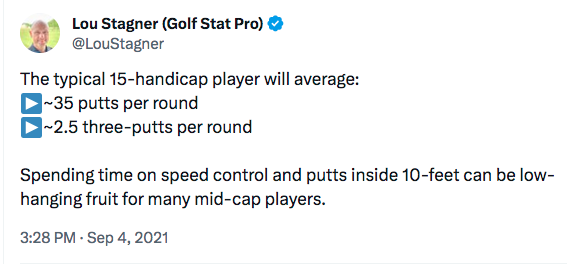
(1) The handicap index is about potential. That is why it is based on the most recent eight “best scores” of all the scores you post. Lou Stagner (golf stat guru) has stated in podcasts that you will only shoot your handicap 20% of the time and your scoring average will be about 3 strokes over your handicap. However, you can shoot better than your handicap too; and Stagner has tweeted “If your handicap is legit, you should beat it about once every five rounds.”

(2) Scores are not all equal. What? That’s right the difficulty of the course and the tees you play, as well as playing conditions for that day are part of the equation for an important number called a “score differential.” And it is the score differential that is used to calculate your handicap Index. In other words, two scores of 90 will not necessarily have the same differential and therefore they will affect the handicap index differently.

In general, the goal of the handicap system is to determine which scores are the best scores, considering the course difficulty and that is why course rating and slope are so important in calculating the score differential and ultimately the golfer’s handicap index.

And, yes, I am going to get geeky now and give you a formula. Below is the score differential which takes the overall rating for a course (represented by two numbers: course rating and slope), adjusted gross score, and PCC (playing condition calculation) to determine a score differential for the score posted by the player that day.

Score Differential = (113 / Slope Rating) x (Adjusted Gross Score – Course Rating – PCC adjustment)

For Example: A golfer shoots a 90 on two courses (both from the forward tees). Course “Easy” has a rating of 65.2/107 and course “Hard” has a rating of 68.6/122.

Course “Easy” differential formula = (113/107)x(90-65.2) = 26.2

Course “Hard: differential formula = (113/122)x(90-68.2) = 18.9

(if you really want to geek out – See the “Additional Information” at the end of the blog for in-depth details on adjusted gross score and playing condition calculations used in the formula.)

The golfer’s handicap is an average of the 8 lowest “score differentials” from the last 20 scores posted. The two calculations above show how shooting a 90 is not the key number that makes your handicap index move up or down. The Differentials of 26.2 or 18.9 are what will increase or decrease your handicap index.

It should be noted that a slope of 113 (in the formula) is used as a “course standard of relative difficulty.” In golf, slope is basically a mathematical representation of how difficult a course is for a bogey golfer compared to a scratch golfer.

Golfers use the overall rating to interpret the difficulty of a course. Looking at a rating of 65.2/122 we would say the course is easier for a scratch golfer than it is for a bogey golfer. Here is how to break it down…

(1) The first number (65.2) is easy to interpret because it is based on strokes and is the rating created for scratch golfers. Therefore, a course rating of 65.2 indicates the course should be easy for a scratch golfer since 65.2 is below the course par of 72. In other words, a scratch golfer has the potential to score a 65 on the course for the tees they are playing.

(2) The second number is slope and is a mathematical representation (think a line on a graph) of how difficult the course is for a bogey golfer compared to a scratch golfer. The higher the number the harder the course. And, 113 is the mathematical average used to “represent” an “average” slope rating for an “average” course which means a rating below 113 is assumed to be “easier” than the “average” course and a rating above 113 is assumed to be “harder” than the “average” course.

Now that you know the course rating/slope has such an important role in calculating a handicap index, you may be wondering (1) how is an overall course rating determined and (2) how do we know the rating truly reflects the difficulty of the course.

There is a whole process for how golf courses get their ratings and the process has 26 evaluations made for each set of tees on each hole for a course — that’s a lot of data! State golf associations oversee the golf course rating process. Most courses are reviewed or re-rated every 10 years. If during the 10-year review gap the course has made major changes, it’s the owner’s responsibility to notify the state golf association and ask for a course review.

Are overall course ratings accurate or “fair”? That’s an interesting topic for another blog post because I guarantee almost every golfer has walked away from a course saying that the course played harder (or easier) than they expected based on the rating on the scorecard.

ADDITIONAL INFORMATION

If you choose to calculate your score differential, besides course rating/slope you will need two numbers (1) the adjusted gross score and (2) the playing condition calculation (PCC). The handicap system (GHIN) will provide the PCC. You have two options for the adjusted gross score. You can manually calculate the adjusted gross score or have the GHIN system provide the number (if you enter your score hole-by-hole). Below is more detail on each number:

(1) Adjusted Gross Score – From the USGA website, “A score for handicap purposes should not be overly influenced by one or two bad hole scores that are not reflective of a player’s demonstrated ability. In addition, incomplete scores and/or scores where a player did not hole out on every hole can provide reasonable evidence of the player’s ability and can be used for handicap purposes.”

If you enter your score in GHIN hole-by-hole the system will automatically adjust your score to the maximum hole score based on par for the hole and your course handicap for that hole; otherwise, you must do a manual calculation, using the “Net Double Bogey” formula, to reduce your score before entering your total gross score into GHIN.

Also, if you don’t complete holes but want to enter a score in GHIN you need to figure out a hole score for each hole you don’t complete or play; and what you enter depends on the status of the hole:

Scenario I. If you started a hole but did not hole out (or complete it) then you enter a “most likely score.” For that hole you take: (a) number of strokes already taken plus (b) any penalty strokes already incurred plus (c) number of strokes most likely to complete the hole.

Scenario II. If you have holes you did not play at all (say due to darkness you only played 7 of 9 holes) then you add an “adjusted score” (basically the par plus any handicap strokes for the hole).

(2) Playing Condition Calculation: The PCC is based on all the scores entered for the day for a course and if the scores are unusually high (or low) the worldwide handicap system will make an adjustment (you will see a PPC number on the impacted score on your GHIN stats page). The score differential for that round will have been calculated with the PPC number included in the formula.

The assumption is that there is a reason (e.g., weather, course setup) causing scores to be higher or lower than normal for the course that day. The PCC range is -1 to +3. A negative (-) adjustment means the course played easier than expected and a positive (+) adjustment means the course played more difficult than expected.

The GHIN system updates your handicap at midnight the day after you post (versus the old method of updating handicaps on the 15th of the month); and that is why the USGA and R&A want golfers to enter their scores on the day they play; otherwise, the GHIN software won’t reflect a PCC accurately.