It’s the most wonderful time of the year for all golf fans – Masters week!
I hope I get a few comments from folks because I really am curious what other’s have for their picks to win and who are sleepers and/or dark horse predictions. Now, I don’t gamble so I’m not big on doing research on odds so my picks are just based on my gut.
Winner – I think the #1 player in the world Scottie Scheffler is a safe bet and he has been one of my favorite players since he won in 2022. He has played in four Masters starting in 2020 and has always finished in the top 20; last year he finished T10. Of course, he has won twice already this season so he is in great form coming into the championship.
Sleepers – There are a few but if I have to pick one as the winner, I am going with Brooks Koepka. I think he will play with a chip on his shoulder given his T2 finish last year and loss to Jon Rahm. It’s also interesting to see all the articles online that predict a LIV golfer will win this year; and Koepka fits the bill.
Other sleeper picks include:
Wyndam Clark: This is his first time at The Masters so I’m not sure how his game fits the course but I’m picking him because his form has been so good coming into The Masters .
Jordan Speith: He had been my favorite player since he turned pro and it’s a roller coaster ride being his fan. He is really not playing well but you can never count Jordan out at The Masters; and he did finish T4 last year.
Nick Dunlap: The young man turned pro this year after winning a PGA tournament as an amateur (the first to do it since Phil Mickelson 33 years ago). He was the #1 Amateur in the world before turning pro and it would be fun to see him win.
Sentimental Dark Horse Pick – I would love to see Keegan Bradley win The Masters. I have followed his career since he turned pro for two reasons (1) He’s a New Englander and Boston sports fan and (2) As a fan of the LPGA, I was familiar with his aunt, Pat Bradley. Over the years, I have come to like his personality too. I also felt sorry for him when he did not get picked for The Ryder Cup. He has played in The Masters eight times and his best finish is T22 (last year, he finished T23) so he really is a long shot but it would be so cool if he won.
The Augusta National Women’s Amateur (ANWA) has quickly become one of my favorite events to watch. There are a number of reasons, first and foremost the final round is at Augusta National, second and just as important to me is that it is a great showcase for the best female amateurs in the world; and as a fan of women’s golf it’s fun to see the players that are up and coming.
The first two days are played at Champions Retreat (72 players) and the final day at Augusta National (for the 30 players and ties that make the cut). You can watch all the action on Golf Channel, Peacock and NBC (final round Saturday Noon to 3:30 pm est). You can also watch the live stream on the ANWAgolf.com website. Here is a list of Air Times.
If you follow college golf you will know many of the players. The school with the most players invited is Stanford University (with five current players and four former Stanford students). You can read about all of them on the Stanford University Website. Including Rachel Heck (who just recently said she was not turning pro after college).
A few players I’ll be marking as “favorites” to follow on the ANWA website include:
Ingrid Linblad – the #1 female player in the world rankings. She is from Sweden, plays for LSU (I try not to think about that since I went to Tulane and LSU is an arch rival). Linblad’s record at AWNA is T3 (2021) and T2 (2022); and she shockingly missed the cut last year so it will be interesting to see how she fares this year.
Megan Schofill (world ranking 7) – She is the 2023 (current) U.S. Women’s Amateur Champion. She plays for Auburn. She defeated Latana Stone in the U.S. Woman’s Amateur; Stone is also playing this year in the ANWA.
Anna Davis (world ranking 17) – famous for winning ANWA in 2022 while wearing a Bucket Hat but she normally wears a visor. Maybe she will bring back the bucket hat for Augusta. I suppose it depends if she is superstitious. She plays her college golf at Auburn University.
Anna Morgan (world ranking 23) – I live in Greenville, SC. so I have to cheer for a Furman student. I played Furman last year and the women’s golf team was on the course and it was impressive to watch.
Hannah Darling (world ranking 19) – She plays her college golf for the Gamecocks and again, I now follow that team since I live in South Carolina. She is a great player and from Scotland! And her Gamecock teammate, Louise Rydqvist (from Sweden) is also playing ANWA.
Jansen Castle (world ranking 109)- is from Columbia South Carolina (yes, I have a theme going with my favorites).
Anabelle Pancake (world ranking 79) – Attends Clemson University. Hometown is Zionsville Indiana and was the runner up in the 2023 Women’s Amateur (not the US but the one run by the R&A).
Rachel Kuehn (world ranking 15) – Plays for Wake Forest. From Ashville NC. She got a lot of press because her mother, Brenda Corrie Kuehn, was a well known golfer. In fact, Rachel won the winning point for the 2022 Curtis Cup team, and her mother had the winning point in the 1998 Curtis Cup.
Emilia Migliaccio (world ranking 44) – A former Wake Forest golfer and now works for Golf Channel but has played in all four ANWA events. She was 2nd in 2021. I really would love to see her take the trophy now that she is an “amateur” like the rest of us. In other words, has a job and plays for the love of the game.
Gianna Clemente (world ranking 32) – She is only 16 but is the 2023 U.S. Amateur Four-Ball Championship and Girls’ Junior PGA Champion. Maybe she will be like Anna Davis and win the ANWA at 16.
It is also fun to see former Drive, Chip, and Putt alumni in the event (nine in total) including Latana Stone (world ranking 30), won DCP twice for her age group (12-13) and won the 2022 U.S. Girls Junior. Runner up at the 2023 U.S. Women’s Amateur and is now at LSU. And there is Kelly Xu won DCP (girls 7-9) in 2014 and now plays for Stanford University and her world raking is 93 .
Of course, there are players that have been in the limelight for years; notably Amari Avery who was featured in the movie “The Short Game” a 2013 documentary about 7-8 year old golfers. Her dad gave her the nickname “Tigress.” (yes after Tiger Woods). She is now at the University of Southern California and her world raking is 20.
I could actually list a number of other players but you can check out all the players bios at ANWA website.
Bottom line is that the Augusta Women’s Amateur is “must watch TV” if you are a golf fan.
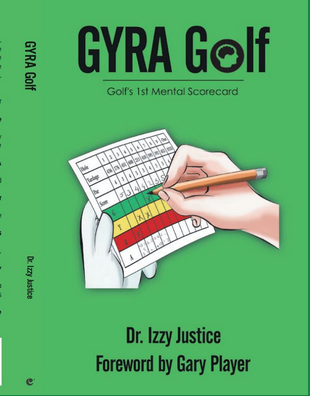
I first learned about Dr. Izzy Justice and his book GYRA Golf watching a YouTube video of a podcast from Wicked Smart Golf. It was fascinating how they discussed how the brain works while you’re playing golf. It is all based on science which means Justice uses wireless EGG devices to measure brain activity while players golf. If you want to see another video, Justice has a YouTube Video called GYRA GOLF.
After watching the videos mentioned above you can get a good sense of the system but I wanted to get the book and learn more about the tools or “neuro-hacks.” FYI – I got the kindle version for under $3.00. I really enjoyed reading the book, doing the exercises and learning the 14 tools (neuro-hacks). Some of the on-course mental neuro-hacks are obvious; such as how you breath, slowing everything down but the main system on rating your emotional state and then moving yourself from red to yellow to green is what makes this different.
First, you really get an understanding of the brain. Here is my layman understanding – Justice explains that in a brain scan when the brain has a high level (amount) and intensity of brain waves the scan will be red (or hot), less brain waves yellow, and a calm brain green. If you are “red” then your neurons, which control muscle sequencing, can’t fire correctly (or there’s too much traffic on the highway); and the outcome will be things like you swing gets too fast or you can’t get the feel for a putt.
A real aha moment for me was regarding putting. Justice said in the podcast the most expensive shot to recover from is a make-able short putt. The brain scans showed that this is more “expensive” than a shank or shot that goes out-of-bounds. And if you don’t have a way to get over it quickly, the next tee shot will be very difficult because your neurons are not getting messages to your muscles because of the high intensity in the brain activity after the surprise of missing that putt.
Another insight for me was that saying things like “one shot at a time” or other cognitive statements won’t help because cognitive thoughts do not live in the emotional part of the brain; and the sensory cortex is impacted by your emotional state and impacts our senses (like touch). For example, with the GYRA system instead of saying one shot at a time, you would look at your yellow card to trigger a memory of a time you had an amazing shot (similar to the shot you need to hit next) or walking to the next tee box you would use a sense tool like 3Ps or 10-2 (from the book) to stop your mind from wondering.
Basically, GYRA stands for “green, yellow, red, and agnostic” and you use this system to understand what state you are in and how to get to agnostic and green. Justice explains he uses the color system because it reflects the heat colors in brain scans; plus everyone is used to the analogies like “red” on the weather channel for a storm or the analogy of a “stop light” where “green” is go!
The premise of the book is that just like you keep score of your golf game, you can learn how to “score” your emotional state and use his neuro-hacks to get yourself back to the preferred emotional state. In other words, you can become a master of your emotional state.
The book has exercises and you create yellow and red cards (to help trigger good memories) and learn about tools that are based on our five senses (vision, sound, sense, taste, touch). You use memories and engage your senses to get in to the best emotional state (which means over the ball you are calm, focused and are “agnostic” and “green” so your mind is not wondering).
Another interesting insight for me was when Justice said that if you ever see a Pro golfer that bogeys the same hole all four rounds; it is because they never took the time to process the first day they made the mistake so when they come to that hole again, the brain (subconscious) goes to what happened last time to process it. So for amateur golfers there is probably a hole that they see as their “nemesis” at their home course. He actually recommends that the last thought at night is to review that hole so the brain will process it while you sleep and you can move on from the past bad memories. In other words you need to process it first before you forget it. For competitive golf, he also advocates visualization playing a course (before you go to sleep) the night.
Another interesting concept is that you have to make decisions based on your brain temperature. If you are in red and can’t get out of that state then your next shot needs to be super conservative, if you are yellow you can be aggressive to a conservative target, and if you are green you can be aggressive to an aggressive target.
Justice has also created an app to use to keep track of your emotional score while playing golf and it looks really interesting; but I have not downloaded it yet. I think at this stage I am happy to use tips from the book. The GYRA website has a really great tutorial of the app!
The last part of the book has a chapter with a real life example of a player at Q-school using the GYRA system. It’s interesting because the professional golfer also explains how he uses the system before and after his rounds which is part of his Golf EQ (Emotional Intelligence) diet. There is another book by Izzy Justice, Golf EQ – the game between shots. This book has some of the same content as GYRA Golf (Golf EQ was written prior to GYRA Golf) but some of the content is more in-dept on science and has chapters geared to what to do the days before competitions. I enjoyed both books.
I have listen to a lot of mental game podcasts and read other mental game books by famous sports physiologists; and tips from those books have help me overcome being bothered by noise (chatting) during my swing, or letting slow play implode my game; but I never really knew how to deal with the feelings when my game started to fall apart. For me, I think the tools in this book will help with that issue. I noticed I am already aware of when I am in a “red” state and just the awareness is impactful and now I need to practice the neuro-hacks to see if it makes a difference. Time will tell if I really see an impact.
Obviously, I think I got my money’s worth from my $2.99 Kindle download.
I googled “most important stats for golfers to improve their game.” All the articles I read said to lower a handicap golfers should not focus on birdies but focus on reducing bogeys, double bogeys or blowup holes. And golf stat experts said to focus on greens in regulation. And, of course, be a great putter. You may be thinking the same thing I did – nothing I didn’t already know and that doesn’t really help with my expectations or set goals. However, what was useful was finding the charts that show various key stats by handicap.
You will see Arccos data mentioned in each area because many articles use them as a data resource. Basically, Arccos is the pioneer of golf data tracking and analysis; per their website collecting over “600 million shots taken during 13 million rounds played by Arccos members in 162 countries” since it’s founding in 2012.
Greens In Regulation (GIR) Data
Lou Stagner, well known for his tweets on Arccos data really wants golfers to focus on “strokes gained” but for those that don’t want to get sensors for their clubs (or can’t afford them) he stated that GIR is the one traditional stat that is valuable because he said, “There is a very strong relationship between handicap and GIR%.” And Stagner has a great newsletter article with stats on different handicaps and GIR from various distances; and from the fairway versus rough. His charts have incredible detail and frankly more data than I need for my goals; also are too large to share in screenshots for this blog post.
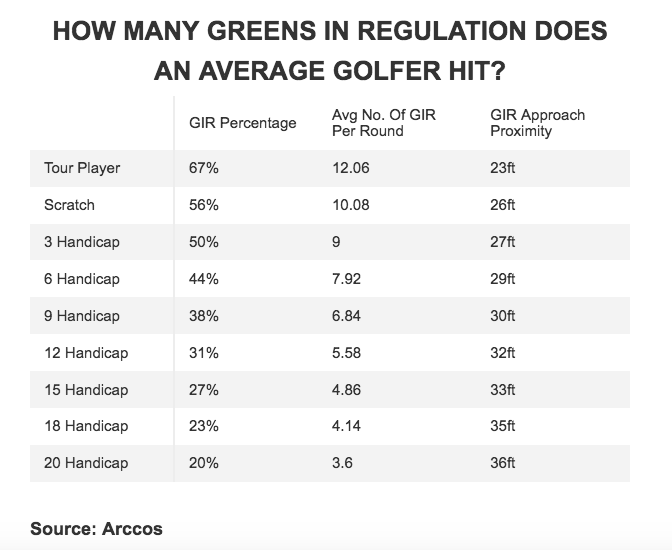
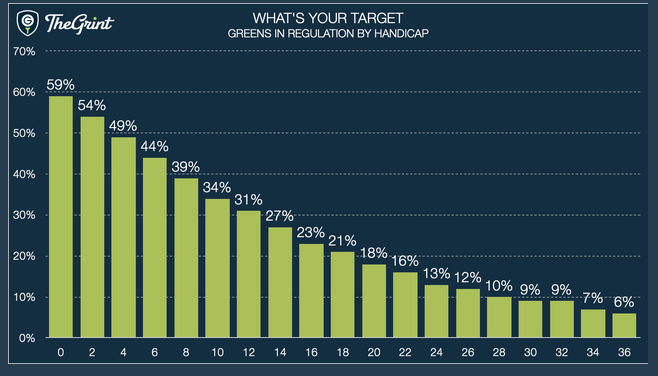
A Golf Digest article dated 12/23/2023 has an interesting chart (see below) which also includes GIR Poximity. The screenshot below of Arccos data was in the article. I found another source “TheGrint” which is a social media and golf scoring app (second image) and the numbers are a bit different (they do not have as large a database as Arccos) but I thought it was good to see two sources.
This is the first time I found a chart that has GIR %, avg. # GIR per round, and GIR approach proximity all in one view. So for example, a 15 handicap when they get on the green in regulation they (on average) are 33 feet from the hole for their birdie putt.
Source: Golf Digest Article with Arccos Data
Putting and Three-Putt Avoidance
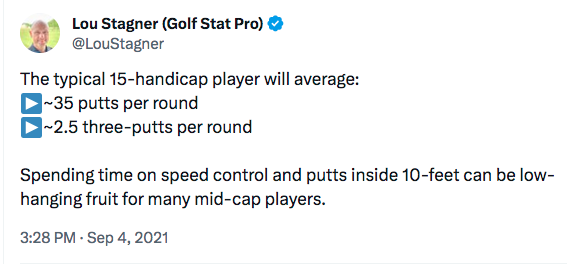
There’s no shortage of online content regarding putting. In 2021, Lou Stagner tweeted a 15 handicap will average 35 putts, (see below) which was a surprise to me because that was my 2023 average and I felt my putting really sucked.
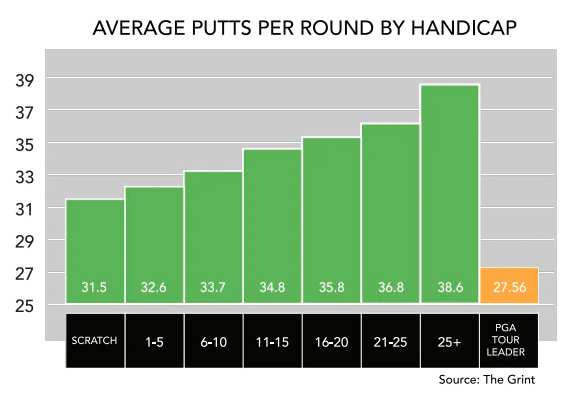
Another data chart from The Grint shows 33 putts a round as the average for a 10 handicap.
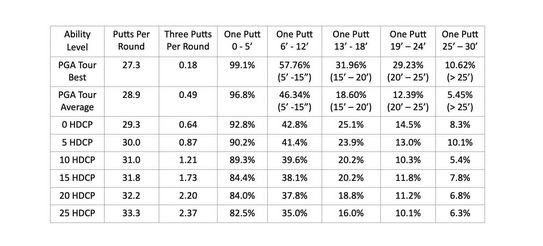
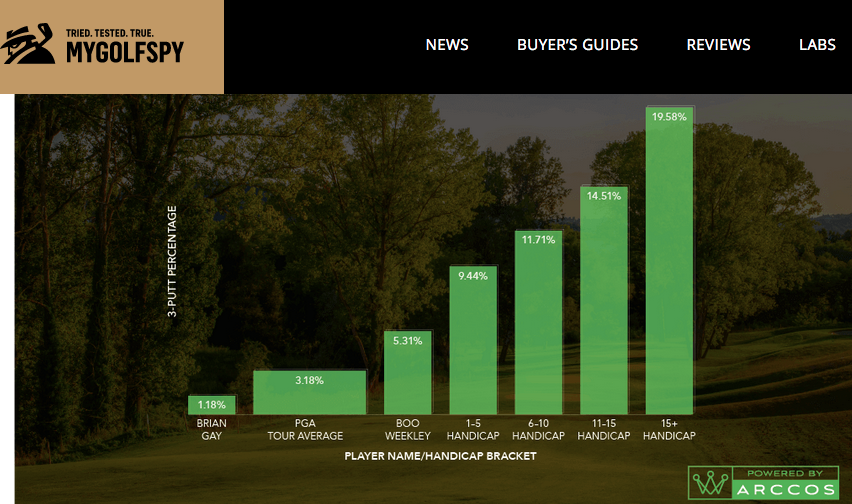
Of course, you also need to consider distance from hole and common sense will tell us that the farther way the more likely a golfer will three-putt. I’m not sure three-putt avoidance is really how I want to track my putting but it was interesting.
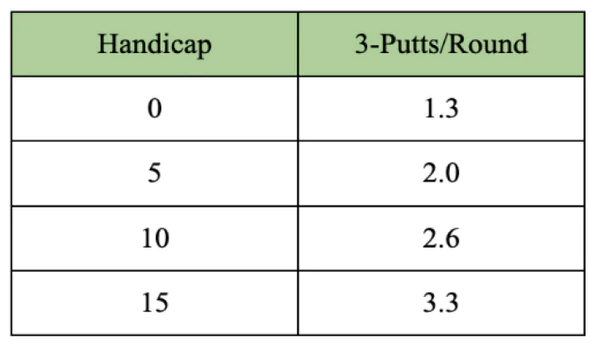
Another diagram (below) from Golf.com article June 2023 shows 3-putts per round which to me is easier to translate to your game. I noticed that that Log Stagner’s tweet in 2021 had a 15 handicap at 2.5 three-putts per round vs 3.3 in the 2023 Arccos chart below. So I guess 15 handicaps using Arccos are either different golfers from 2021 data or perhaps the database in 2023 is so large that the data is actually more representative of the larger golf population.
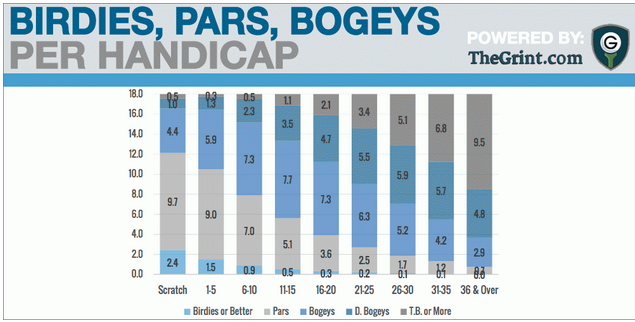
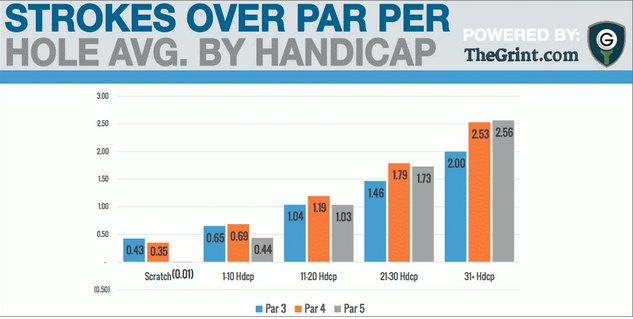
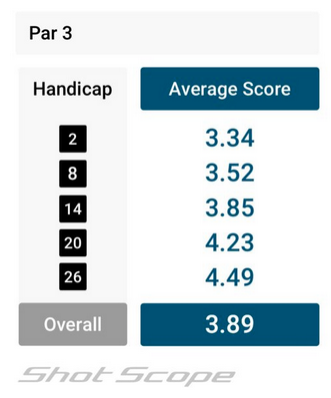
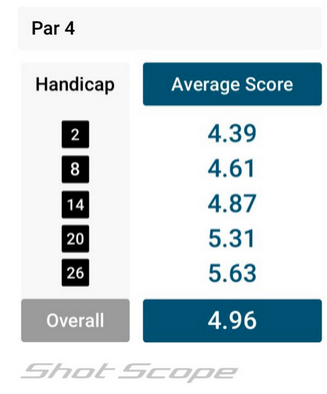
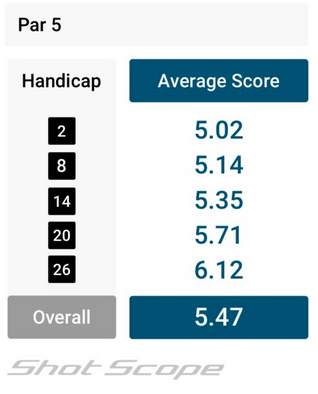
I found articles that talked about the importance of reducing big numbers and strokes over par but I could not find 2023 data. I did find some interesting charts. The photo gallery below has data from two different MyGolfSpy Articles (one with TheGrint.com data from 2014 and one with ShotScope data from 2020 . I wanted to capture these charts (even thought they are a few years old) because the GHIN app captures birdies, pars, bogeys; and average score to par stat.
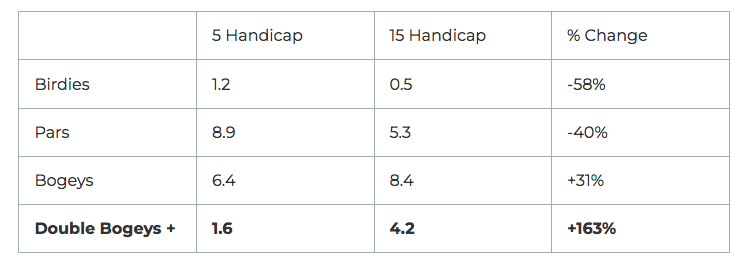
I also found another Arccos article from Oct 2023 titled, “Stats That Prove You’re Not That Bad At Golf” which compares a 5 Handicap to a 15 Handicap (chart below). The article also has an embedded Golf Monthly Youtube Video that is fun to watch. What surprised me is a 15 handicap only makes a birdie once every two rounds based on this data.
Source: Arccos Blog Article chart
Again, Lou Stagner has a newsletter focused on “Performance by Hole Handicap” and for perspective he stated that “For scratch players, par 3s have a much higher scoring average (in relation to par) than par 5s….As handicap increases, this starts to shift, and eventually par 5s have a higher scoring average (in relation to par) than par 3s.”
My 2024 Goals
Overall Goal: I mentioned in my 2023 year-end review that my “big picture goal” for 2024 is to score more in the 80s (get myself off the 91 average score).
Goal #1Greens In Regulation: Target average of 4.86 (15 Handicap stat) which is a good challenge given my 3.78 avg (21%) from last year. At a minimum I want to maintain my 2023 stat.
Goal #2 Putting: Targets are 33 putts or less per round and two or fewer three-putts per round. These were my targets last year. Based on the data above these are definitely stretch goals since these translate to a 10 handicap golfer. Always good to have “stretch goals.”
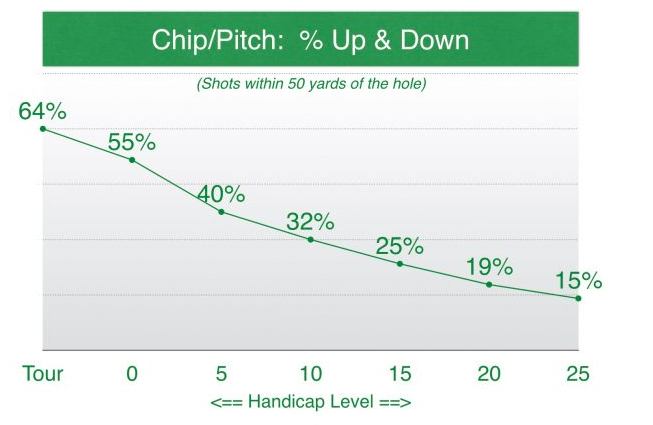
Goal #3 Scrambling: My “Up & Down” was 1.9 per round and as I mentioned about the data above is for 50 yards in and my stat from GHIN is not that specific. So if covert my 1.9 to a percentage (to relate to the chart above) then if I averaged four GIR in a round that would mean I would have 14 holes that provide an opportunity to up and down. So 1.9 of 14 is 13.57%.
I could use the chart above that shows a 15 handicap gets Up & Down from 50 yards 25% of the time. So again, if I only hit the green four times in a round, 25% of 14 greens missed would be 3.5 Up & Down goal for that round. As much as I want to improve my 2023 Up & Down stat I’m not sure is 25% is a the correct goal; but I’ll go with it. Of course, hopefully, I’ll hit more GIRs than four each round reducing the need to get up & down.
In some ways, I think I’m more interested in how close I get to the hole from a chip shot since proximity has a big impact on putting.
Goal #4 Fewer Blowup Holes: I was listening to a Mark Immelman podcast and he told a fascinating story about Jason Day. When Jason Day was the number one player in the world he “had a goal to average three on par 3s” and “for the season he averaged 3.01.” So a pro on tour had a goal to par all the par threes. I would have expected a very different goal. Fascinating!
I did see a nice reduction in double bogeys in 2023 (from 26% to 22%); and looking at the Arccos data feel pretty good about my number; but clearly I really want to continue reducing double bogeys or higher on the scorecard in a round. And of course, fewer blow up holes will hopefully lead to more pars!
Mental Game Goals
As I mentioned in my 2023 review there were a few months last year when I was definitely a head case chipping and putting. I worked on technique in September before my Pinehurst trip which helped give me a bit more confidence.
Last year I did listen to a golf podcast by Kathy Hart Wood, Above Par which was a big help in dealing with slow play or nerves in competition but since I love to learn, it’s time to see what other metal game process might be right for me. Of course, I will still listen to her podcast!
So my mental game goal is to find a “mental game process” (and there are plenty of books and videos on the mental game) and implement some of the tools suggested. Hopefully, I will find a process that also provides a way to track progress with the mental game. Of course, I’m sure I will blog about this once I decide on my plan.
I know one thing for sure, I’m not going to worry about goals when I play. These are strictly for after round evaluation so I can target my practice each week.
I have always wanted to improve my game for one reason – it’s more fun when you play well. I’ve also always loved to practice but as they say you need to “practice with purpose.” So I decided maybe data would help me focus on what I need to work on.
In 2021 I started using the hole-by-hole scoring feature in the GHIN App. At the end of 2021, I had all this data and really didn’t know how to evaluate it to set goals but I was glad to have a “baseline;” and it was interesting to see so many stats! So I just decided to work on my full swing since I was frustrated with lack of distance. This was my “big picture” plan.
In the Spring of 2022 I found a new Pro to help me with my full swing and I was diligent in practicing between my lessons. We all know how working on a new swing can be frustrating. I would hit it great in lessons and felt my swing was sporadic while playing a round of golf.
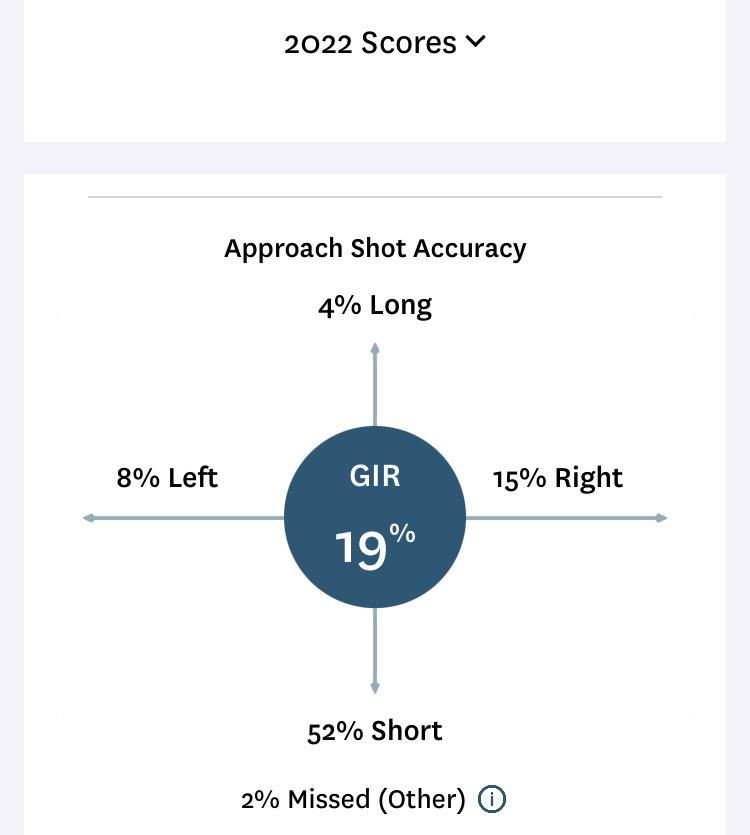
Evaluating my year-end stats for 2022 what stood out for me was the greens In regulation (GIR) number, which indicated I was only hitting 17% of greens on average. I didn’t have a breakdown that showed GIR for par 3s, par 4s, or par 5s. However, I didn’t need stats to know I was still struggling to get on long holes in regulation; which was frustrating since I was working on distance. I mentally just told myself to be patient because I am making a swing change. So in 2023 I continued to work with my Pro and had the extra motivation that in October I would be going on a bucket list golf trip to Pinehurst.
My 2023 goal setting process was basically to pick a statistic related to distance (GIR) and randomly decide on how much I think I can improve.
2023 Greens In Regulation (GIR) Goal and Results
My 2023 GIR percentage was my main focus (or primary goal) and I set a goal of 22% (or 4 per round) which seems low but remember my GIR average was 17% in 2022. Well, all the focus on my full swing paid off because my GIR number for 50 rounds was 21% (or 3.78 per round). And I looked into the details and 40% of my rounds had five or more GIRs. One of my best rounds was late August, with nine GIRs which was amazing for me; and translated to me equaling my best score (84) of the season.
I also noticed that my avg shot stat had greatly improved for Par 5s. And the breakdown of greens missed stats changed with “missing short” going from 53% to 48% and “missing long” increased year-over-year to 7% (which was fine because it meant I was getting to the green). Screen shots below are from the GHIN App Statistics feature:
Other 2023 Goals (with Results)
So even though in 2023 I was still really focused on my full swing, I decided with two years of advanced stats from GHIN, I should set additional goals for 2023. The other goals I set were:
Fairways – Hit 79%. This was my 2022 stat and I felt it was a good “maintain” goal. Results: I improved to 81% for fairways hit.
Bunkers – get out in one stroke. I was always good out of bunkers so this was a “maintain” goal (and I was going to be playing Pinehurst and knew I needed good bunker play). This is not a GHIN stat but I tracked it on my own and was really happy with my bunker numbers. Results: I played 50 rounds (900 holes) and was only in bunkers 40 times and got out in one stroke 35 times.
Putting – my goal was 33 total per round and 2 or fewer 3-putts per round. Results: My putting was not good this year. My average was 35.2 and I had 136 3-putts which equals 408 putts or 25% of my total putts in 2023.
Up and Down – 2 per round. Again a low goal but it was a new goal and I really didn’t have a plan (never a good thing when you set a goal). Results: 1.9 so close to 2. And this was not a surprise since I really didn’t work on short game in 2023. I did focus on chipping and putting in September getting ready for Pinehurst. It was interesting that my up and down at Tobacco Road was decent; I had eight pars and four of those were Up & Downs! And at our year-end women’s golf assoc. championship, three of my four pars were achieved with Up & Downs; which was confirmation that I needed to get back to my short game of past years.
Final Thoughts
So I definitely believe I sacrificed my short game with my intense focus on my distance issue but I am at peace with that decision because I was very happy with my GIR number, reduction in my average over par on Par 5 holes, and also saw fewer double and triple bogies.
Although I will say I did notice my short game became a real mental challenge for me because I would be over a chip or putt and have so many thoughts from technique to memories of missing short birdie putts or thinning a chip across a green. Although I do try to remind myself that when I am putting well it can go very well. I had a league round in July with only 28 putts which produced a score of 84.
I was a bit perplexed by my average score stat being flat (91-92). Logically I knew my long game improved and shot game suffered. It was such an “aha moment” on how hard it is to work on all parts of your game.
My next blog post will be on setting goals for 2024. I already know that my “big picture goal” is to play more consistently in the 80s; but this year I want to do more research so that I see what are realistic golf statistic expectations. For example, if I want to consistently shoot in the 80s (which I believe would be around a 10 handicap) what are the stats for GIR and putting to achieve that goal?
First, for those of you not familiar with South Carolina, there are four regions in SC (map below) referred to as: the Upstate (green), the Midlands (yellow), the Peedee (tangerine), and Low Country (blue). I live in the Upstate which boarders North Carolina (near Hendersonville and Asheville).
Side note: I was curious where the Peedee region got it’s name and it comes from the river Pee Dee which was named after the native American Pee Dee Indians that lived in the region.
Map from South Carolina government website sc.gov.
A crazy storm is crossing the United States today (January 9, 2024) and for us that means a month of rain (four to five inches) in one day with winds gusting up to 50-55 miles an hour. Anyway, sitting here watching the local news has made me reflect on my winter golf the last few years.
Our golf courses are open all year and we can post scores to GHIN for handicap purposes all year. However, after living here for a few years I have realized that playing golf in the winter is limited, not because of the cold but because of the rain in the winter.
It does get cold which does create frost delays at golf courses so most days we teed off around 10 am. And last year we had a number of days were it was too cold (high in 30s) for me to play. On good days it warmed up into the high 40s or 50s (sometimes 60s but often times a day in the 60s came with rain). So it really wasn’t the temperature that limited my golf last winter.
Moving to the south I expected the typical southern summer rain (heat creating thunderstorms in the last afternoons) but I didn’t realized how much it rained in the winter or in general. Turns out the Upstate averages 50.24 inches of rain a year. Someone told me we get more rain than Seattle (that shocked me) but I think the difference is Seattle has dreary light rain for days on end and we can get a day with significant rain often making courses unplayable.
Actually I think my first two years the rain wasn’t as big as impact as the last few years. In 2023 (based on scores posted in GHIN) I posted a score once in January, twice in February and really it wasn’t until late April that regular weekly golf was in my schedule. I remember last year being so frustrated when a warm day would come and it would rain all day, then a cold front would come and it would be too cold to play for a few days, then it would warm up and yes, rain.
So I have realized that I’m not going to play as much golf in January and February as I thought (when I originally moved to SC) but it has turned out that it probably is a good thing because it gives my body a bit of a break; and I get excited when I do play. It’s also a good time to practice (putting inside) or going to the driving range (my choice to practice a half-hour versus playing a 4 hour round when the high is below 40 degrees); and thinking about what goals I need to set for the new year.
My final thought on this issue is that perhaps it’s time to think about a winter golf trip to Arizona. I have never played golf in Arizona so time to do some research.
This weekend I watched the inaugural event of the Grant Thornton Invitational which was a joint PGA Tour and LPGA Tour event with 16 teams. I really enjoyed the format of the event and seeing the camaraderie within and among the teams. Not to mention the fact that there was some great golf played.
The format was three days of golf. Day one was a scramble, day two were foursomes (alternate shot), and the final day was a modified four-ball where both players tee off, and then they switch balls for their second shots and play that same ball until it is holed. The lower score of the partners is then counted as the team score for the hole.
There were low scores and great shots. After day one the team of Nelly Korda and Tony Finau were leading, day two Lydia Ko and Jason Day shot 66 to take the lead and although other teams came on strong Lydia Ko made a clutch birdie putt on the 18th hole to win the event for team Ko/Day with a 26 under par.
The Canadian team of Brooke Henderson and Corey Conners finished second moving up the leader board by shooting an impressive 9 under, 63 total. And the Swedish team of Madelene Sagström and Ludvig Åberg shot 12 under to move up six places to finish third.
There were teams that every golf fan could get excited about whether it was because they were representing a fan’s country or whether it was a team with two of the most popular pros on each tour; and they did not disappoint. For example, the team of Lexi Thompson and Rickie Fowler gave the crowd a fun moment at the Par 3, 16th when Lexi made a hole-in-one.
I used to watch a ton of golf on TV but this year I just got turned off by the PGA tour/LIV news and really spend more time watching the LPGA, the Majors, Amateur golf (including college golf); and as I mentioned in a previous post YouTube golfers. I really don’t miss watching the weekly PGA tour events.
This mixed tour event is exactly what professional golf needs and I hope that the Grant Thornton Invitational continues for many years. For me, next year, it will be a must watch golf event.
In march the USGA suggested a “Model Local Rule” (MLR) that could be used to address the distance issue in golf; specifically male pro golfers overpowering golf courses. Now the USGA has come out with a statement that the golf ball roll back will not be an MLR specifically used for elite tournament golf but instead they will require all golf balls conform to new specifications. All golf balls are measured to meet specific standards with a set swing speed, spin, and launch angle so the new specifications are designed to limit the distance a ball travels.
Side Bar: Did you know the USGA tests golf balls after they have been used in a tournament to make sure they are conforming. They will randomly ask Pros for the balls after a round and test them. I know this because I have seen the rows and rows of cabinets storing the balls in the test center at USGA headquarters.
According to articles I have read the reason for this move away from the MLR to a new conforming ball specification for all balls is because of the push back from the PGA Tour. In other words, the tour would not implement a ball MLR. If that is true, then in my opinion, the USGA and R&A’s new conforming ball strategy is not really about “protecting the future of the game” but it is about protecting the historic venues that the USGA and R&A want to continue to use for championships.
The USGA states that amateur golfers will only lose a few yards (based on studies on swing speed). They also state that approximately thirty percent of 2023 golf balls would pass the tests in 2030 (examples I found in other articles mention balls like the Callaway Supersoft – basically balls designed for lower swing speeds). Below is the chart the USGA has shared and you can read their formal announcement on the USGA Website.
This chart only shows the few yards lost on a drive but a ball roll back will impact every club in the bag (expect the putter) so on every shot distance is less which means it’s really more than 3 yards.
If you want to see statistics that counter the USGA data follow an analyst from Arccos, on twitter, named Lou Stagner He has multiple Tweets on this issue.
This change will take place for Professional/Elite competition golf before it impacts the recreational amateur golfer in 2030. I have seen some funny comments on social media from golfers saying now is the time to hoard balls. The best comment was that the average golfer will just play non-conforming balls because golfers really don’t do what the governing bodies tell them to do anyway.
My thought on this is that the USGA and R&A should have stayed with the plan to use a Model Local Rule and if the Tour does not want to implement it for their events that’s there choice. Of course, the USGA and R&A could implement a specific ball for the majors. Given how important the majors are to the Pros, they would probably start playing the “major approved ball” all the time to get use to it – problem solved. :-)
The issue is also impacted by The USGA’s position that golfers don’t want “bifurcation” and that amateurs want to play the same equipment and game as the professionals. But the reality is golf already has “bifurcation” based on the simple facts that (1) amateurs don’t play the same equipment because the Pros have so many “tweaks” made to their equipment that their clubs are a far cry from the “off-the-shelf” standard club offerings; and even if amateurs get a custom clubs fitting it is nothing like what a pro might have with special grinds for bounce, etc.. (2) There is a “category” of golf balls called “Custom Performance” which includes a ProV1 left dot, a ProV1 left dash and other balls played by the Pros that are not readily available to the average golfer via retail markets. (3) the courses that the professionals play are on a different level when it comes to setup – fairways so manicured that it’s like carpet, greens that are lightening fast. The majority of amateurs will never play on the same quality “playing field” as pros because even if you do a “bucket list trip to Pebble Beach or Pinehurst” they are not “setup” for a major; and (4) the tours already implement MLRs in their tournaments that most amateurs aren’t even aware of in their recreational play. Plus golf courses can implement MLRs that elite competitions would never use. For example, MLR: E-5 “Alternative to Stroke and Distance for Lost Ball or Ball Out of Bounds” which basically gives the player the option to take relief in the fairway and take a two-stroke penalty rather than going back to the tee (or where they last played the ball). This local rule was designed to address slow play.
Only time will tell if these new standards in 2030 for conforming golf balls will actually negatively impact the regular amateur golfer but just the fact that the USGA and R&A are so blind to the impact this policy has on the perception of the governing bodies is disconcerting. The majority of comments I have read online are filled with complete disrespect for the governing bodies. Basically, golfers express a view that the USGA and R&A are a bunch of “old guys stuck in another era.” It is interesting that even Tiger Woods has stated that he believes bifurcation is the way to go (and he gives the example of different bats used in professional baseball).
My reaction to the announcement was disappointment. I want to respect the governing bodies but time and time again they take actions that reinforce a lack of awareness of how golfers feel about the sport they love. On a strictly personal level, the idea that there might be the slightest possibility that I will lose distance in the future due to manufacturing limitations is very annoying. I am already losing distance as an “aging” golfer and need all the help I can get from forgiving equipment and golf balls made to travel far.
Now that I have had a few days to get over my gut reaction, I just hope that it really will be a non-issue for amateur golfers in 2030. For now, I’m not going to follow any more stories on rolling back the ball and I’m just going to focus on my game and get ready for the 2024 golf season.
Over the years, one of the ongoing jokes with my best golf buddy is that I am one of the least competitive people she knows yet I am constantly being asked by other golfers to be their partner in golf tournaments. It’s true, I don’t feel I am a competitive person but I never really thought about why except that I didn’t like the stress I felt in competitive golf and since I play golf for enjoyment why put myself in stressful situations.
I have played competitive golf in the past. And for fun, at the end of this post is a recap of my competitive golf history/trophies. But for now it’s all about 2023. The driving force for wanting to get myself to like or enjoy competitive golf more was that I wanted to play courses I normally would not have the opportunity to play. What I learned this year is that I am slightly competitive (I care about playing well and where I placed in the flight) but not highly competitive (win at all costs). I realized there are internal and external factors impacting my enjoyment of competitive golf.
Internal Factor
One of the reasons that I shied away from competitive golf is that I have always had an issue with not feeling I was good enough (not wanting to feel embarrassed) or I was worried I didn’t know the rules well enough to play competitive golf.
This year I did realize I do have confidence in my game and my knowledge of the rules so that was a big step in relaxing during a competition. I was able to tell myself to “just have fun” and I was also able to play poorly and know that it’s was just not my day and that’s golf.
The only time I felt really horrible internal stress (pressure to not let my partner down) was in a 4-ball tournament. I wasn’t playing well on the front nine and I felt really bad about not pulling my weight. I played much better on the back nine and contributed. And it’s interesting that I don’t feel stress when there is a four player team where two scores count. And, I love a good scramble!
External Factor
I also realized that what really drives my dislike for competition is what I view an an external factor – who is in your group? Will they be fun or “challenging” during the round? Specifically what I call “challenging” are golfers with aggressive personality traits including: being a “Rules Nazi,” displaying accusatory behavior when questioning another golfer about a score on a hole, or just plain having a bad attitude (e.g., the angry golfer, the golfer who complains the whole round about everything, the extremely slow player).
It’s fine and necessary to care about the rules and be mindful that you need to protect the field (by confirming a score on a hole or addressing a rule issue) but you can do it in a respectful way.
For example, I believe you should help someone if they don’t know a rule. I do not understand someone that will see a person about to break a rule and not stop them. Instead, they let the player do the wrong thing and then say “You broke a rule that’s a general penalty, 2 strokes.” Really? That is how you want to win? Not me. I have stopped plenty of women from breaking a rule and they appreciated my sportsmanship.
And if necessary, I have no problem with anyone telling someone else if they incurred a penalty but deliver the information with respect. A “Rules Nazi” is the worst because they are usually nasty in their delivery with a condescending tone in their voice. And beware the “Rules Nazi” because I have seen times when they actually are not correct about a rule, yet because they are so aggressive in their delivery other golfers assume the person knows the rule. I always tell someone don’t argue about a rule, if you aren’t sure, just tell the other golfer you are going to play two balls and let the Pro running the event decide the ruling when you get into the club house.
Challenging scores is a very interesting aspect of competitive golf. Most of the time it’s not an issue but every now and then it can be intense. I had a situation where someone challenged my par score on a hole and she wouldn’t let it go even after I walked her through the shots. I was lucky to have another woman in our foursome (she was keeping my scorecard) defend my score (she went over my score shot by shot) and refused to change my score. Honestly, the woman was so aggressive that I would have probably changed my score just to end the confrontation. In hindsight it did rattle me. I didn’t play the next two holes well. My cart partner noticed and said “I know it’s bothering you and I would worry about your character if it didn’t but she is just upset because she forgot she was in the woods and had to punch out while you were down by the green. She’s being a jerk so let it go.” Now, that’s a nice cart partner/competitor giving me a pep talk in a competition.
In another competition, there was a player in our group that had her score questioned on a few holes by another player; and in that instance, it was done with respect each time but it was still uncomfortable because you could tell she really felt she was keeping her score correctly but the other women walked her though all her shots and there was no dispute. It highlights the other issue that some golfers just aren’t good at keeping their own score. The golfer either accepts the correction or gets very defensive but in either situation it’s always a bit awkward for everyone.
My Competitive Golf Season
So of the 12 events I played in this year, I only had two events with a player in my group that was “challenging.” Not bad, I guess. But before each tournament it’s on my mind and I do have anxiety over whether I will have a nice foursome. So as much as I feel I have managed the internal stress, I still find the external stress of others behavior a deterrent to competitive golf.
I guess facing challenging golfers is another mental skill I need to develop. I actually have been working on my mental game and find I can deal with slow play now (which use to send me over the edge) but still need better skills with “challenging” players.
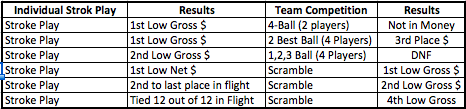
I can’t write about playing competitive golf without sharing results (chart below). I played in six individual stroke play events and was in the money four times (1st low gross at two events, 2nd low gross at one event, and 1st low net at one event). I was 2nd to last in my flight in an event in August – the heat got to me. I will never play in 100 degrees in South Carolina in August again. For my final event, the weather was perfect but I tied in last place in my flight of 12. I was disappointed because I had won 1st place (low gross) in my flight at the same course earlier in the season; but I was not surprised by my results because I was dealing with a sore wrist.
I played in six team events of which 3 were scrambles. As we all know scrambles are fun and less stressful so I have always loved scrambles. In the three events, my scramble teams came in 1st, 2nd, and 4th. So in the money two out of three times. Now the other team events consisted of (1) a four-ball competition, (2) a 2-Best Ball competition (four player team and the two best scores on each hole are used for the team score), and (3) a “1,2,3 Best Ball” which was a very odd format, where it is a four player team and you take only one best score on a par 5, two best scores on par 4, and three best scores on par 3 holes. For that event we had a DNF (did not finish) because our team made an error in golf genius. I think just one player score was entered for a Par 3, when we were supposed to enter three player scores for a total. But again, lesson learned, the team needs to double-check the golf genius before the final posting. In the four-ball we did not place in the money and in the 2-best ball we were in the money with a 3rd place finish. Note: In my stats, I did not include charity events I played because in those events teams purchased mulligans, etc.
Looking back I am very happy that I challenged myself to play competitive golf this year. I think feeling good about my game overall and taking time to review basic rules at the beginning of the year helped me feel prepared and diminished my internal stressors. I do think my attitude of just have fun and do not focus on score (and don’t compare my score to the others in my foursome while playing) is the right mental strategy for me. I still need to learn to not get flustered when challenged but hopefully being challenged will be the exception when playing in future competitions.
Final Thoughts About Competitive Golf
Do I now love competitive golf? No but I do enjoy it more now. And I found that my stress level reduced dramatically over the course of the season. I will say if I have a nice group I really do have a good time; and I am finding that more often than not, the ladies I get paired with are great. And I have made a few new golf friends through competitive golf this year!
BONUS CONTENT
Past Golf Competitions
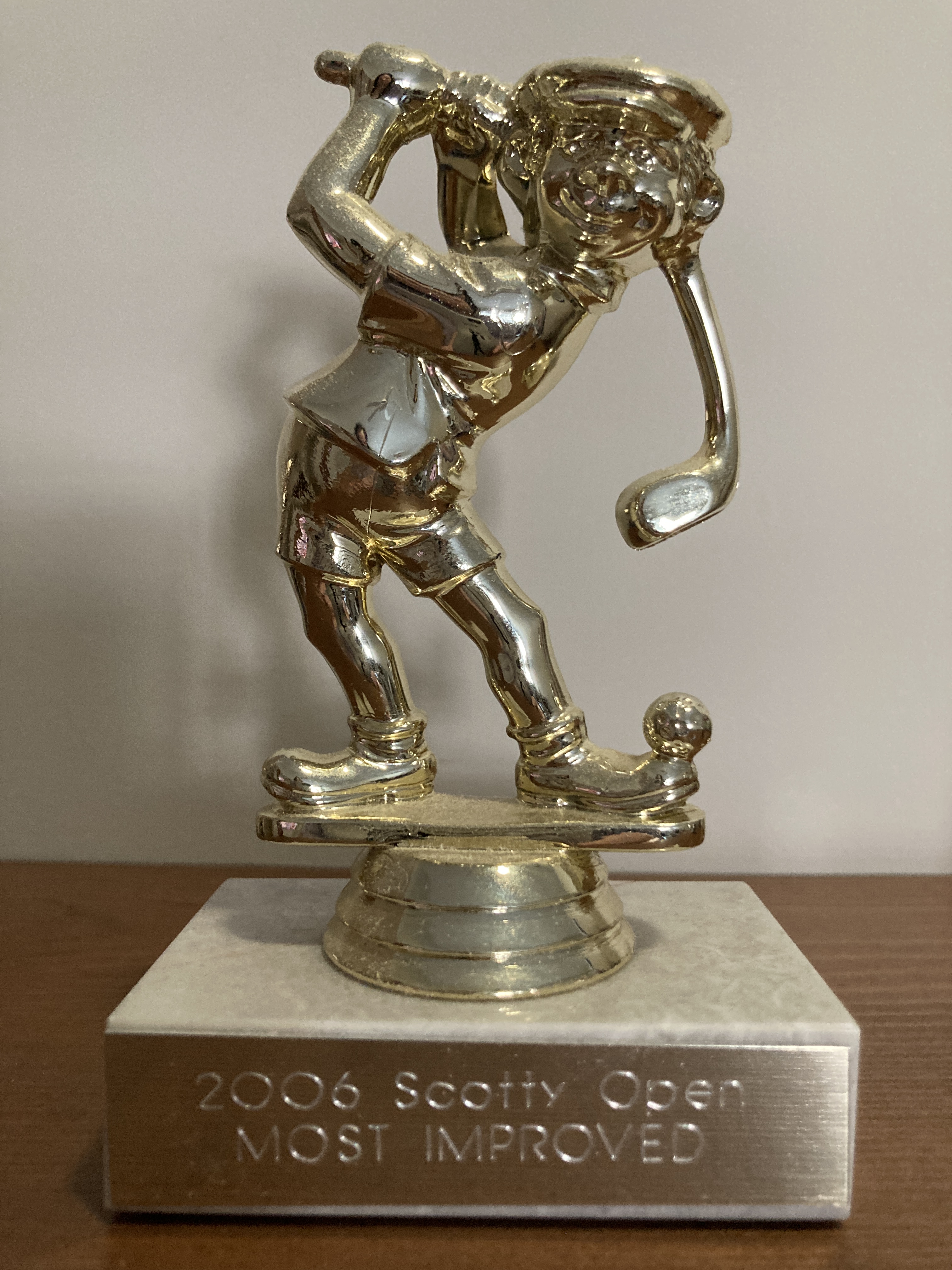
I have played competitive golf in the past. Now my first trophy ever for golf was playing a company golf outing and I won “Most Improved Player” and since I was still at that stage in my golf journey where I was extremely hard on myself, I was thrilled (and surprised with the recognition) even if it was just a fun award.
I played golf off and on but it wasn’t until my move to New Jersey to work for the USGA that I really became a “golfer.” I played in the “Moggy Brook Golf Championship” which was the USGA staff championship and I won the Moggy Brook Ladies trophy twice in 2015 and 2016 (but given my handicap was high and it was a net competition, I think I actually had an advantage over all the scratch golfers) but a win is a win and I got to have a cool trophy on my desk for two years. I also played in the USGA staff match play and go to the semi-final round. I felt compelled to participate in company events because that’s what you do in your corporate life but try to imagine playing against a golfer that hits a drive 230 yards when you were lucky if your drive went 150 yards; my saving grace was a great short game.
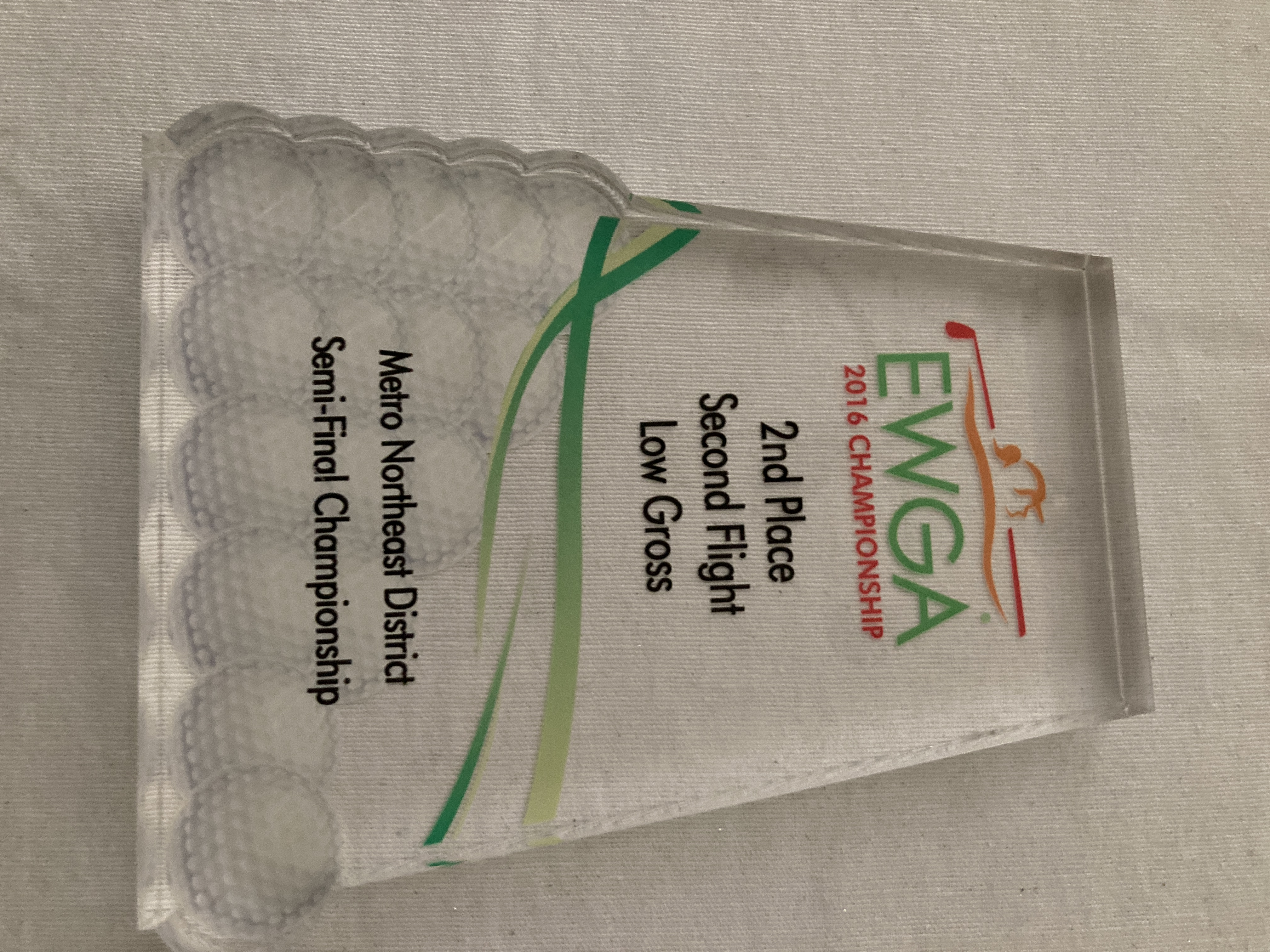
I joined the LPGA Amateur (formally EWGA) golf association, Central New Jersey Chapter and really only signed up for the chapter championship to support my chapter and to my surprise I qualified to go to the LPGA Amateur Regional. So back in the day, you need to win at the chapter level and then at the regional level to go to Nationals. I played really well at the regional competition (again surprising myself) but missed going to Nationals by one stroke. A few friends were upset because the golfer that beat me was apparently known to be a “sandbagger” (she was from a New York state chapter) but that’s not something you can control. However, I must admit I was disappointed and it made me wonder why anyone would want to win by keeping their handicap inflated? Do they really feel self-satisfaction winning that way? Do they really think other golfers don’t know that they are a sandbagger?
Trophy Gallery – yes, I kept my trophies (or medals from the USGA). It maybe silly to keep them but I just can’t seem to get rid of them. They are in a shoe box in my closet. Maybe when I’m old and can’t play anymore, I’ll look at them and remember my golf journey.
CLICK ON ANY IMAGE TO OPEN THE GALLERY AND SEE LARGER PHOTOS.
2006 – Most ImprovedLPGA AM – 2016 Chapter ChampionshipLPGA AM – 2016 Regional USGA – Keep trophy at your desk for the year (two consecutive years)USGA Top of Medal Boxes USGA – Boxes w/Medals2015 – Back of Ladies Champion Medal2016 – Back of Ladies Champion Medal
My first “bucket list” trip was to Pebble Beach Resort in 2021. This year’s bucket list is Pinehurst Resort in North Carolina to play Pinehurst #2, Pinehurst #4, Pinehurst #8 and Tobacco Road. You must stay at the Pinehurst Resort to play the “bucket list” courses #2 and #4. We stayed in the Golf Terrace 208 Condo on Pinehurst #5 – in the distance, we could see the main Pinehurst Clubhouse from the balcony; as well as watch golfers playing the 18th hole in front of the condo. It was a great vibe staying in the condos. I wrote a blog with “non-golf” tips for visiting Pinehurst if you are planning a trip.
Pinehurst is a lovely resort and easy to get around because they have a free shuttle service that will take you to all the courses, hotels, and dinning options around the resort and in the village of Pinehurst. It’s fun to just hang out at “The Deuce” at the main club house and watch golfers play the 18th green, Pinehurst #2. We also loved playing the 18 hole “Thistle Dhu” putting course. “Thistle Dhu” is Scottish and translates to “this will do.” We had two matches (I won one match and my friend won the other – on the line was a transfusion drink). We did not play the “Cradle” (the short course). Past experience shaped our decision to not play. We had played the short course (The Hay) at Pebble Beach – hitting off mats for the lovely price of $65 – which was nothing special and felt like playing our local short courses. The Cradle is $50 (and yes, you hit off a mat). It was very busy so I’m sure folks enjoyed it but it was not something we felt we needed to experience.
We played Pinehurst #4 on day one, Tobacco Road on day two, non-golf day on day three, played Pinehurst #8 on day four and ended the trip playing Pinehurst #2 on day five. It was a great mix of golf and relaxing (walking around Pinehurst Village and near by Southern Pines) but this is a golf trip so let’s talk golf.
Overall Impressions of Courses
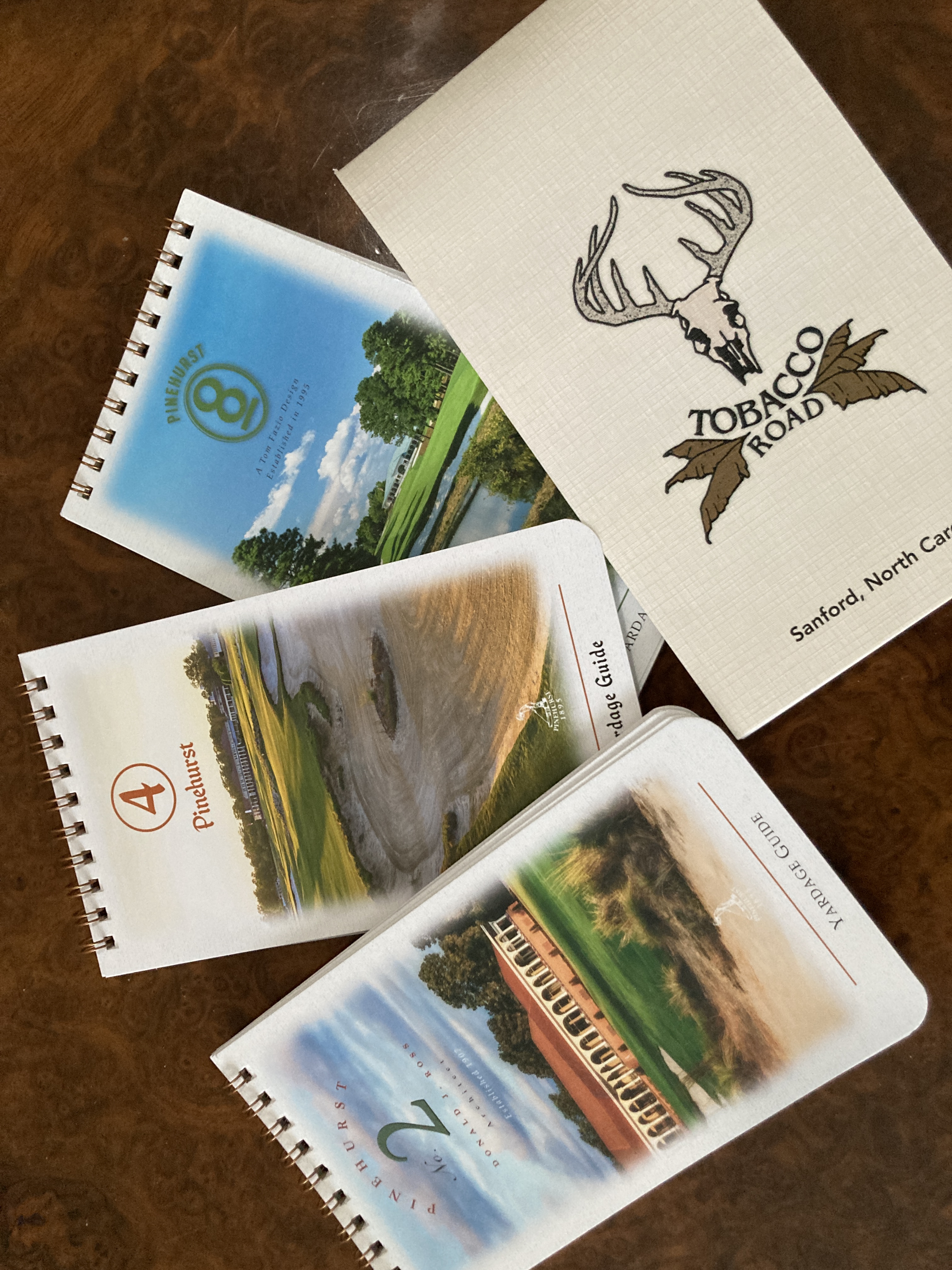
Yardage Books
By the Numbers – All the courses were beautiful, in excellent condition, and challenging to play. To get a sense of the challenge of the courses I looked up the ratings for each on the USGA National Course Rating Database (see the chart below). For my non-golf friends, the first number is an indication of the course difficulty for a scratch golfer (e.g., if par is 72 they play to that number) and the second number is “slope” and indication of the relative difficulty of a golf course for players who are not scratch players compared to players who are scratch players. And the USGA also provides a potential score for bogey golfers. The USGA course rating system lists a male bogey golfer as a 20 handicap and a female bogey golfer as a 24 handicap. For my golfing friends that are wondering about the handicaps — the USGA course rating uses driving distance in determining bogey handicaps (and states the average drive for females is 150 yards). So if you are a female with a 24 handicap index you can set an expectation of a score of 103 (or about three strokes over your “target score” calculated as the course par plus your course handicap: 72+28=100). I personally like to use the GHIN app and look up my course handicap (which is the strokes you get for that course and is not the same as your handicap index) to calculate my target score.
The Chart below shows that Pinehurst #2 is the hardest course. As a non-scratch golfer, I care about the slope of 133 (which is fairly significant against an average course rating slope of 113). Also, the bogey rating is 103.3 for Pinehurst #2. It is interesting that the front 9 slope is easier than the back 9 slope because the caddie said the first six holes of Pinehurst #2 are the hardest.
My opinion on each course…
In many reviews and articles I read before my trip the overall opinion was that Pinehurst #4 was becoming the new favorite (even more so than #2). I disagree (and so did my golf buddy, Donna). We thought both were pretty and challenging but we preferred #2 over #4. In short, the two main differences between #2 and #4 is that #4 had more elevation change than #2 and the sand and grass in the waste areas was different – the waste area for #2 was easier for us to advance the ball farther down the fairways.
Anyway, the easiest way to distinguish the courses are a paragraph on each…
Pinehurst #2 – Everyone said “get ready to get beat up by Pinehurst #2” but that was not my experience. Yes, it was the most difficult course and for women I believe it’s not just the fast greens but also the length. The tee to green yardage for many holes meant I often could not get to the green in regulation or I was hitting a wood into the green which made “holding the fast greens difficult.” For example, Par 3, 17th hole played 167 yards (all carry per Chris our caddie) taking into consideration the elevated green protected on the right by a large bunker. That is basically a driver for most women. On most of the Par 4 holes, it was driver and three wood into the greens and, as I mentioned earlier, that makes holding a green very difficult. With respect to the waste areas, the sand was hard packed so once you realize you could hit a wood or hybrid in the area, it really wasn’t too penalizing unless your ball landed in a “love bush.” Even with the challenges Pinehurst #2 was enjoyable to play. One of the things that surprised me was how peaceful and relax I felt walking Pinehurst #2.
Pinehurst #4– I expected to really like this course given the reviews but it was my least favorite of the four I played. It was very pretty, hillier than Pinehurst #2 (but nothing like the elevation changes at my local course in the foothills of South Carolina). We did not walk the course because it was noon and a bit warmer; but in the crisp fall mornings, I think it would be an easy walk.
The defense of the course in my opinion was the length (especially on the Par 4 holes) and the sand and grass in the waste areas. After playing #2 and #4, we decided it was much harder to advance your ball out of the waste areas on Pinehurst #4 because the sand was sort of soft and fluffy and the grass was more spread out. Comparatively, the sand in the waste areas at Pinehurst #2 was hard packed. But it really was the distance on some very long par 4 holes on #4 that seemed almost unfair; even my caddie would say to me you can’t get on this par 4 in two (and I was hitting my drives great that day for me at 170-180 yards and my 3 wood 130-140 yards but not reaching a par 4 at 340 or 356 yards). On the bright side, the Par 3s distances were reasonable ranging 90 to 135; but again for any short hitter they would be looking at a hybrid or wood to get on in regulation on the longer par 3s.
Pinehurst #8 – This is a great course for women (and men). It is rated the same as Pinehurst #4 with a slope of 124 but the individual holes have yardages tee to green that are much more manageable because there is a chance you can reach many holes in regulation. It feels a bit more like a course many golfers are use to playing with traditional fairway and green-side bunkers. Yes, there are waste areas but not on every hole or as exceedingly large as the waste areas on #4 and #2. The real challenges at #8 are the really fast greens. The greens were significantly faster than #2 or #4. The reason is that the greens are “new” – all the turf was replaced 18 months ago. I mentioned the fast greens at Pinehurst #8 to our caddie at Pinehurst #2 and he agreed with my assessment. The caddie even told me Pinehurst caddies have a hard time reading the “immature greens at #8.” So my guess is when the greens are “mature,” Pinehurst #8 will be a really fun scoring course.
Tobacco Road Golf Course – This course is in Sanford, NC and is about a half hour drive from the Pinehurst Resort. This course should be on your golf itinerary when you go to the sand hills of North Carolina. It is the most visually stunning of all the courses we played with pristine fairways and huge mounts shaping the terrain; as well as exceedingly large waste areas and every hole was protected by bunkers (some very deep). There were many blind shots and you had to ring a bell on five of the holes so the players behind you knew when it was clear to hit. Our playing partners (men hitting from “Disc” tees at 6,317 yards) described it as “playing on the moon” given they were often hitting over the vast waste areas or playing from them. Often times you would ride your golf cart into the waste area/bunker areas to walk up to the greens.
If your game is not in good shape (e.g., you cannot control your direction or you are not a good sand player) you will probably have a hard time at Tobacco Road. Some call the course quirky, I just call it “a blast” to play.
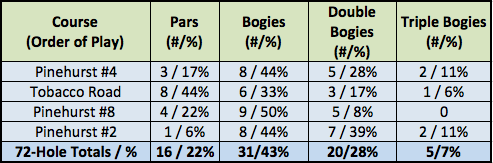
My Game Overall – So you may be wondering how I did based on the opinions above. I will share with you that I really prepared (practicing every part of my game, taking lessons, etc.) the weeks before this trip. My lowest score was at Tobacco Road with a 86 (with eight pars, six one-putts) which was one stroke better than my target score; but I played well all week and basically played within four strokes of my target scores for each Pinehurst course which means (according to USGA guidelines of four strokes within your target score) I played to my ability – see the chart below – courses are in order of play.
If I look at my pars, bogies, etc. by course (which is a stat in GHIN if you post hole-by-hole with stats), I’m really happy with the results for the four rounds (72 holes) resulting in 65% Bogies or Better (Pars 22% and Bogies 43%).
So, I was really hitting it well and I’m very happy with my scores. Perhaps my biggest take away about my play was that I could say I gave too much respect to the greens because I left so many putts on the edge of the cup. As an optimist I would say that it was great lag putting! LOL
At Pinehurst #4, the first day I had four par putts and one birdie putt that rolled to the edge of the hole. At Tobacco Road I did a much better job with speed with six one-putts but still left some putts on the edge of the cup. This continued with every round. At #8, I had a chance at birdie putts on every Par 3 and the first ones were short and the final one I got to the hole and lipped out. Even on Pinehurst #2 I had a chance to par Hole 1 and I left the putt short. I just think all the folks telling me that the greens were fast and get ready to three and four putt (or get “Donald Rossed” which means you are on the green putting and your putt roles off the green) got in my head and I just never putted with freedom. I did have some three putts but not as many as I anticipated; so perhaps leaving putts short at Pinehurst was not such a bad “miss.”
Thanks for reading my blog and if you want to see more pictures (photo gallery at the end of each post) and more details on playing each course click on the links for each course: Pinehurst #2, Pinehurst #4, Pinehurst #8 and Tobacco Road. If you do go to the detail course blogs please know that I wrote them to document my play (for myself) — so you have been warned that it might bore you to death reading those posts but at least you can quickly scroll and enjoy the photos.
If you are looking for tips on planning a trip to Pinehurst Resort, see my blog post titled “Pinehurst Non-golf Tips.”
A few photos of some Pinehurst SWAG
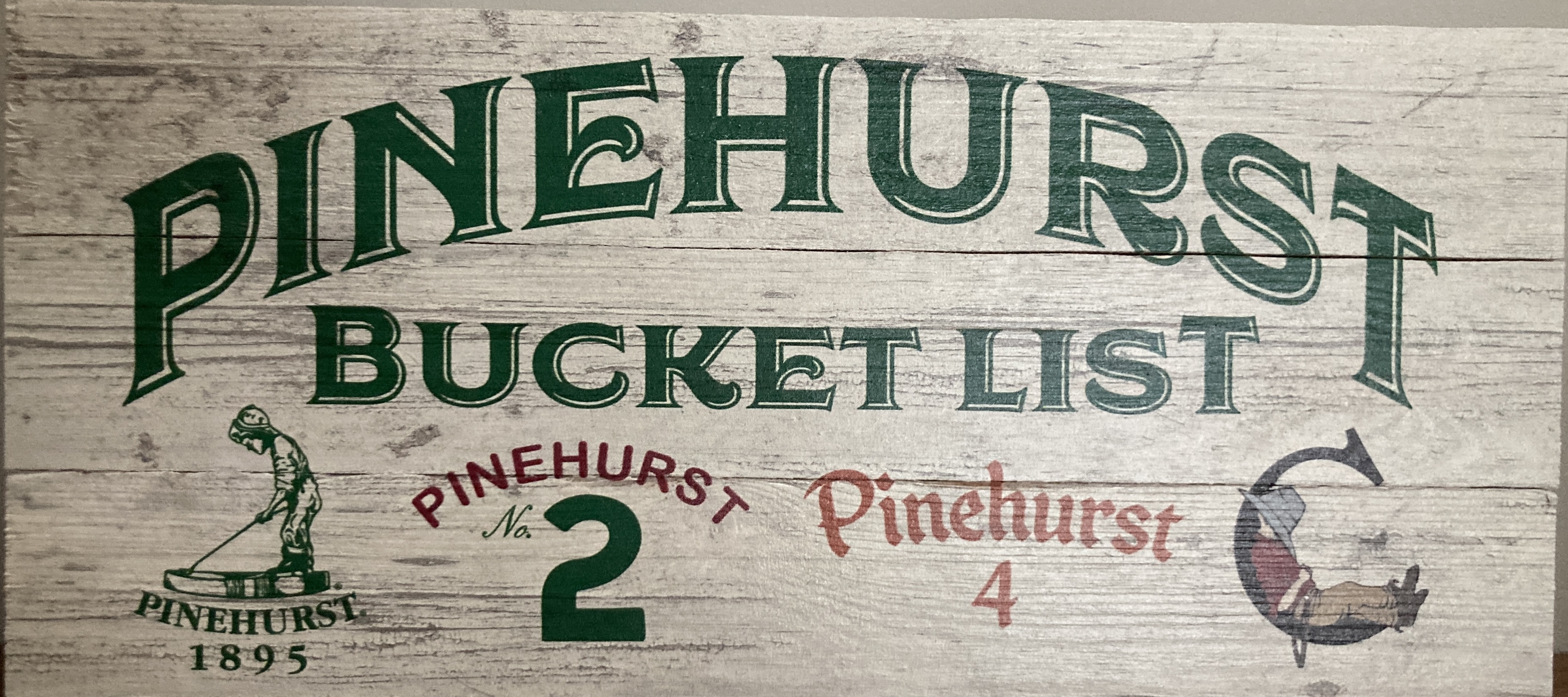
The image of “bucket list sign” and yardage books earlier in this blog post were purchased and I also bought a zip sweater, ball markers, a cap. The ball marker from Tobacco Road is cool. Believe it or not, I actually controlled my spending (purchased much less than I did at Pebble Beach – ha,ha).
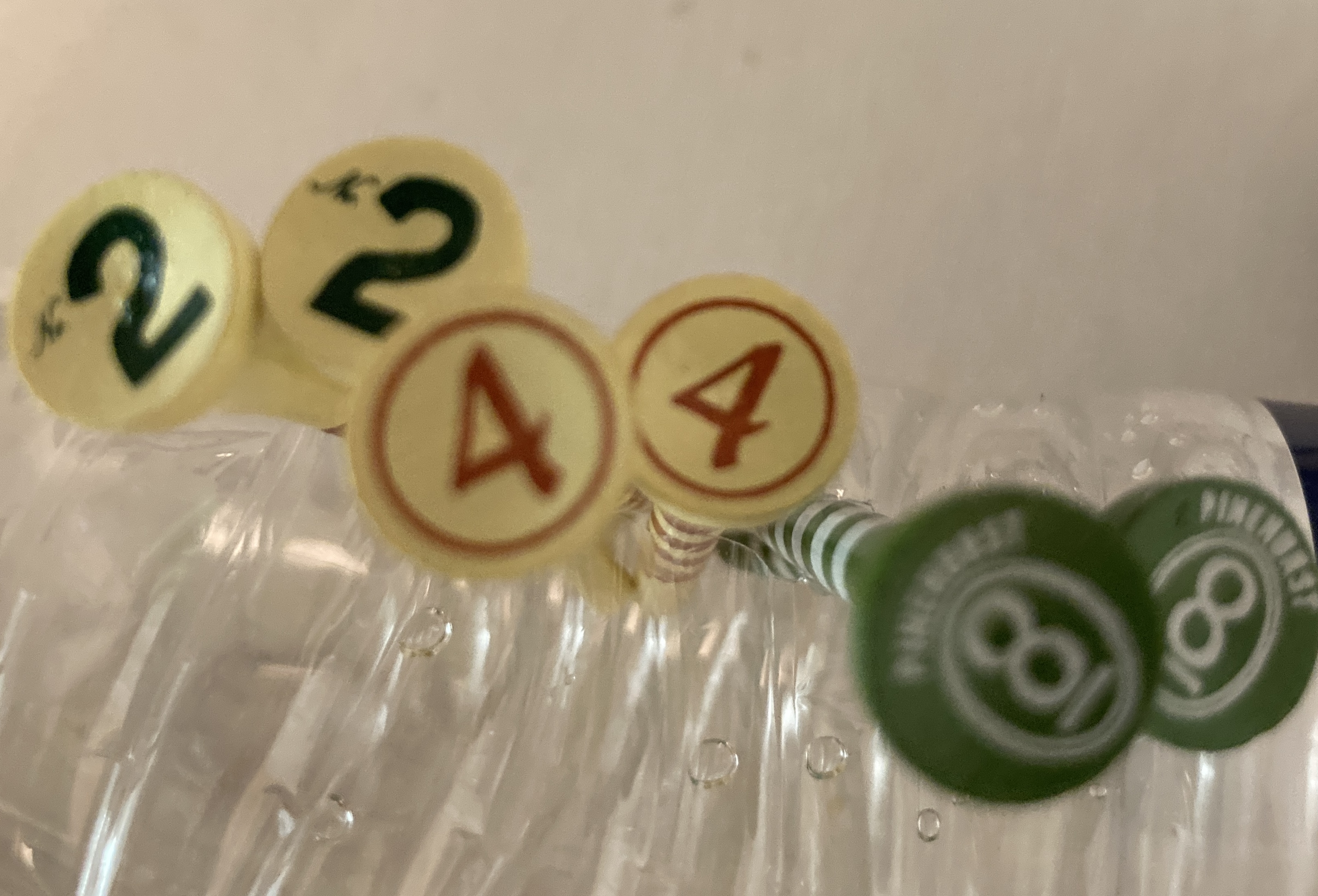
Also, each course at Pinehurst had tees (# on top of tee, different stripes on sides) and plastic ball markers for golfers to take at the 1st hole. Unfortunately at #2 there were no plastic ball markers.











 Golf Expectations