Stroke and Distance Relief – Putting Greens and Bunkers, Model Local Rule E-5

Ask the average golfer about “stroke and distance” and they will mostly likely tell you that stroke and distance is what you must take for a lost ball or a ball out of bounds; and you incur a one stroke penalty. And some golfers may explain that it is a relief option when your ball is in a penalty area (Rule 17) and a relief option when a golfer declares a ball unplayable (Rule 19). But not many golfers will cite Rule 18.1 which is a governing rule that states that the player can proceed under stroke-and-distance at any time.

Most golfers don’t realize when you take stroke and distance relief under Rules 17.1, 19.2 and 19.3 they could also be correct to say that Rule 18.1 applies. And, most golfers don’t realize how to take advantage of the rules when on a putting green or in a bunker.

Putting Green – Here is the basic scenario. You are on the putting green and you hit your putt which roles off the green and comes to rest perhaps by a tree, or in mud, or even in a penalty area at the back of the green. What is the stroke and distance option? You can declare you ball unplayable (Rule 19.2) any where on the course expect in a penalty area. Declaring your ball unplayable allows you to take stroke and distance with one penalty stroke. Technically if you were asked by another player to state the Rule you could state Rule 18.1 or Rule 19.2.

This rule is useful when you really don’t have a shot or don’t feel confident in the shot you would need to make, etc. So let’s say my ball rolls off the green and is by a tree behind a root; I don’t want to risk hurting my wrist so I declare my ball unplayable and go back on the green and hit from the previous location of the putt that I just hit. And yes, I have a one stroke penalty; but a second putt (with a one stroke penalty) in many cases is better than taking a drop by the tree (again with a one stroke penalty for lateral relief), and trying to get up and down.

Now if your putt roles off the green into a penalty area, you again have the stroke and distance option as one of your relief options for a one penalty stroke under Rule 17.1. Or again, if asked you could state Rule 18.1. But in general, most golfers state they that they are taking relief under Rule 17 (penalty areas) although it is the same option as an unplayable (but remember, you can’t declare your ball unplayable in a penalty area).

I know, the rules can seem overly complicated when you are taking the same action and different rules can be stated but that is just one of the nuances of the Rules of golf; where Rules often repeat instructions.

For me, if I am not confident in making the next stroke from off the green, I’m taking stroke and distance every time and putting again (with the knowledge of what I learned when I hit the previous putt).

If you would like to watch a video on stroke and distance and the putting green, view this Golf Rules YouTube Video.

Some interesting golf trivia – Tiger Woods used stroke and distance at The Masters after a putt rolled off the green into Rae’s Creek. People thought he was wrong but he knew that stroke and distance was an option!

Bunkers – When the Golf of Rules were revised in 2019, the USGA and R&A added a relief option for golfers when they declare the ball unplayable (Rule 19.3). The additional option was to take “back-on-the-line” relief outside the bunker for two penalty strokes. But don’t jump to this option to get the ball out of the bunker; consider the stroke and distance option.

If you declare you ball unplayable in the bunker, for one stroke you can take stroke and distance. Or again you could also state Rule 18.1. Again, you are going back to where you last played the ball but it saves one penalty stroke (versus the back-on-the line option outside the bunker).

I think most golfers would be worried about irritating the other golfers in their group if they take stroke and distance (and have to walk back 100 or more yards). I get it and in general casual play maybe take the two stroke option; but if you are in a competition you should do what is best for you. Personally, if I take an unplayable in the bunker and I can get a decent lie with lateral relief that is what I do. However, if I had no shot at all, I would seriously consider stroke and distance.

I have been asked by a high-handicap player what to do (usually they really have trouble getting out of bunkers even with a good lie). Frankly I tell them in casual play, just take the two stroke option. In league play or a competition; if they are already struggling and 2 strokes won’t impact the outcome then just take the back-on-the-line two strokes; but if they are playing well and think a stroke will make a difference then they have the right to take stroke and distance. It’s a personal decision. I remind them, when they enter their hole-by-hole in GHIN, it will adjust to their max score. Also, if they are new to a league, I tell them to ask if there is a max score for pace of play because that may impact their choice too.

One scenario that always surprises me is when a golfer is a short distance from the green (maybe 5 or 10 yards) and they chunk a shot into the bunker guarding the green. Then they take the back-on-line outside the bunker with two penalty strokes; without even a thought about going back the 5 or 10 yards to where they last hit the ball.

If you’d like to watch a video, you can view this from the USGA. For those that like diagrams, below is the USGA diagram for the relief options for an unplayable ball in a bunker:

Bottom line: It’s never a great feeling to take a penalty stroke but sometimes stroke and distance can be your friend on the golf course.

Model Local Rule E-5

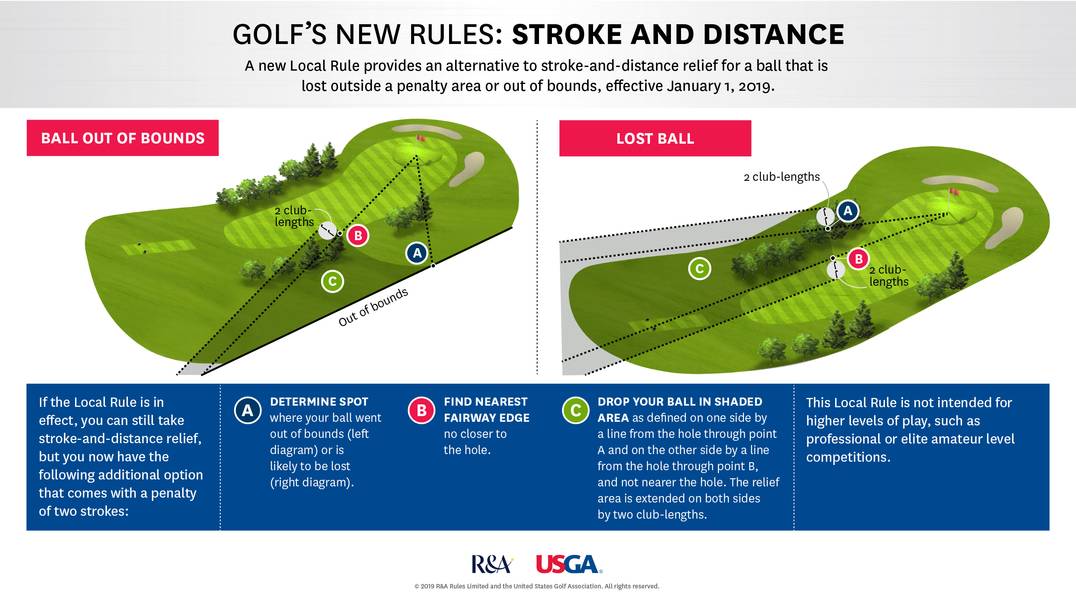
A Model Local Rule is a modification to a rule that “the committee adopts for general play or a particular competition.” The new stroke and distance model local rule is MLR E-5. This is an alternative to stroke and distance for a ball that goes out of bounds or a lost ball. You cannot use this rule if you played a provisional or your ball is lost in a penalty area.

Basically, when you are OB or have a lost ball, in stead of going back to where you last played your ball, you figure out where your ball came to rest (and imagine a line to the flag) and then you find the nearest fairway edge (imagine a line to the flag); from the edge of the fairway you get two-club lengths (along with the imaginary lines from the flag) to create your relief area. This model local rule comes with a 2-stroke penalty.

I believe courses implement MLR -E5 hoping it will help with pace of play. Of course whether or not golfers will use it is debatable because it does have a two stroke penalty. In a casual round I think many golfers would be open to using MLR E-5 but in competition I would guess no one would want to use it unless they were already feeling they were out of the money.

You can watch the USGA video or below is a diagram of the Rule:

Bonus Info:

Lost Ball in Abnormal Course Condition: Some golfers think you must take stroke and distance for ALL lost balls but remember that if it is known or virtual certain that you lost your ball in an abnormal course condition (the abnormal course condition must be in bounds and not in a penalty area); including animal hole, ground under repair, immovable obstruction or temporary water, you get free relief under Rule 16; you do not have to take stroke and distance.

For example, there is a pile of storm debris (in the general area, not OB or in a penalty area) that you know the maintenance crew will be removing from the course. The pile of debris is considered ground under repair even if not mark. So, if you are virtually certain (95% likely) you ball is in the pile of debris but you can’t find it, you can take free relief.

Ball in Water in a Bunker: Another example when it’s good to know the rules. It rained the night before and there is temporary water in a bunker. You hit your ball in the bunker and find it in the temporary water. Some golfers will think they need to take an unplayable but that is not correct. Under Rule 16 (Relief from Abnormal Course Conditions) you get free relief from the water but you must stay in the bunker taking free relief (one club length from nearest point of complete relief). So, again, if you want out of the bunker then you can use Rule 18.1 (stroke and distance) or Rule 19.3 (unplayable).

Water on the Green but Ball is Off the Green: Sorry, you don’t get free relief if you want to putt your ball from off the green and there is water on your line on the green. To get free relief from temporary water on the green your ball must also be on the green. Here is a great short video from Jay Roberts.

Do you know how to properly find the nearest point of complete relief? If you want a refresher there is a good video from the USGA.

Women’s Golf – Top Five LPGA Player Moments in 2024

If you are a fan of golf or like watching golf and you don’t watch the women play you are truly missing out on great entertainment.

Here are my top five for women’s golf in 2024

These players had big years and/or big events:

(1) Nelly Korda – The #1 player in the women’s world rankings had an incredible start to 2024. She won six out of her first seven starts on tour; five wins in a row and one won the first major of the year. And Korda, after not playing because of a “minor neck injury” comes back in November and wins the “The Annika driven by Gainbridge at Pelican.” Of note, no LPGA golfer has had six or more wins in a season since 2013 when Inbee Park had six wins.

So it is no surprise that Korda won player of the year in 2024.

(2) Lauren Caughlin – a journey woman on the LPGA tour had the year of her professional life in 2024. Caughlin is 31 years old and has been on tour since 2018. In July, winning the Canadian Women’s Open was her first tour win in 103rd starts on tour. One month later she won the ISPS Handa Women’s Scottish Open.

Caughlin with her excellent play met a personal goal to qualify for The Solheim Cup that was contested in her home state of Virginia just an hour from her home. The pressure of playing for a home town crowd and as a rookie on the biggest stage in women’s golf could have been too much for some golfers but not Caughlin. She showed up to the Solheim and once again had the “week of her professional life” winning all three of her team matches and garnering a tie for her singles match. This is a stellar record for a “rookie” Solheim Cup member.

(3) Lydia Ko

Ko had pressure all year with the golf analysts constantly asking will this be the tournament that Ko wins and get’s the one point she needs to enter the LPGA Hall of Fame. The LPGA Hall of Fame has the most difficult criteria of all sports hall of fame (it’s not voted on, it’s all points); requiring 27 points.

Per the LPGA website the criteria is:

1. Must have won/been awarded at least one of the following – an LPGA major championship, the Vare Trophy or Rolex Player of the Year honors; and2. 

2.Must have accumulated a total of 27 points, which are awarded as follows – one point for each LPGA official tournament win, two points for each LPGA major tournament win and one point for each Vare Trophy or Rolex Player of the Year honor earned.3. 

3. One point for an Olympic gold medal

Per Golf Digest, “Ko is a 15-time winner, including two majors and three season-ending awards. She earned 70 percent of her 20 points in two years—2019 and 2021.”

Her quest for the LPGA Hall of Fame was a storybook ending when she won the Gold Medal at the Olympics; and giving her the point she needed to be in the LPGA Hall of Fame.

(4) Rose Zhang – Zhang was the most decorated player in women’s amateur golf; including winning back-to-back NCAA Individual National Championships and winning the August National Women’s Amateur in April 2023. Zhang held the position of the #1 female amateur golfer in the world for over two-and-a-half years (or 141 weeks at #1).

In May 2023, Zhang turns Pro and she wins her first LPGA tour event at the Cognizant Founders Cup (she is the player that stopped Nelly Korda’s win streak of five wins in a row). After that 2023 was rather quiet and she did not perform well at the Solheim Cup in Spain with two ties and a loss.

In early 2024 she seemed to still be missing that spark but the spark caught on fire at the Solheim Cup in the USA. Zhang won all four matches. And she is the only player in Solheim history to win all four matches and never have to play the final holes (17 and 18). There have only been eight players to have a 4-0-0 record at a Solheim Cup and only two other American’s have achieved this accomplishment (Dottie Pepper in 1998 and Morgan Pressel in 2011). Zhang also won 28 holes only lost 8; no player has been that dominant in the last 20 years.

It’s worth noting the scores for Zhang’s four matches: She won 3&2, 3&2, 5&4, and her singles match was 6&4 (ending her match against Carlota Ciganda on the 14th hole).

(4) Soleim Cup Players – The 2024 Solheim Cup was everything a golf fan wants in a competition – great play and a competition that goes down to the end; which is stressful but fun to watch. The USA won 15 1/2 points to Europe 12 1/2 points.

The points don’t tell the whole story but for those that don’t normally follow match play. The current holder of the Solheim Cup (Europe) only needed 14 to maintain possession and the USA needed 14 1/2 points to win (take possession) of the cup. The last meeting (2023 in Spain) of the teams was heart braking because the teams tied (14 points each) therefore Europe “won” because they won the cup in the previous meeting in 2021 in Ohio at Inverness.

Along with Rose Zhang, Khang (3-0-0), Coughlin (3-0-1) and Andrea Lee (2-0-1) were the other Americans to go undefeated (since they tied and did not lose one match). It is the second time the U.S. team had that many undefeated players at one Solheim Cup.

So do yourself a favor and watch the LPGA in 2025.

Fall Golf – Do you love it? I Do, I Do, I Do!!!

Obviously in South Carolina “fall golf” or “sweater weather golf” comes a bit later than up north. I absolutely love fall golf and my unscientific poll of my fellow league players were unanimously excited for the fall season. Perhaps this is because we suffer through 90+ degree heat with ridiculous humidity in the south all summer and fall is such an amazing reprieve; but for me it’s not just about the temperatures, it’s about the vibe.

I think part of the reason is that by the fall many of the women I play golf with have found their groove so they just “play happy” (as Nancy Lopez would say). Looking back at my scoring history, I also see my scores trending lower in the fall. But that is not the only thing that makes me love fall golf.

These are the things that make the vibe of fall golf so awesome:

(1) The beauty of fall golf: I don’t care if I loose a ball in the leaves! The beauty of golf courses in the fall can be breathtaking. I have so many memories of just looking down a fairway and saying to myself, “How luck am I to be health, happy and able to play a game I love.”

(2) The crisp air and perfect temperatures: Yes, I have to mention it again. Even as a person that moved to the south for warmer weather, I just love sweater weather. You take a deep breath and breath in crisp air that just feels cleaner and healthier. The chill in the air wakes you up and if there is a breeze you might see colorful leaves falling from the trees.

(3) A great time for golf trips: Many of my golf trips have been in the fall. There is nothing better than the anticipation of a golf trip! Three terrific trips I have had in the fall with my best golf buddy, Donna, were Primland Golf Resort (in Virginia’s blue ridge mountains). And, of course, the bucket list trips to Pebble Beach where I got to celebrate my birthday (2021) and Pinehurst (2023)!

(4) The golf courses are in great shape: Most of the courses have completed green aeration (late July/early August seem to be the time for aerating here in the Upstate of SC). The fairways are lush (the summer heat that can burnout the grass is gone). The courses just seem to be saying “I’m in peak condition so come play me!”

(5) Less busy courses: I’m not sure if it is tied to school being back in session or people just get busy with other activities but the courses are not as crowded and pace of play always seems much better. For example, our league finished our round in just under 4 hours and we really did not wait on any hole…that was amazing!

So I’ve listed my reasons for why fall golf have such a great vibe. Did I miss any reasons that make fall golf your favorite time of year? Or is another season your favorite?

Olympic Golf Course: How It Played, Day One – Men’s vs Women’s Events

One of the interesting things about golf is that the same course can play so differently day to day due to weather, which tees you play, and pin placement. The Olympics are a great example of the how differently a course can play and how important course setup (by the tournament officials) is to the competition. Course setup this week is the responsibility of Kerry Haigh (who’s regular day job is PGA of America’s Chief Championships Officer, setting up courses for the PGA Championship and Ryder Cup).

Another unique aspect with back-to-back men’s and women’s competitions is the added issue of “comparison.” It’s only natural that viewers will compare how the men and women play and so course setup is critical. As a female golfer and fan of women’s golf, the last thing I want to see is viewers assuming the men “are better” than the women because they don’t understand course conditions or course setup.

The course was setup for the men as a Par 71 (at 7,174 yards) and for the women a Par 72 (at 6,374 yards). Obviously the difference is to take into consideration the differences between the men and women. The general difference (stated by many experts in the golf world) is that the men’s game has more power and distance and the women are more accurate . However, some would argue the 6,374 is still a bit long for women. Why? Because on some holes the yardage difference is not enough to allow the women to hit the same club for their approach shot as the men. After a practice round, one of the women French golfer’s said that the male golfer for her country hit an iron into a green and she hit a 3-wood. It is much harder to make a 3-wood land and stop on a green.

I’m sure Haigh wants to make the setup a fair test for both events; but there were a few decisions I found very odd. First, he lowered the rough in the third cut (or the rough well off the fairways) and he did not lower the rough in the first and second cuts. Given that the statistics show the women are more accurate off the tee and less likely to have wild misses, this change makes no sense especially when the argument for lowering the rough is that the women do not have the same wrist strength as the men which is why rough is often cut differently. That logic would say the length should have been changed in all three levels of rough.

The other odd decision (made for the atmosphere of the opening hole) was a last minute decision (the day before the start of the tournament) to have the women play off the same tees as the men did for the opening hole. The first hole (originally) for the women was stated as 386 yards (then men’s tee set up for 419 yards). As expected having the women play from the men’s tees (419 yards) did now help the women. As one reporter noted for the women golfers, the opening hole “played as the most difficult hole of the first round, averaging more than 0.4 strokes over par and yielding just seven birdies against 24 bogeys or worse.” I understand the desire of the Olympic planners to have a “stadium vibe” but the first tee decision to move the ladies back to the men’s tees clearly hurt the women on day one.

The week the men played, the course was “soft” because it rained every night and that meant the men could go pin seeking (the ball would hit the green and not roll out excessively). There was barely any wind (a major defense of the course) and the air temperature was also relatively mild and it was humid during the week the men played. That made the course “easier” because the men did not face the ball rolling out on the fairway into the rough. There were many holes where the men could just hit a fairway wood to get in a good position in the fairway. This was a big advantage given the men have much greater dispersion (missing the fairway into the deep third rough cut) with driver.

Comparatively the course is playing very differently for the women. Round one the women faced a much firmer course due to no rain, no humidity, and lots of sun shine; plus the wind was starting to become a factor. So when the men could hit 3-woods, the women golfers needed to hit drivers to put themselves in the same position in the fairway for a good approach shot. The result of using drivers meant the women were seeing good shots roll out of the fairway into the rough. They also had fewer opportunities to go pin seeking having to play for the roll out of a long iron (or wood) onto a green. The weather forecast for Saturday (the day of medal play) is 90 plus degrees which will make the course even firmer.

After day one, there are statistics that show the course was harder for the women. For example, the number of players under par on day one were significantly different: Men under par was 41 and women under par was 12. Also the scoring average on day one for the men was 69 and the scoring average for the women was 74. This is not about skill but about how the course was presented to the players (soft vs firm, no wind vs windy, humid vs no humidity in the air, speed of greens, etc.). One analyst, during the broadcast, noted her surprise of many pin placements given the changes in the weather conditions for the women’s event.

These differences made the course more challenging for the women and more challenging for the course setup director Kerry Haigh. It will be interesting to see if Haigh (and other’s involved in course setup) make changes after day one. Will they cut the rough? Will they go back to the original tee selection for the opening hole? Will they change pin locations if the wind picks up? I don’t want to see the setup be so easy it’s a birdie fest but I want the women to have the same approach shot opportunities as the men did last week.

Pros Focus on Cover Number versus Front of Green

Golf Digest’s YouTube Channel has a series called “The Game Plan” and all the videos are interesting for anyone that is interested in the technical side of golf strategy.

I watched a video that was really fascinating to me because as an amateur golfer I’ve always been told to aim at the center of the green. Yes, most times this makes sense but I watched a video on how Pro Golfers focus on carry number.

Basically, they look for the worst possible place to miss on the green and make sure they “cover” that place. The other number mentioned by the PGA Tour Caddie is “run out number” or what is long.

At 3:30 mins in the Golf Digest video they talk about dispersion and it was very interesting. Also, I like that they give specific examples of different shapes of greens. They explain why August Nationals 12 hole is one of the most difficult shapes and why the cover number is so critical.

Here is the video from Golf Digest video from the series “The Game Plan”: The Critical Number Pros Use That Amateurs Don’t

I do often think about what it is to carry a bunker or water. If I know trouble is long I do try to get that number too but I never really thought about it the way it is explained in the video with green shapes and a golfer’s specific dispersion pattern.

Do You Have A Power Leak?

We all want distance and I know I have worked hard on my swing the last two years to fix my “over the top” tendency (a big power issue for a lot of women). My pro has also taught me how important the hands and wrists are in creating speed. We also worked on swinging out – so that I don’t get so much spin (causing my ball to roll right when it lands, instead of rolling straight, which loses distance); and we have worked on fundamentals (stance, alignment, ball position) that we know are key to distance (and accuracy). I’ve learned so much over the last few years and keep working hard to ingrain my new swing.

Tips from my Pro are great but sometimes another way of seeing/hearing a tip helps. And below are tips I have seen on social media that really resonate with me and remind me of the lessons from my Pro.

(1) Grip – We all know that the grip is important in controlling the club face but it also is important in creating speed. If you do not have your club in your fingers and/or you have a death grip on the club you will not be able to release the club correctly; and in turn, the tension created in your grip travels up your arms which reduces your ability to generate power and speed. One tip is to grip your club tightly and then release it just before you hit. This is also used as a mental game tip to release tension. I did this a few times in practice and it helped; and now I know the feel of a light grip when I set my hands on the club.

(2) Rotation – The best tip for a mental image of the rotation is from Lisa Longball who’s mantra is “Turn the Shirt/Turn the Skirt.” The key she is trying to relay is that the first move on your downswing is to “turn the skirt” (or hips) because if you “turn the shirt” (upper body/arms) that is a huge power leak. This really is a lot of what I have worked on with my Pro because an “over the top” swing is basically turning the shirt (arms) first. My Pro likes to remind me that I should feel like my trail shoulder is holding back as my lower body fires forward.

(3) Finish Your Swing – You may think the fastest part of your swing is when your club face hits the ball but all the experts explain that the fastest part of your swing is (or should be) past the ball and the only way to achieve this is to “finish your swing.” If you hit at the ball, you are likely to decelerate after the hit and that is a power leak.

The tips that have really helped me finish my swing are:

(A) Don’t hit at the ball but swing through the ball.

(B) Club finishes behind your back. Lisa Longball says that if your hands stop high up in front of your head/face, that is a sign that you decelerated after the ball so make sure you finish with the club behind your back.

(C) Dirty Toe Like a Pro – I heard this saying from Patrick Harrington. He said if you have a dirty toe on your trail shoe then you know you have shifted your weight to your lead side and are finished your swing with the back of your shoe showing and you are on your toe of the trail foot. He said look at any professional golfers shoes after a round and the toe is dirty. Another way to think about it – If you keep your trail foot flat that is a power leak because your weight is not shifting.

These may sound obvious but it is amazing how on the course you can forget these simple tips and then wonder why you aren’t hitting the ball as far as you did the last time you played.

So do you have a power leak? If yes, give one of the tips above a try and see how it helps your game.

Chevron Championship – LPGA’s First Major of 2024

Another week and another major – I love Spring!

It’s a good thing that the LPGA moved the first major of the year so there is no conflict with the Augusta National Women’s Amateur or The Masters. Most people over a certain age will remember the first major as the Dinah Shore or the Colgate Dinah Shore, then it became the ANA Inspiration (which was held in Palm Springs) but with the new sponsor came a new venue in Texas at The Club at Carlton Woods, the Woodlands, Houston.

Last year was the first year at the new location and Lilian Vu won in a playoff against Angel Yin. I don’t think Vu is likely to play well enough to defend her title because she has been dealing with back issues. Perhaps if Angel plays well she may have a chance but my money is on the LPGA’s number one player.

Yes, just as I picked the number one player in the world on the men’s side to win The Masters, I am picking the number one female player in the world, Nelly Korda to win the Chevron Championshiop. Korda, like Scheffler, has won multiple times on tour this season.

In fact, if she wins the Chevron that will be five (5) consecutive wins this season. The last player to win five in a row in the same season was Nancy Lopez back in 1975 in her rookie year. The only other LPGA player to win 5 consecutive tournaments is Annika Sorenstam but she did it in two seasons (end of one season and beginning of another season).

The other players I’ll be watching are:

(1) Lydia Ko – if she wins that will give her the final point she needs to be eligible for the LPGA Hall of Fame. The most difficult Hall of Fame to get eligibility for based on a point system.

(2) Brooke Henderson – I always cheer for the Canadian star to win.

(3) Rose Zhang – came on tour out of Standford with a bang by winning her first professional tournament but hasn’t done much this season so maybe the first major will be the spark to get the 2nd win.

How to Watch the Chevron Championship

The Golf Channel will show the championship early (10 am – 2 pm and late 6 pm to 8 pm) on Thursday and Friday. And the weekend telecast will be on NBC from Noon to 6 pm.

Both Peacock and ESPN+ will offer steaming of the championship so if you have subscriptions there is an opportunity to see more of the event live.

Below are the dates, times, and options:

Thursday, April 18: 10 a.m.-2 p.m.; 6-8 p.m. ET (Golf Channel/Peacock)
Friday, April 19: 10 a.m.-2 p.m.; 6-8 p.m. ET (Golf Channel/Peacock)
Saturday, April 20: 2-3 p.m. ET (Peacock); 3-6 p.m. ET (NBC/Peacock)
Sunday, April 21: 2-3 p.m. ET (Peacock); 3-6 p.m. ET (NBC/Peacock)

The 2024 Masters – My Picks for the Winner, Sleepers, and Sentimental Dark Horse

It’s the most wonderful time of the year for all golf fans – Masters week!

I hope I get a few comments from folks because I really am curious what other’s have for their picks to win and who are sleepers and/or dark horse predictions. Now, I don’t gamble so I’m not big on doing research on odds so my picks are just based on my gut.

Winner – I think the #1 player in the world Scottie Scheffler is a safe bet and he has been one of my favorite players since he won in 2022. He has played in four Masters starting in 2020 and has always finished in the top 20; last year he finished T10. Of course, he has won twice already this season so he is in great form coming into the championship.

Sleepers – There are a few but if I have to pick one as the winner, I am going with Brooks Koepka. I think he will play with a chip on his shoulder given his T2 finish last year and loss to Jon Rahm. It’s also interesting to see all the articles online that predict a LIV golfer will win this year; and Koepka fits the bill.

Other sleeper picks include:

Wyndam Clark: This is his first time at The Masters so I’m not sure how his game fits the course but I’m picking him because his form has been so good coming into The Masters .

Jordan Speith: He had been my favorite player since he turned pro and it’s a roller coaster ride being his fan. He is really not playing well but you can never count Jordan out at The Masters; and he did finish T4 last year.

Nick Dunlap: The young man turned pro this year after winning a PGA tournament as an amateur (the first to do it since Phil Mickelson 33 years ago). He was the #1 Amateur in the world before turning pro and it would be fun to see him win.

Brian Harman: The reason I pick him as a sleeper is because he is a lefty and there is a fascinating theory that The Masters favors lefties which is explained in a Golf Digest Video on YouTube and this video that explains hole #12

Sentimental Dark Horse Pick – I would love to see Keegan Bradley win The Masters. I have followed his career since he turned pro for two reasons (1) He’s a New Englander and Boston sports fan and (2) As a fan of the LPGA, I was familiar with his aunt, Pat Bradley. Over the years, I have come to like his personality too. I also felt sorry for him when he did not get picked for The Ryder Cup. He has played in The Masters eight times and his best finish is T22 (last year, he finished T23) so he really is a long shot but it would be so cool if he won.

Augusta National Women’s Amateur 2024 – Players to Watch

The Augusta National Women’s Amateur (ANWA) has quickly become one of my favorite events to watch. There are a number of reasons, first and foremost the final round is at Augusta National, second and just as important to me is that it is a great showcase for the best female amateurs in the world; and as a fan of women’s golf it’s fun to see the players that are up and coming.

The first two days are played at Champions Retreat (72 players) and the final day at Augusta National (for the 30 players and ties that make the cut). You can watch all the action on Golf Channel, Peacock and NBC (final round Saturday Noon to 3:30 pm est). You can also watch the live stream on the ANWAgolf.com website. Here is a list of Air Times.

If you follow college golf you will know many of the players. The school with the most players invited is Stanford University (with five current players and four former Stanford students). You can read about all of them on the Stanford University Website. Including Rachel Heck (who just recently said she was not turning pro after college).

A few players I’ll be marking as “favorites” to follow on the ANWA website include:

  • Ingrid Linblad – the #1 female player in the world rankings. She is from Sweden, plays for LSU (I try not to think about that since I went to Tulane and LSU is an arch rival). Linblad’s record at AWNA is T3 (2021) and T2 (2022); and she shockingly missed the cut last year so it will be interesting to see how she fares this year.
  • Megan Schofill (world ranking 7) – She is the 2023 (current) U.S. Women’s Amateur Champion. She plays for Auburn. She defeated Latana Stone in the U.S. Woman’s Amateur; Stone is also playing this year in the ANWA.
  • Anna Davis (world ranking 17) – famous for winning ANWA in 2022 while wearing a Bucket Hat but she normally wears a visor. Maybe she will bring back the bucket hat for Augusta. I suppose it depends if she is superstitious. She plays her college golf at Auburn University.
  • Anna Morgan (world ranking 23) – I live in Greenville, SC. so I have to cheer for a Furman student. I played Furman last year and the women’s golf team was on the course and it was impressive to watch.
  • Hannah Darling (world ranking 19) – She plays her college golf for the Gamecocks and again, I now follow that team since I live in South Carolina. She is a great player and from Scotland! And her Gamecock teammate, Louise Rydqvist (from Sweden) is also playing ANWA.
  • Jansen Castle (world ranking 109)- is from Columbia South Carolina (yes, I have a theme going with my favorites).
  • Anabelle Pancake (world ranking 79) – Attends Clemson University. Hometown is Zionsville Indiana and was the runner up in the 2023 Women’s Amateur (not the US but the one run by the R&A).
  • Rachel Kuehn (world ranking 15) – Plays for Wake Forest. From Ashville NC. She got a lot of press because her mother, Brenda Corrie Kuehn, was a well known golfer. In fact, Rachel won the winning point for the 2022 Curtis Cup team, and her mother had the winning point in the 1998 Curtis Cup.
  • Emilia Migliaccio (world ranking 44) – A former Wake Forest golfer and now works for Golf Channel but has played in all four ANWA events. She was 2nd in 2021. I really would love to see her take the trophy now that she is an “amateur” like the rest of us. In other words, has a job and plays for the love of the game.
  • Gianna Clemente (world ranking 32) – She is only 16 but is the 2023 U.S. Amateur Four-Ball Championship and Girls’ Junior PGA Champion. Maybe she will be like Anna Davis and win the ANWA at 16.

It is also fun to see former Drive, Chip, and Putt alumni in the event (nine in total) including Latana Stone (world ranking 30), won DCP twice for her age group (12-13) and won the 2022 U.S. Girls Junior. Runner up at the 2023 U.S. Women’s Amateur and is now at LSU. And there is Kelly Xu won DCP (girls 7-9) in 2014 and now plays for Stanford University and her world raking is 93 .

Of course, there are players that have been in the limelight for years; notably Amari Avery who was featured in the movie “The Short Game” a 2013 documentary about 7-8 year old golfers. Her dad gave her the nickname “Tigress.” (yes after Tiger Woods). She is now at the University of Southern California and her world raking is 20.

I could actually list a number of other players but you can check out all the players bios at ANWA website.

Bottom line is that the Augusta Women’s Amateur is “must watch TV” if you are a golf fan.

Book Review – GYRA Golf, A Neuroscience-based approach to Golf’s Mental Game

I first learned about Dr. Izzy Justice and his book GYRA Golf watching a YouTube video of a podcast from Wicked Smart Golf. It was fascinating how they discussed how the brain works while you’re playing golf. It is all based on science which means Justice uses wireless EGG devices to measure brain activity while players golf. If you want to see another video, Justice has a YouTube Video called GYRA GOLF.

After watching the videos mentioned above you can get a good sense of the system but I wanted to get the book and learn more about the tools or “neuro-hacks.” FYI – I got the kindle version for under $3.00. I really enjoyed reading the book, doing the exercises and learning the 14 tools (neuro-hacks). Some of the on-course mental neuro-hacks are obvious; such as how you breath, slowing everything down but the main system on rating your emotional state and then moving yourself from red to yellow to green is what makes this different.

First, you really get an understanding of the brain. Here is my layman understanding – Justice explains that in a brain scan when the brain has a high level (amount) and intensity of brain waves the scan will be red (or hot), less brain waves yellow, and a calm brain green. If you are “red” then your neurons, which control muscle sequencing, can’t fire correctly (or there’s too much traffic on the highway); and the outcome will be things like you swing gets too fast or you can’t get the feel for a putt.

A real aha moment for me was regarding putting. Justice said in the podcast the most expensive shot to recover from is a make-able short putt. The brain scans showed that this is more “expensive” than a shank or shot that goes out-of-bounds. And if you don’t have a way to get over it quickly, the next tee shot will be very difficult because your neurons are not getting messages to your muscles because of the high intensity in the brain activity after the surprise of missing that putt.

Another insight for me was that saying things like “one shot at a time” or other cognitive statements won’t help because cognitive thoughts do not live in the emotional part of the brain; and the sensory cortex is impacted by your emotional state and impacts our senses (like touch). For example, with the GYRA system instead of saying one shot at a time, you would look at your yellow card to trigger a memory of a time you had an amazing shot (similar to the shot you need to hit next) or walking to the next tee box you would use a sense tool like 3Ps or 10-2 (from the book) to stop your mind from wondering.

Basically, GYRA stands for “green, yellow, red, and agnostic” and you use this system to understand what state you are in and how to get to agnostic and green. Justice explains he uses the color system because it reflects the heat colors in brain scans; plus everyone is used to the analogies like “red” on the weather channel for a storm or the analogy of a “stop light” where “green” is go!

The premise of the book is that just like you keep score of your golf game, you can learn how to “score” your emotional state and use his neuro-hacks to get yourself back to the preferred emotional state. In other words, you can become a master of your emotional state.

The book has exercises and you create yellow and red cards (to help trigger good memories) and learn about tools that are based on our five senses (vision, sound, sense, taste, touch). You use memories and engage your senses to get in to the best emotional state (which means over the ball you are calm, focused and are “agnostic” and “green” so your mind is not wondering).

Another interesting insight for me was when Justice said that if you ever see a Pro golfer that bogeys the same hole all four rounds; it is because they never took the time to process the first day they made the mistake so when they come to that hole again, the brain (subconscious) goes to what happened last time to process it. So for amateur golfers there is probably a hole that they see as their “nemesis” at their home course. He actually recommends that the last thought at night is to review that hole so the brain will process it while you sleep and you can move on from the past bad memories. In other words you need to process it first before you forget it. For competitive golf, he also advocates visualization playing a course (before you go to sleep) the night.

Another interesting concept is that you have to make decisions based on your brain temperature. If you are in red and can’t get out of that state then your next shot needs to be super conservative, if you are yellow you can be aggressive to a conservative target, and if you are green you can be aggressive to an aggressive target.

Justice has also created an app to use to keep track of your emotional score while playing golf and it looks really interesting; but I have not downloaded it yet. I think at this stage I am happy to use tips from the book. The GYRA website has a really great tutorial of the app!

The last part of the book has a chapter with a real life example of a player at Q-school using the GYRA system. It’s interesting because the professional golfer also explains how he uses the system before and after his rounds which is part of his Golf EQ (Emotional Intelligence) diet. There is another book by Izzy Justice, Golf EQ – the game between shots. This book has some of the same content as GYRA Golf (Golf EQ was written prior to GYRA Golf) but some of the content is more in-dept on science and has chapters geared to what to do the days before competitions. I enjoyed both books.

I have listen to a lot of mental game podcasts and read other mental game books by famous sports physiologists; and tips from those books have help me overcome being bothered by noise (chatting) during my swing, or letting slow play implode my game; but I never really knew how to deal with the feelings when my game started to fall apart. For me, I think the tools in this book will help with that issue. I noticed I am already aware of when I am in a “red” state and just the awareness is impactful and now I need to practice the neuro-hacks to see if it makes a difference. Time will tell if I really see an impact.

Obviously, I think I got my money’s worth from my $2.99 Kindle download.