2023 Bucket List Golf Trip – Pinehurst Resort

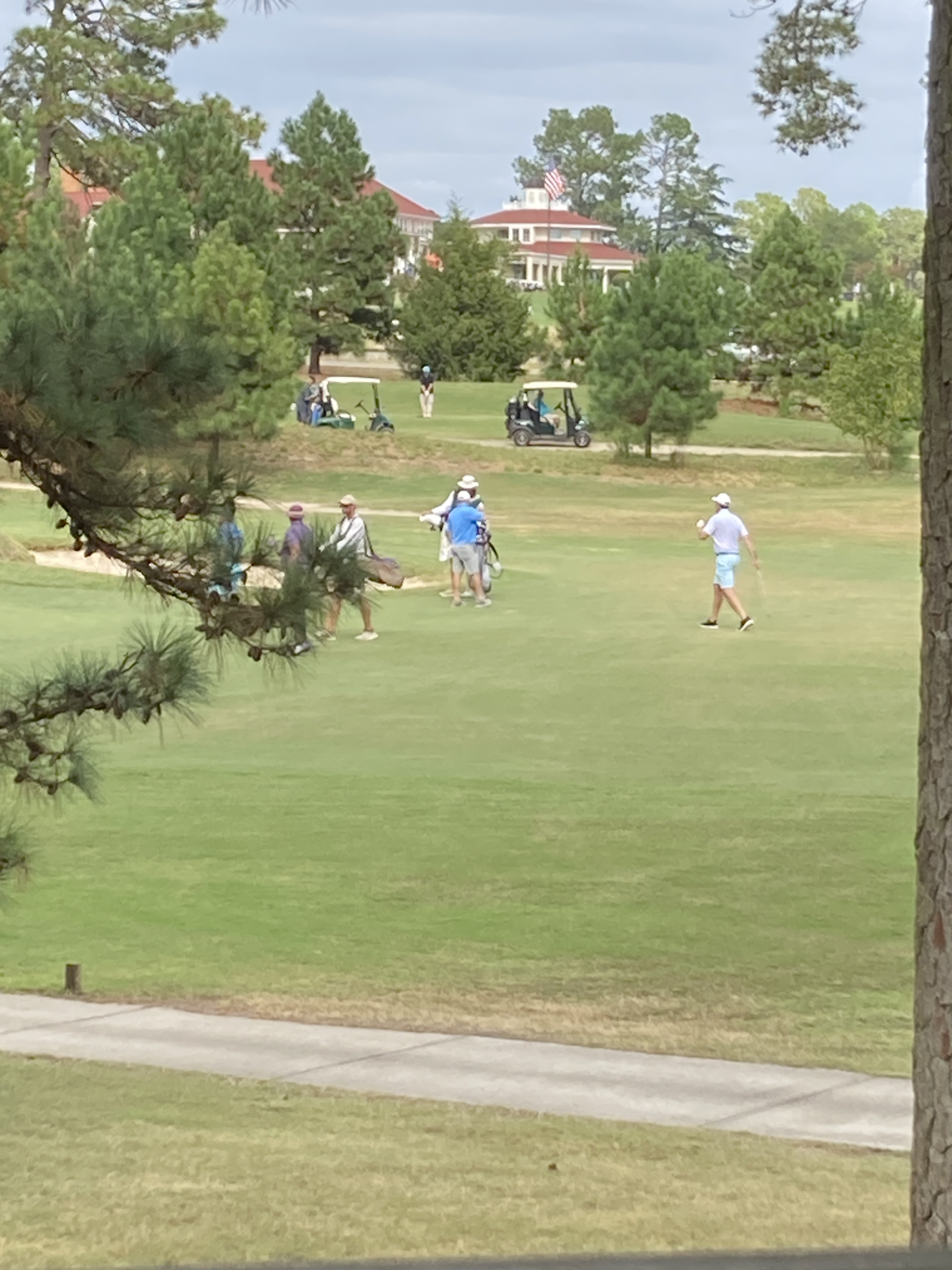
My first “bucket list” trip was to Pebble Beach Resort in 2021. This year’s bucket list is Pinehurst Resort in North Carolina to play Pinehurst #2, Pinehurst #4, Pinehurst #8 and Tobacco Road. You must stay at the Pinehurst Resort to play the “bucket list” courses #2 and #4. We stayed in the Golf Terrace 208 Condo on Pinehurst #5 – in the distance, we could see the main Pinehurst Clubhouse from the balcony; as well as watch golfers playing the 18th hole in front of the condo. It was a great vibe staying in the condos. I wrote a blog with “non-golf” tips for visiting Pinehurst if you are planning a trip.

Pinehurst is a lovely resort and easy to get around because they have a free shuttle service that will take you to all the courses, hotels, and dinning options around the resort and in the village of Pinehurst. It’s fun to just hang out at “The Deuce” at the main club house and watch golfers play the 18th green, Pinehurst #2. We also loved playing the 18 hole “Thistle Dhu” putting course. “Thistle Dhu” is Scottish and translates to “this will do.” We had two matches (I won one match and my friend won the other – on the line was a transfusion drink). We did not play the “Cradle” (the short course). Past experience shaped our decision to not play. We had played the short course (The Hay) at Pebble Beach – hitting off mats for the lovely price of $65 – which was nothing special and felt like playing our local short courses. The Cradle is $50 (and yes, you hit off a mat). It was very busy so I’m sure folks enjoyed it but it was not something we felt we needed to experience.

We played Pinehurst #4 on day one, Tobacco Road on day two, non-golf day on day three, played Pinehurst #8 on day four and ended the trip playing Pinehurst #2 on day five. It was a great mix of golf and relaxing (walking around Pinehurst Village and near by Southern Pines) but this is a golf trip so let’s talk golf.

Overall Impressions of Courses

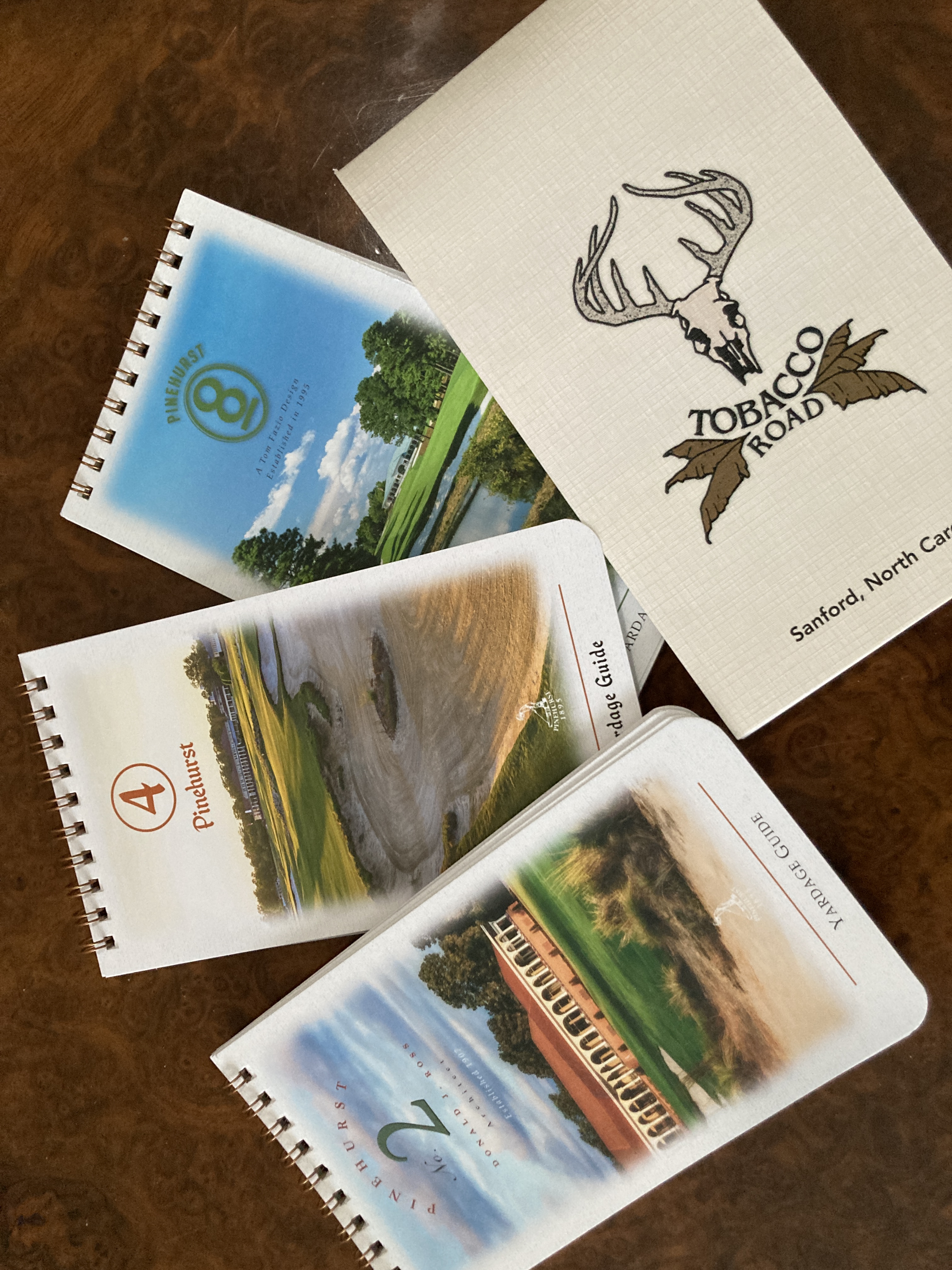
Yardage Books

By the Numbers – All the courses were beautiful, in excellent condition, and challenging to play. To get a sense of the challenge of the courses I looked up the ratings for each on the USGA National Course Rating Database (see the chart below). For my non-golf friends, the first number is an indication of the course difficulty for a scratch golfer (e.g., if par is 72 they play to that number) and the second number is “slope” and indication of the relative difficulty of a golf course for players who are not scratch players compared to players who are scratch players. And the USGA also provides a potential score for bogey golfers. The USGA course rating system lists a male bogey golfer as a 20 handicap and a female bogey golfer as a 24 handicap. For my golfing friends that are wondering about the handicaps — the USGA course rating uses driving distance in determining bogey handicaps (and states the average drive for females is 150 yards). So if you are a female with a 24 handicap index you can set an expectation of a score of 103 (or about three strokes over your “target score” calculated as the course par plus your course handicap: 72+28=100). I personally like to use the GHIN app and look up my course handicap (which is the strokes you get for that course and is not the same as your handicap index) to calculate my target score.

The Chart below shows that Pinehurst #2 is the hardest course. As a non-scratch golfer, I care about the slope of 133 (which is fairly significant against an average course rating slope of 113). Also, the bogey rating is 103.3 for Pinehurst #2. It is interesting that the front 9 slope is easier than the back 9 slope because the caddie said the first six holes of Pinehurst #2 are the hardest.

My opinion on each course…

In many reviews and articles I read before my trip the overall opinion was that Pinehurst #4 was becoming the new favorite (even more so than #2). I disagree (and so did my golf buddy, Donna). We thought both were pretty and challenging but we preferred #2 over #4. In short, the two main differences between #2 and #4 is that #4 had more elevation change than #2 and the sand and grass in the waste areas was different – the waste area for #2 was easier for us to advance the ball farther down the fairways.

Anyway, the easiest way to distinguish the courses are a paragraph on each…

Pinehurst #2 – Everyone said “get ready to get beat up by Pinehurst #2” but that was not my experience. Yes, it was the most difficult course and for women I believe it’s not just the fast greens but also the length. The tee to green yardage for many holes meant I often could not get to the green in regulation or I was hitting a wood into the green which made “holding the fast greens difficult.” For example, Par 3, 17th hole played 167 yards (all carry per Chris our caddie) taking into consideration the elevated green protected on the right by a large bunker. That is basically a driver for most women. On most of the Par 4 holes, it was driver and three wood into the greens and, as I mentioned earlier, that makes holding a green very difficult. With respect to the waste areas, the sand was hard packed so once you realize you could hit a wood or hybrid in the area, it really wasn’t too penalizing unless your ball landed in a “love bush.” Even with the challenges Pinehurst #2 was enjoyable to play. One of the things that surprised me was how peaceful and relax I felt walking Pinehurst #2.

Pinehurst #4 – I expected to really like this course given the reviews but it was my least favorite of the four I played. It was very pretty, hillier than Pinehurst #2 (but nothing like the elevation changes at my local course in the foothills of South Carolina). We did not walk the course because it was noon and a bit warmer; but in the crisp fall mornings, I think it would be an easy walk.

The defense of the course in my opinion was the length (especially on the Par 4 holes) and the sand and grass in the waste areas. After playing #2 and #4, we decided it was much harder to advance your ball out of the waste areas on Pinehurst #4 because the sand was sort of soft and fluffy and the grass was more spread out. Comparatively, the sand in the waste areas at Pinehurst #2 was hard packed. But it really was the distance on some very long par 4 holes on #4 that seemed almost unfair; even my caddie would say to me you can’t get on this par 4 in two (and I was hitting my drives great that day for me at 170-180 yards and my 3 wood 130-140 yards but not reaching a par 4 at 340 or 356 yards). On the bright side, the Par 3s distances were reasonable ranging 90 to 135; but again for any short hitter they would be looking at a hybrid or wood to get on in regulation on the longer par 3s.

Pinehurst #8 – This is a great course for women (and men). It is rated the same as Pinehurst #4 with a slope of 124 but the individual holes have yardages tee to green that are much more manageable because there is a chance you can reach many holes in regulation. It feels a bit more like a course many golfers are use to playing with traditional fairway and green-side bunkers. Yes, there are waste areas but not on every hole or as exceedingly large as the waste areas on #4 and #2. The real challenges at #8 are the really fast greens. The greens were significantly faster than #2 or #4. The reason is that the greens are “new” – all the turf was replaced 18 months ago. I mentioned the fast greens at Pinehurst #8 to our caddie at Pinehurst #2 and he agreed with my assessment. The caddie even told me Pinehurst caddies have a hard time reading the “immature greens at #8.” So my guess is when the greens are “mature,” Pinehurst #8 will be a really fun scoring course.

Tobacco Road Golf Course – This course is in Sanford, NC and is about a half hour drive from the Pinehurst Resort. This course should be on your golf itinerary when you go to the sand hills of North Carolina. It is the most visually stunning of all the courses we played with pristine fairways and huge mounts shaping the terrain; as well as exceedingly large waste areas and every hole was protected by bunkers (some very deep). There were many blind shots and you had to ring a bell on five of the holes so the players behind you knew when it was clear to hit. Our playing partners (men hitting from “Disc” tees at 6,317 yards) described it as “playing on the moon” given they were often hitting over the vast waste areas or playing from them. Often times you would ride your golf cart into the waste area/bunker areas to walk up to the greens.

If your game is not in good shape (e.g., you cannot control your direction or you are not a good sand player) you will probably have a hard time at Tobacco Road. Some call the course quirky, I just call it “a blast” to play.

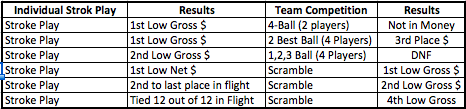
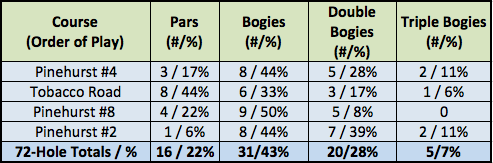
My Game Overall – So you may be wondering how I did based on the opinions above. I will share with you that I really prepared (practicing every part of my game, taking lessons, etc.) the weeks before this trip. My lowest score was at Tobacco Road with a 86 (with eight pars, six one-putts) which was one stroke better than my target score; but I played well all week and basically played within four strokes of my target scores for each Pinehurst course which means (according to USGA guidelines of four strokes within your target score) I played to my ability – see the chart below – courses are in order of play.

If I look at my pars, bogies, etc. by course (which is a stat in GHIN if you post hole-by-hole with stats), I’m really happy with the results for the four rounds (72 holes) resulting in 65% Bogies or Better (Pars 22% and Bogies 43%).

So, I was really hitting it well and I’m very happy with my scores. Perhaps my biggest take away about my play was that I could say I gave too much respect to the greens because I left so many putts on the edge of the cup. As an optimist I would say that it was great lag putting! LOL

At Pinehurst #4, the first day I had four par putts and one birdie putt that rolled to the edge of the hole. At Tobacco Road I did a much better job with speed with six one-putts but still left some putts on the edge of the cup. This continued with every round. At #8, I had a chance at birdie putts on every Par 3 and the first ones were short and the final one I got to the hole and lipped out. Even on Pinehurst #2 I had a chance to par Hole 1 and I left the putt short. I just think all the folks telling me that the greens were fast and get ready to three and four putt (or get “Donald Rossed” which means you are on the green putting and your putt roles off the green) got in my head and I just never putted with freedom. I did have some three putts but not as many as I anticipated; so perhaps leaving putts short at Pinehurst was not such a bad “miss.”

Thanks for reading my blog and if you want to see more pictures (photo gallery at the end of each post) and more details on playing each course click on the links for each course: Pinehurst #2, Pinehurst #4, Pinehurst #8 and Tobacco Road. If you do go to the detail course blogs please know that I wrote them to document my play (for myself) — so you have been warned that it might bore you to death reading those posts but at least you can quickly scroll and enjoy the photos.

If you are looking for tips on planning a trip to Pinehurst Resort, see my blog post titled “Pinehurst Non-golf Tips.”

A few photos of some Pinehurst SWAG

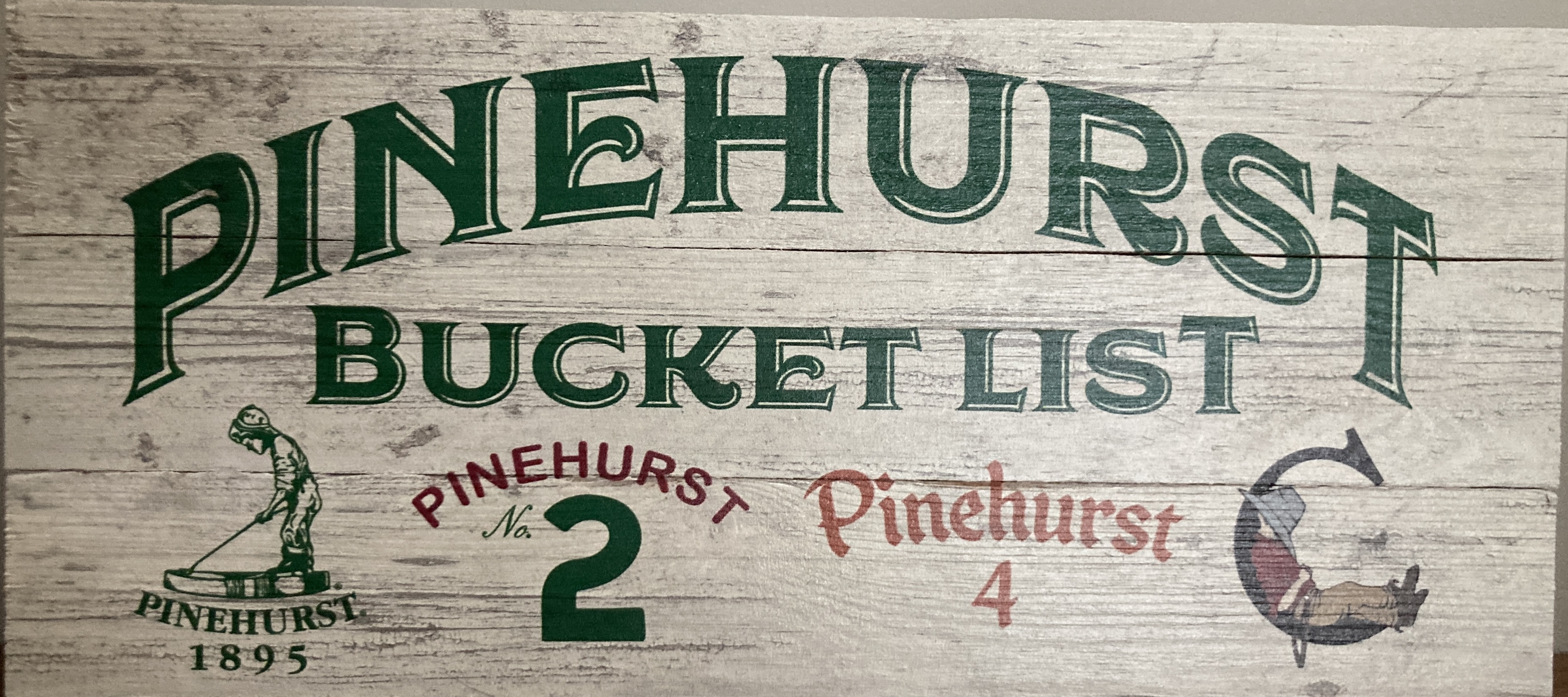
The image of “bucket list sign” and yardage books earlier in this blog post were purchased and I also bought a zip sweater, ball markers, a cap. The ball marker from Tobacco Road is cool. Believe it or not, I actually controlled my spending (purchased much less than I did at Pebble Beach – ha,ha).

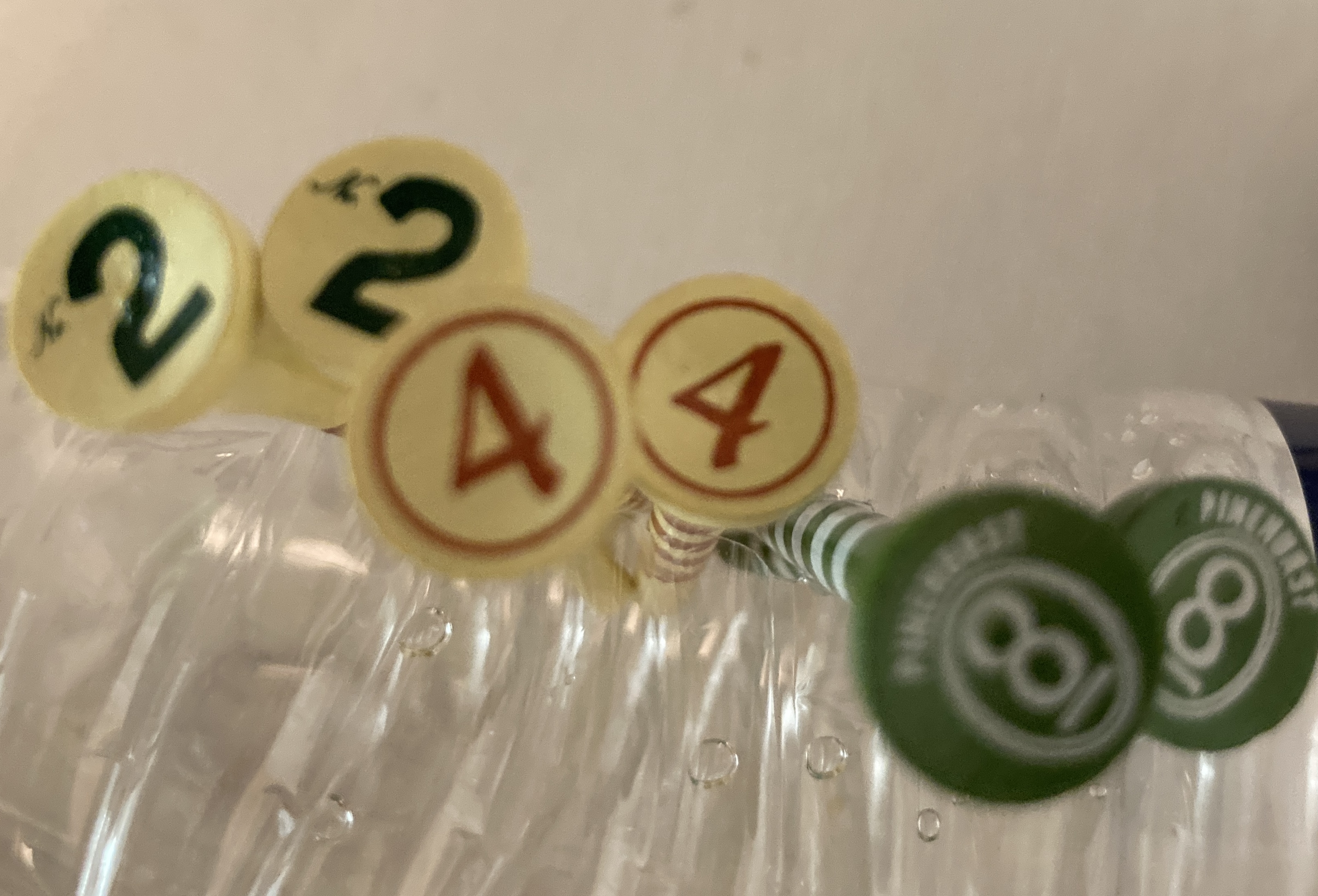
Also, each course at Pinehurst had tees (# on top of tee, different stripes on sides) and plastic ball markers for golfers to take at the 1st hole. Unfortunately at #2 there were no plastic ball markers.

Pinehurst Trip: Non-Golf Tips

If I had a friend planning a trip to the Pinehurst Resort these are the tips I would share:

Book Early: If you want to go during a peak time (spring or fall) book early. Especially if you have your heart set on staying at a specific hotel or want specific tee times. For example, we booked in July for October and there was not much choice in tee times. We had two early morning tee times at Pinehurst which turned out fine but getting up in the dark on vacation to play isn’t ideal.

Transportation: We had a car which was great because we wanted to play a course outside the Pinehurst Resort and we had a day that was a non-golf day and we went exploring. However, if you plan to just stay at the Resort (and Pinehurst Village), then a car isn’t necessary because they have a great shuttle service. All you do is call the shuttle and they will take you to any location on property or in the Village of Pinehurst. They advise you to call for a shuttle 15 mins in advance but we never waited that long. I asked a shuttle driver how it works and he said they have 50 shuttle vans and 200 drivers! The driver also said they do airport shuttles for guests.

Also, If you are playing multiple Pinehurst courses, the night before they use shuttle vans to take guest clubs from the main club house to the various courses and your clubs will be waiting for you when you arrive for your tee time. So you don’t need to worry about lugging your clubs back and forth to your hotel or condo every day during your stay.

Food: First, all the food was excellent. Our plan came with breakfast and dinner included. The breakfast buffet opens at 6 am and everything you could want to eat is available. The dinner plan included all the restaurants at the resort and some places in the Village of Pinehurst. The dinner plan includes an appetizer, entree, and dessert so it was a lot of food. Also, if you order ice tea that is included in your meal plan but wine/beer or other alcohol drinks are not included. By the last night my friend and I just did a “to go meal” of soup from The Deuces because we were so tied of eating so much food.

Also, they recommend you book dinner reservations before you arrive at the resort. If you really want to eat at a specific time then book early because we really could not make a dinner reservation (at a reasonable time) a day or two ahead. So, we ate early and found it easy to get a table.

There is a 18% gratuity added to every meal. Oddly, at Pinehurst #8, when we had lunch, the server said she did not get any of the “service charge fee” – which surprised us. We thought maybe a “service charge” was different from a gratuity charge. Anyway, I did some research for this blog post and the Pinehurst resort states that they have a 10% service charge, a resort fee, and if you go to a “dinning establishment” an 18% gratuity fee is automatically applied (which you see on the bill). And, they state the majority of the 18% gratuity does go to the server. So perhaps at Pinehurst #8 which is “off site” the grill is categorized differently? Either way, read the meal receipt carefully to see what fees are being charged.

Bottom line, I would definitely recommend you get the breakfast buffet in your plan but if its possible, I would ask the cost of a plan without dinner. Depending on the cost difference in plans with and without dinner, it may make sense to skip the dinner option (unless you are a big eater).

Lodging: There are a number of options and I assume many guests want to stay at the Carolina Hotel. Although I did see reviews that complained about the hotel rooms being old and needing to be updated. I spoke to the receptionist when we were at the Holly Inn (in the Village of Pinehurst and part of the Pinehurst Resort lodging options) and asked about the rooms. She said the hotel is a “historical site” so the rooms are older.

Anyway, we stayed in a condo on property, The Golf Terrace (perhaps built circa 1980s but very nice – didn’t feel new but didn’t feel “old”). I really liked staying in the condo. It had a kitchen, nice sitting room, balcony, and we each had our own bedroom and bathroom. Everything was clean and water pressure in the shower was great. Like a lot of Airbnb places, you could log into your apps (i.e. Netflix, YouTube) but it was hard to find local TV channels or the Golf Channel. The condo also does have maid service.

The only tip staying in an on-course condo is that it is very dark at night so if you are driving to your condo on the course, pay attention to where your are driving (or better yet, just take the shuttle). Also, driving during the day, you have to watch out for golfers teeing off or riding by in a golf cart.

Golf Terrace Balcony View

Bring Some Cash: Most of the resort is credit card only (even the drinks cart on the golf course only takes credit card). However, If you use a caddie you need to pay the tip in cash; and it is good to have some cash to pay a tip at the bag drop when you arrive at the main club house or any other service person you want to tip; and of course, we left a cash tip for the cleaning staff at the end of our stay in the condo.

Statues at Pinehurst – just for fun!

It’s Here – Back to Back Solheim Cup and Ryder Cup in 2023

We have the pandemic to thank for the Solheim Cup and Ryder Cup being contested in the same year and back-to-back. If you love team competition and golf then this fall is your time to enjoy hours and hours of match play from across the pond.

Dates for each Cup: The official days of competition run Friday through Sunday.

Solheim Cup Competition days: Friday, September 22 – Saturday, September 23 – Sunday, September 24. Golf Channel coverage is from 2 am to 1 pm on Friday and Saturday and 5 am to 11 am on Sunday.

Ryder Cup Competition days: Friday, September 29 – Saturday, September 30 – Sunday, Oct 1. The Ryder Cup gets more TV coverage (including the Junior Ryder Cup and opening ceremony on Thursday). You can find all the times on How to Watch the Ryder Cup on the website.

I assume you will also be able to see replays on YouTube.

Note: When the 2020 Ryder Cup was moved to 2021 (due to Covid), it meant that the Ryder Cup would now be played on “odd” years and therefore be the same year as the Solheim Cup. The LPGA and LET decided to move from their traditional odd years to even so that do not have to “complete” every year with the Ryder Cup. They could not move the 2023 event so their only solution was to not wait 2 years to wait for the next Solheim Cup so there will be a 2024 Solheim cup, in the USA.

My thought was that it would be amazing if the men’s and women’s tours could work together to have one big “match play week” where they combine the events and also add some mixed match events into the event.

If you are interested in a bit of insight, read the overviews below.

SOLHEIM CUP OVERVIEW

The Solheim cup is much “younger” than the Ryder Cup since the first competition was in 1990. The record stands with the USA 10 wins and Europe 7 wins. Team Europe has won the last two cups.

The Solheim Cup is being contested in Andalucia, Spain at Finca Cortesin. The European Captain is Suzanne Petterson and the USA Captain is Stacy Lewis. Details can be found on the Solheim Cup website but let’s look at the players.

Team USA players: I would say that there were no really big surprises in the captain picks from Lewis. Rose Zhang is the new star on the LPGA (winning her first professional tournament her first week on the LPGA) and as a recent college graduate she has played a lot of match play. The other captain picks were all next in qualifying points.

The players earned points starting at the Portland Classic in 2021. The USA has the recent number one ranked player, Lilia Vu and the US Open Champion in Allisen Curpuz. Rose Zang is the new star on the LPGA and has a steller match play record from college. Watching the LPGA tournaments the last few weeks it appears most players are coming into Solheim in great form. For example, Megan Kang just won her first tournament on tour (the Canadian Open). The two players that are struggling are Jennifer Kupcho and Lexi Thompson. In fact, Lexi Thompson has had seven missed cuts in her last 9 tournaments and her best showing was a T31 at the Founders Cup in May. She is on the team because of all the Solheim cup points she accumulated in 2021. But both Kupcho and Thompson love match play and so hopefully they will rise to the occasion.

  • Lilia (automatic qualifier)
  • Nelly Korda (automatic qualifier)
  • Allisen Corpuz (automatic qualifier)
  • Megan Kang (automatic qualifier)
  • Jennifer Kupcho (automatic qualifier)
  • Danielle Kang (automatic qualifier)
  • Lexi Thompson (automatic qualifier)
  • Andrea Lee (automatic qualifier)
  • Rose Zhang (captain’s pick)
  • Alley Ewing (captain’s pick)
  • Angel Yin (captain’s pick)
  • Cheyenne Knight (captain’s pick)

Team Europe players: Suzanne Petersen has stated this is the best European team ever and that’s a big statement given the Europeans have won the last two Solheim Cups. Only time will tell if it is the best team “ever” but she does have a stellar list of players. Celine Boutier (#4 in the world who won back-to-back at Evian Championship and the Scottish Open), Charley Hull with an 11-5-3 Solheim Cup Record and Leona McGuire with a 4-0-1 record from 2021. It is interesting that there are five swedes on her team and three of them were captains picks. The big surprise was Carolina Hedwall because she’s not highly ranked but she is a fierce competitor and did well in past Solheim cups.

  • Celine Boutier (automatic qualifier)
  • Marja Stark (automatic qualifier)
  • Charlie Hull (automatic qualifier)
  • Leona McGuire (automatic qualifier)
  • Georgia Hall (automatic qualifier)
  • Linn Grant (automatic qualifier)
  • Carlota Ciganda (automatic qualifier)
  • Anna Nordquist (automatic qualifier)
  • Madelene Sagstrom (captain’s pick)
  • Gemma Dryburgh (captain’s pick)
  • Emily Pedersen (captain’s pick)
  • Carolina Hedwall (captain’s pick)

Morning Foursomes

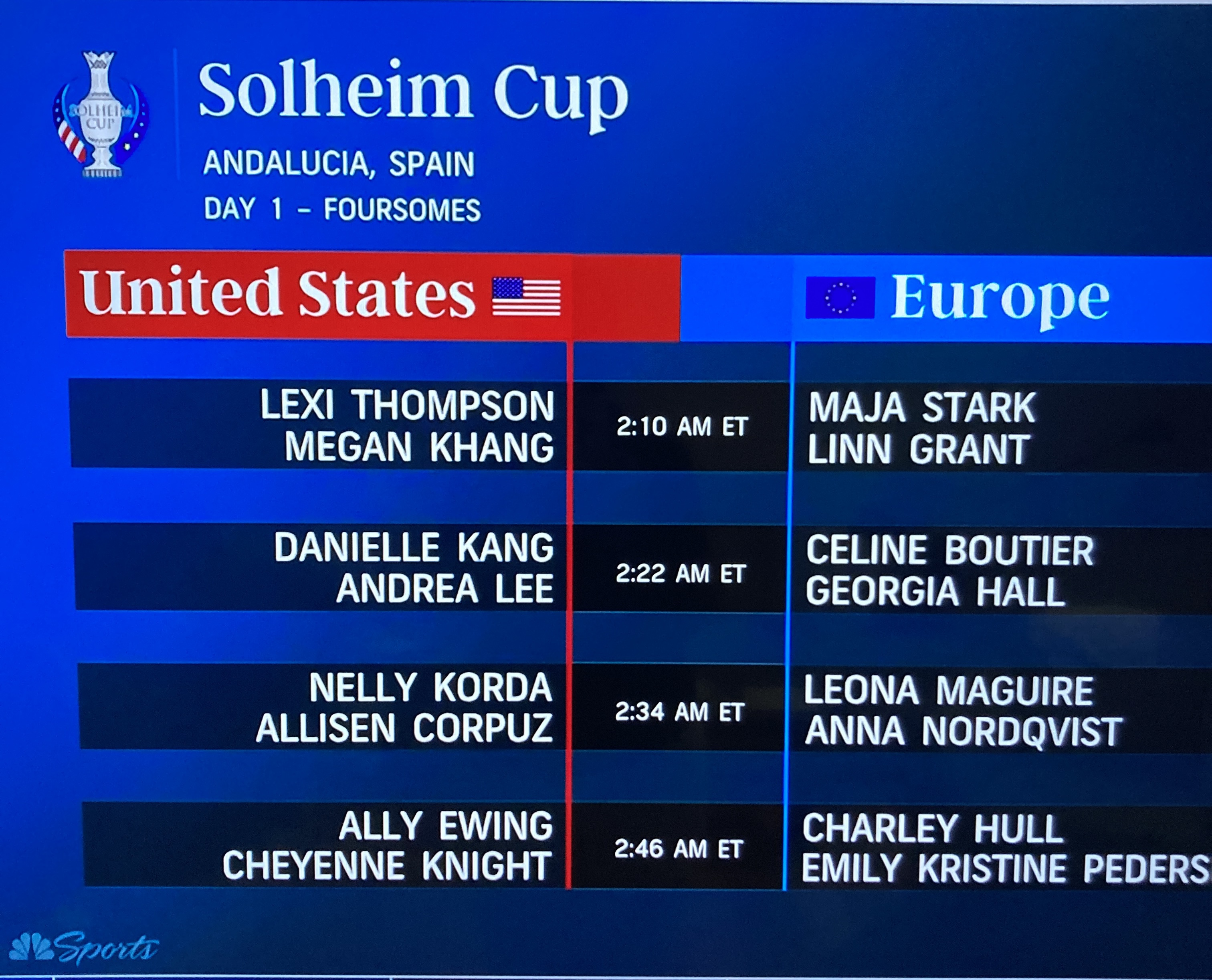
The Morning Foursomes for Friday were announced today (Thursday) at the opening ceremony. I am a bit surprised to see Lexi going out first; and Rose Zhang, Lilia Vu are not playing. I’m not sure what Stacey Lewis is thinking. Let’s hope she sees something in the player stats that made these morning pairings make sense. On the European side, Suzanne Petterson has stacked her foursomes with Lin Grant, Celine Boutier, Leona Maguire, and Charley Hull.

RYDER CUP OVERVIEW

The Ryder Cup was first played in 1927 and the record stands as USA 27 wins and Europe 14 wins. If you love golf history you can read about every Ryder Cup on the Ryder Cup Website.

The Ryder Cup is being contested in Rome, Italy at the Marco Simone Golf & Country Club. The European Captain is Luke Donald and the USA Captain is Zach Johnson. Details can be found on the Ryder Cup Website but, as we did with the Solheim Cup, let’s look at the players.

Team USA Players: If you are a golf fan you know the most controversial pick was Justin Thompas (JT). He has played well below his normal standards this year but was picked because of his stellar match play record. Hopefully, JT plays well but I can’t imagine the pressure he must feel given so many feel he did not deserve to be on this team.

  • Scottie Scheffler (automatic qualifier)
  • Max Homa (automatic qualifier)
  • Brian Harman (automatic qualifier)
  • Patrick Cantlay (automatic qualifier)
  • Wyndham Clark (automatic qualifier)
  • Xander Schauffele (automatic qualifier)
  • Brooks Keopka (captains pick)
  • Sam Shepard (captain’s pick)
  • Rickie Fowler (captain’s pick)
  • Collin Morikawa (captain’s pick)
  • Jordan Spieth (captain’s pick)
  • Justin Thomas (captain’s pick)

Team Europe Players: The European team is solid and they have a few players that are coming into this Ryder Cup is exceptional form. There is Viktor Hovland who won the FedEx Cup and Ludvig Aberg who, like Rose Zhang, was a college star that came on tour and won quickly. I think the United States will face a very tough European team.

  • Viktor Hovland (automatic qualifier)
  • Rory McIIroy (automatic qualifier)
  • Jon Rahm (automatic qualifier)
  • Matt Fitzpatrick (automatic qualifier)
  • Tyrrell Hatton (automatic qualifier)
  • Robert MacIntyre (automatic qualifier)
  • Ludvig Aberg (captain’s pick)
  • Tommy Fleetwood (captain’s pick)
  • Nicolai Højgaard (captain’s pick)
  • Shane Lowry (captain’s pick)
  • Justin Rose (captain’s pick)
  • Sepp Straka (captain’s pick)

So grab your cup of morning coffee (or tea, in my case) and sit back and enjoy the golf. Hopefully the matches will be great battles and make each cup exciting and closely contested.

Lilia Vu – a New World #1 on the LPGA

Congratulations to Lilia Vu winning the AIG Women’s British Open by six strokes! An even more impressive feat given she was six back of the leader when she started her round on the weekend. Vu is now a two-time major champion in a single year and the new #1 player in women’s golf. Another way to think of it, Vu has three wins in eight months and two of those wins are majors.

I doubt many had Vu on their radar to win the last major of the season given she has played spotty since her win at Chevron in April but her record on the Epson tour and her top 10s in 2022 on the LPGA tour were clear indicators of her talent.

If you don’t know much about Vu, she is 25 years old, is American (born in California) but her family comes from Vietnam (Grandfather moved family to USA in 1982). She played her college golf at UCLA and was on the winning Curtis Cup team in 2018. She graduated in 2019 and started her rookie year on the LPGA. Her rookie year was a disaster with 7 missed cuts out of 8 tournaments; only making $3,830. She almost quit but her mother encouraged her to stay the course and so she went to the Epson tour in 2020 where her journey to outstanding golf started to take shape.

Lilia Vu was a standout on the Epson tour (feeder tour for LPGA) in 2021 with four wins and 10 top 10 finishes; then transitioned to the LPGA tour in 2022 and she recorded eight top ten finishes.

Vu appeared to be on the way to great things when she won the first major of the year, The Chevron. However, after Vu’s win at Chevron, she missed the cut at the next two majors (The KPMG PGA Championship and the US Women’s Open) and had a T42 at the Evian.

During various press conferences, when asked about her game, She mentioned she was struggling with some back issues; and she also was learning how to juggle demands after winning a major because so much more is expected of winners with the sponsors, etc. For instance, before her win at Chevron she didn’t even have an agent. Now she has an agent to deal with all the requests of her time outside the ropes.

Prior to the win at the AIG Women’s Open, Vu’s world golf rank was 6 (Race to CME rank 7). Vu is now ranked the #1 player in the world (Race to CME rank 1). This season on the LPGA, Vu has 4 top 10 finishes and 3 wins (including two majors). That’s a very impressive 2023.

While being interviewed after winning the AIG Women’s Open Vu said she had felt (at times) like her first two wins in 2023 were a fluke. When asked if she believed in herself after winning the AIG Women’s Open, she said “Yes. And she mentioned that “the only thing that get’s in her way of winning is herself.” The players on the LPGA should watch out for a Vu who now believes in herself.

She is a talented golfer and deserving of her wins. You can read all about Vu on the LPGA website Player Profile

Five Things I Loved about the U.S. Women’s Open at Pebble Beach

It goes without saying the significance of a women’s major at Pebble Beach. The media has discussed it at great length so that is not the focus of this blog post. This post is just a quick commentary on what I, as an avid golf fan, enjoyed about watching the U.S. Women’s Open this week.

  1. The Course – There is no more beautiful course than Pebble Beach. I always enjoy watching the AT&T Pro Am each year just to see the beautiful views as I sit in my home in the middle of winter on the east course. I think every golfer “knows” the course (even if they have never been to Pebble Beach) just from the broadcast of course for so many years. Here is a flyover of every hole from the USGA.
  2. Reliving My Golf Experience – I had my “bucket list” golf trip to Pebble Beach in 2021 and watching the women play the course and knowing each hole and how I played it made watching the championship that much more enjoyable and exciting for me. My best hole at Pebble Beach was a par on the 6th hole (Par 5) so that hole in particular was fun to watch. But I also remember my friend’s great play on hole #7, and can say with certainty that the cliff on hole 8 (or the Speith hole as it is now known) is really scary when standing by the edge.
  3. Charley Hull’s Charge on Sunday – Corpuz was an example of what many call boring golf meaning “fairways and greens.” Charley Hull gave us the excitement we want on the final day of a major. She was fearless and the number of long putts she made was amazing. Her final round of 66 was just awesome.
  4. The Steller Play of Allisen Corpuz – I do not enjoy seeing a player in the lead blow up. I want them to play their best golf and if someone beats them it’s because the other golfer player better (not because the leader fell apart in the final round). Corpuz played her best golf.
  5. Prime Time Golf – The bonus of having the U.S. Women’s Open on the west coast was that it was prime time coverage. Not only prime time but live coverage!

Overall I really enjoyed this U.S. Women’s Open and I am excited for “major season” to continue with the next golf major from across the pond; which will be the men playing The Open at Royal Liverpool Golf Club July 20 through 23. The Open is the final major for the men but we have two more majors for the women. The Evian Championship July 27 through 30 and the final major of the year will be the Women’s British Open at Walton Heath Golf Club August 10 through 13.

Scottie Scheffler Doesn’t Let the Media Get in His Head

I’m always amused at how so many golf analysts focus on the bad. Even when they acknowledge the great aspects of a player’s game, they quickly pepper the player with questions about their weakness. Point in case was this past week when Scottie Scheffler finished in second place at the Memorial Tournament with the best tee to green play of any player in the field; and that is saying a lot given how hard Muirfield Village played.

There is so much data now in golf. You can look at your favorite golfer’s profile and see all the stats. For example, Scottie Scheffler (by the way is the #1 golfer in the world) has amazing stats when you review his profile on the PGA Tour site. Scheffler’s PGA Tour Stats (SG = Strokes Gained) include:

Scottie Scheffler’s Stats as of 6/7/2023

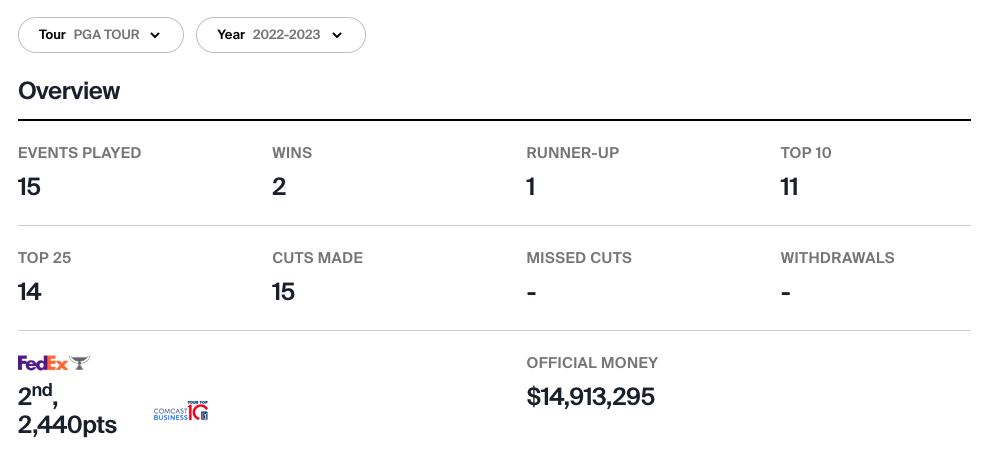
Now you would think with being #1 in strokes gained in Total, Tee-to-Green, and Off-the-Tee; as well as, #2 in Approach to the Green that he would win every week; but then you see his putting has been off. But overall his consistency is incredible. He has made every cut, has won twice, and has 11 top 10 finishes. See the screenshot below of his performance as of June 7,2023.

Scottie Scheffler’s record as of 6/7/2023

So when the golf media decides to focus on what’s not going right instead of what is amazing consistency; I love the fact that Scottie Scheffler basically ignores all the “talk” and just plays his game. And he doesn’t let the media get in his head. His reply to his poor putting “Sometimes it goes in and sometimes it doesn’t.” Now he did go on to say it is frustrating but he then said “If I was putting my best this week, I would have won by a crazy amount.” He also said that he and Jon Rahm were joking about how the putts weren’t falling this week.

Even though he knows he has an issue with his putting. He has been asked about his putting every week for a few weeks; he acknowledges it but doesn’t let the media “poke the wound” and get upset about it.

I have admired Scottie Scheffler since his Master’s win not just because of his play but also because of his easy going personality with the media. Some of the players that show their irritation with the media (when the golf analysts question their weaknesses) need to take a lesson from Scheffler – don’t give the media fuel for the fire by letting them get into your head.

Rose Zhang and Sam Bennett make their Professional Debuts

After the completion of the NCAA D1 Championships, two notable amateur golfers turned professional. Rose Zhang the #1 female amateur golfer in the world and Sam Bennett the #5 ranked male golfer in the World Amateur Golf Rankings.

Rose Zhang

You cannot call yourself a golf fan if you do not know about Rose Zhang. She won the 2023 Augusta National Women’s Amateur, she has been ranked the #1 female golfer in the world for a record 141 weeks, she has won the D1 Individual NCAA Championship title back-to-back (2022 and 2023). Other notable wins in her amateur career include the U.S. Girls Junior (2021) and the U.S. Women’s Amateur (2020). Her other amateur accomplishments are too long to list.

She had all eyes on her at the LPGA’s Mizuho American Open (at Liberty National in New Jersey where the President’s Cup was held in 2017). How did she do? She WON!!!

It’s incredible that Rose Zhang won her 1st LPGA professional event. Her scores were:

Round One: Tied 12th at 2-under par

Round Two: Tied 4th at 5-under par

Round Three: Leader at 11-under par

Round Four: Tied 1st at 9-under. Won in playoff.

It was an exciting ending for fans (probably very stressful for Zhang) because she was in a playoff against Jennifer Kupcho. Zhang won on the 2nd playoff hole.

It really is remarkable what she has accomplished. The last player to win in her debut on the LPGA was in 1951.

Sam Bennett

Although Sam Bennett was not the #1 amateur in the world; he became an amateur darling with his stellar performance at the 2023 Masters taking home the low amateur honors but more impressive was his T16 (2-under) finish. Of course, he was invited to the Masters as the reigning U.S. Amateur.

Bennett made his professional debut at the Memorial Tournament (notable for being hosted by Jack Nicklaus at his course at Muirfield Village in Ohio). So how did Bennett fare:

Round One: 1-under

Round Two: Even

Round Three: Even

Round Four: Tied 63rd, +12 (an 84 on the last day was not a great finish)

Final Thoughts

Sam Bennett had a very respectable showing for his first PGA Tour event. Just making the cut in your debut on tour would be considered a major accomplishment.

As for Rose Zhang – she has once again shown the golf world what a special golfer she truly is by winning her first professional tournament. Keep an eye on her at the U.S. Women’s Open because she holds the course record (63) at Pebble Beach. And even better is that she is now eligible for The Solheim Cup this fall. I would bet my house on Zhang being a captain’s pick by Stacey Lewis.

It Takes a Team – Understanding Golf Course Ratings

In my last post I wrote about how important the rating of a golf course is to the calculation of a player’s handicap. So how do golf courses get rated?

I knew that state golf associations managed the process for rating golf courses but I did not know they have volunteers that do course ratings. Of course, it makes sense when you realize that golf associations depend on volunteers for so many activities. For example, they have volunteers as rules officials, scorers, and other various roles for golf competitions.

What do volunteer course rating teams do when they evaluate a course? If you want a quick understanding here is a great video called “Go Inside A Course Rating” from the USGA. If you want more insight, read on!

The state golf associations have programs to train volunteer golf course raters. Teams (4 to 6 members) rate a course. They do the following activities:

(1) Measurement – “Each hole is measured from every tee from the middle of the tee box to the middle of the green.” This is the number we see as the “permanent” distance on scorecards and on the tee box signs or plaque on the tee box. And of course measurement also includes the full yardage of the course from each tee box.

(2) Rate Obstacles – There is a rating manual but there is still a human “decision” to be made during the rating process.

(note: I don’t have access to the actual manual so I used information I found in various articles online)

Obstacles are rated on a scale of 0 to 10 with 0 being “non-existent” and 10 being “impossible to avoid.” For me zero is fairly obvious (there are no visible obstacles on the hole) and I assume 10 rating is fairly obvious (e.g. a forced carry). If you watch the USGA course rating video you will see that team members have a lot of discussions on what to rate various obstacles.

I read a number of state golf association articles and they all listed the obstacles in the same order. Also, it was noted in one article that the obstacles are evaluated from landing zones for both the scratch golfer and bogey golfer from each tee. The obstacles are:

Topography: “A player’s stance or lie in the landing zone, and whether the player has an uphill or downhill shot to the green.” This was the definition I found but I wonder (and would have assumed) that how the balls lands (rolls severely in one direction) would be an important part of topography.

Fairway: “The width of the fairway from which a scratch and bogey player will play his shots.”

Green Target: “The difficulty of hitting the green with the approach shot. The size of the green and the length of the approach shot are the primary factors.” I wonder if they use the same “landing area” for the male and female scratch and bogey golfers? This interests me as a female golfer because (as noted in many articles) women often have a longer club in their hand for an approach shot.

Recoverability” and Rough: “The difficulty of a shot from the rough measuring how difficult it is to recover.” I wonder how they really measure this? Do they measure the depth of the grass?

Bunkers: “The number of bunkers, depth of bunkers, and placement of bunkers.” I assume placement would be fairway bunkers vs greenside bunkers; as well as feet/yards from the green.

Crossing Obstacles : Basically I think of forced carries (water, waste areas, etc.) but various articles also mentioned out-of-bounds (which I found very odd) as crossing obstacles but perhaps OB would be used for a hole that has an actual road (not cart path) cutting across the fairway.

Lateral Obstacle: “Lateral Obstacles include penalty areas extreme rough and out of bounds that come into play laterally on the hole.” With respect to out of bounds (OB), I was surprised it didn’t have it’s own seperate category given that the Rules of Golf have different approaches to how they treat OB versus red stake (lateral) penalty areas; but I assume each obstacle within the “lateral obstacle” category is rated independently.

Trees: I found this definition interesting, “The rating for trees depends on the size, density and distance from the center of the landing zone and green. The probability of recovering from various locations within a group of trees is also considered.”

Green Surface: “The speed and contours of the putting surface.”

Psychological: “The mental effect on play based on the number and magnitude of above-average ratings in other obstacle categories.”

The obstacles are not all equal. Each obstacle has a weight factor applied for both the scratch and bogey golfer. I don’t have access to the weights but this makes sense given the variety of obstacles being considered in a course’s evaluation. Now, since so many articles listed the obstacles in the same order, I would assume that Topography is weighted significantly more than the psychological obstacle.

Of all the obstacles above the only one that surprised me was the “psychological” obstacle. We all know that “Golf is a mental game” but I had no idea the governing bodies (USGA and R&A) actually included the psychological aspect of a hole in the rating of a course.

I also found it interesting to learn the “landing zone” is used to determine difficulty which means the “assumptions” for how far golfers hit their drive is a significant factor. The governing bodies (USGA and R&A) released a distance study in 2020 and I assume the guidelines for the course rating teams come from the distance study (or years of data collected by the Handicap departments at the USGA and R&A).

Lastly, one area that is always open for debate is how many tees are rated for both genders. I often see tweets or other social posts from women (usually scratch players that hit it long) highlighting this issue. There is an FAQ on the USGA website that addresses what to do for tees not rated for your gender.

Researching information for this blog post has me pondering the idea of looking into becoming a volunteer. If I do, you know I will write a blog post.

Favorite Golf Podcasts

Yes, I am a golf junkie and besides playing golf, watching golf on TV (and recently YouTube) and reading golf articles; I also listen to Golf Podcasts.

My favorites right now are (in no particular order):

  1. Above Par (Kathy Hart Wood) – focused on the mental game. Tip: Start listening with episode one.
  2. Tee Time (Tori Totlis) – the content is tailored for women golfers but many topics are good for all golfers.
  3. Hack It Out Golf (Saturday Morning Stat) – Focused on helping golfers get better. Saturday Morning Stat episodes with a focus on one stat from Lou Stagner (Arccos) is my favorite.
  4. College Golf Talk – from Golf Channel with Steve Burkowski (my favorite college expert on Golf Channel).

A bit more about each Podcast

Above Par: Kathy Hart Wood is a certified life coach and a top 50 LPGA Golf Teacher (2017-2022); and she has played golf most of her life. Her website gives you access to her coaching program but you get so much free advice from her podcast, Above Par which you can access from her website or your favorite podcast app.

Kathy talks fast and her podcasts are 15 to 20 mins long. She gives useful tips, tools, strategies. For example, I used to feel bad for friends getting upset when they were playing bad. In her podcast “How to Deal with Negative Golfers” Kathy explains its not your responsibility to make them feel better and it will only hurt your game by wasting your energy on trying to change them. And if that person is your partner, she gives a strategy to say at the beginning of the round “Let’s agree not to be negative. Let’s agree not to apologize for missed shots there’s no upside to it and we are all going to have our share of missed shots.”

Tee Time: The podcast is hosted by Tori Totlis an Arizona golfer who created a program (website) called Complete Confidence Golf and has a passion for helping women get into and enjoy the game of golf. The blog page of her website has links to all her podcasts (or you can search for Tee Time on whatever app you use to listen to your favorite podcasts).

Tee Time podcasts run about an hour because Tori goes in-depth on the topic she is discussing. Tori has had Lou Stagner and other experts on her podcast. I also enjoy when she has other golfers on the show; particularly golfers that have played in USGA Amateur events.

Hack It Out Golf – This podcast has three guys talking about how to improve your game. I like the episodes that are released on Saturday called “Saturday Morning Stat” and are about 10-15 mins. long with Lou Stagner from Arccos focusing on a single golf stat. Lou Stagner has a newsletter and you can signup at his website. He is also very active on Twitter or you can search for Hack It Out Golf on your favorite podcast app.

I plan to write a blog post about Golf Stats because learning stats from Lou Stanger has helped me put my game in perspective!

Here is one interesting statistic from Lou Stagner – Tiger Woods only made 80% of greens from a 110 yards out. Or he missed the green 20% of the time from 110 yards. The stats he shares are all about setting expectations for amateur golfers. If Tiger only hits greens 80% then why do we, as amateurs, get upset when we miss a green.

College Golf Talk – If you enjoy watching college golf on Golf Channel then you may enjoy this podcast hosted by Steve Burkowski and Brentley Romine from the Golf Channel. Full disclosure I do not listen to this podcast every week (like I do my other favorites) but I’ll listen before big events like the NCAAs or The Augusta Women’s Amateur.

I’ve been following college golf for a few years and love the fact that you can watch a college golfer and then see them transition to the professional ranks. In 2018, I remember watching the NCAA Division 1 golf on Golf Channel and Jennifer Kupcho won the individual title. In 2019, I cheered for Jennifer Kupcho to win the first Augusta National Women’s Amateur; which she won. Then I became vested in watching her on the LPGA and seeing Kupcho win her first LPGA Major (The Chevron, formally ANA, formally DIana Shore) in 2022 was exciting. Unfortunately as I’m writing this blog post, Kupcho (as the defending champion of the Chevron) missed the cut.

Do you have a favorite golf podcast? Let me now in the comments so I can check it out!

Results for LIV players at The Masters

First, congratulations to the 2023 Masters winner, John Rahm with a 12 under, final score of 276! First place prize money is $3.24 million but the green jacket is priceless.

I have not watched any LIV golf but like any golf junkie, I have seen all the social media chatter and I was curious if the assumptions about LIV golfers “letting their games go” by playing the limited 54-hole event tour might be true. So let’s look at the results.

I mentioned in my previous post, 18 LIV golfers qualified for The Masters. After two rounds. 12 made the cut, 4 missed the cut, and two withdrew from the championship. Or to put it another way – 67% of the LIV players in the championship made it to the weekend. I think anything over 50% should be viewed as a respectable outcome and probably much higher than many “golf analysts” would have predicted.

The four LIV players that missed the cut were: Sergio Garcia, Bubba Watson, Bryson DeChambeau, and Jason Kokrak. To be honest this does not surprise me. The only one that surprised me was Bryson. I thought his game was in better shape. The two LIV players that withdrew were Kevin Na and Louis Oosthuizen.

Brooks Koepka was leading after the cut and the third round. The final pairing was Brooks Koepka and John Rahm. Master’s history reveals in the last 25 years, 21 winners have come from the last group. Another golf statistic, prior to this Masters, Koepka had won every major championship in which he lead going into the final round. However, Koepka lost his 2 shot lead quickly and John Rahm never looked back while Koepka lost all momentum.

Biggest surprise of the Masters was Phi Mickelson shoots 65 in the final round and is the club house leader (as Rahm and Koepka start the back nine) with a final total score of 280. Phil’s round is the lowest round for a player over the age of 50 at the Masters.

Phil Mickelson and Brooks Koepka tied for 2nd place with each earning $1.594 million.

Here is the final scores and finishes for the 12 LIV players that made the cut: