New Golf Stats to Track in 2025

I’ve always been interested in the best way to track improvements in my golf game. Yes, handicaps and scoring are results but they do not help me figure out what part of my game needs work. In the past I looked at fairways hit, greens in regulation (GIR), total putts, etc. However, after reading the latest and greatest suggestions from golf stat gurus (like Lou Stagner) I’m tracking my 2025 golf season with a different approach.

Most of the game improvement gurus online will tell you to get a game tracking app or program to track “strokes gained.” For example using Arccos or Shot Scope might be worthwhile; but I am not at a stage where I want to spend money to start tracking strokes gained. So, after reading many articles and books, it seems that there are a few interesting new stats (at least for me) that I can track without much fuss.

(1) Three-putt Avoidance – A golfers ability to avoid three-putts. You might think what’s wrong with the old school “total putts” statistic? I like the stat but there really isn’t any context and I have realized after tracking three-putts that it is a much better indicator of my putting overall. Focusing on this stat has made me much more aware of how far I am from the hole (proximity) on my first putt which has changed the way I practice my putting. I have become much more focused on speed control. I started tracking this stat in the summer last year and I have greatly improved my putting.

Below is a chart (by handicap) with the statistics (from Lou Stagner) to measure your three-putt avoidance. To calculate the percentage just figure out how many three putts per number of holes. The PGA Tour has been tracking this stat since 1992. For example, the number one player in the world, Scottie Scheffler during the 2024 golf season played 1,278 holes with 24 three-putts or a 3-putt avoidance of 1.88%. It’s interesting that Scheffler is not the best in this category.

Fun Golf Trivia about Three-Putting: Jack Nicklaus in 1962 won his first Major (U.S. Open at Oakmount) in an 18 hole playoff against Arnold Palmer. Jack’s putting was the key to winning. Nicklaus had only one three-putt in 90 holes compared to Palmer who had 10 three-putts that week.

(2) Greens In Regulation Plus One (GIR+1) – The golf articles I have read on game tracking seem to all agree that if you are going to track a traditional stat then track greens in regulation (GIR) because it’s the only traditional stat that correlates to lower scores.

In addition to GIR, I came across a stat to track GIR+1 and I love it. This was a concept I learned from Lou Stagner’s Newsletter (#86).

GIR+1 is a statistic that tracks how often you get on a green and give yourself a chance at a par with a one-putt. For me, I still have a GIR goal but I really like tracking GIR+1 for two reasons. First, I’m not the longest hitter and so I get frustrated with how few GIR I have in a round because of my lack of distance versus me hitting a bad shot (e.g., out of bounds, penalty area, lost ball). It doesn’t mean I’ve given up on working on distance but I’m not as obsessed with distance in 2025. I have now been working on my short game to get my proximity to the hole dialed-in from shots just off the green.

Second, GIR+1 is just a positive way for me to look at my post round results and my mental game on course is more positive. Now I find I’m telling myself I still have a chance at par with a one putt versus thinking it’s automatically a bogey because I will two-putt (which I hate to admit was my old mind set). I’m surprised how this different perspective has made the game more enjoyable for me the few times I have played in 2025.

Here is a chart with GIR+1 by Handicap (data from Lou Stagner). Basically, a 20 handicap is giving themselves 11 or 12 chances to save par with a one putt compared to a scratch golfer with 16 or 17 opportunities.

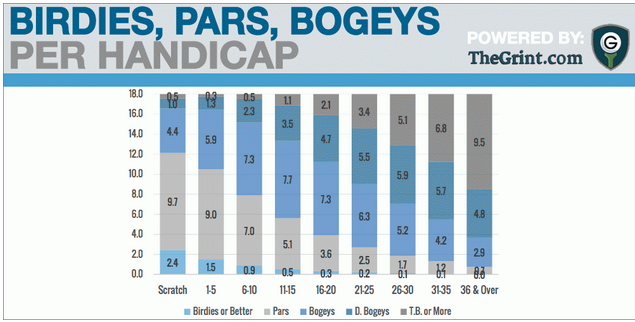
(3) Tracking “Double Bogey or Worse” Data – This may seem odd but I have started tracking double bogey or worse versus focusing on Pars and Birdies. Don’t get me wrong I’m very excited when I have Pars and Birdies but again data shows that even scratch golfers do not make that many birdies in a round. In fact, the experts say the key to good golf is fewer “blowup” holes. So instead of looking at my post round review and being frustrated if I didn’t have a birdie; I now look at my scores and I’m excited if I achieve my 2025 goal of four or less double bogeys (or worse) in my round.

Chart with Bogey and Double Bogey by Handicap (source: Lou Stagner)

So I guess this year the best way to express my personal golf data tracking journey is the focus is really on avoiding blow up holes. I know it makes sense but it is really a different mind set for me. Now I’m really excited to get on a green with a chance at a par with a one-putt. I am very focused on avoiding a three-putt, and try to make sure I’m walking off the green feeling good about a bogey on a hole.

I’ll be very interested to see if at the end of the year, this new approach makes a difference in the numbers every golfer is measured by – handicap and/or average score.
2024 Goal Setting – Using Research to Set Statistical Goals

As I mentioned in my last post, 2023 in Review – My Golf Goals and Results, I decided to do some research before setting my goals this year.

I googled “most important stats for golfers to improve their game.” All the articles I read said to lower a handicap golfers should not focus on birdies but focus on reducing bogeys, double bogeys or blowup holes. And golf stat experts said to focus on greens in regulation. And, of course, be a great putter. You may be thinking the same thing I did – nothing I didn’t already know and that doesn’t really help with my expectations or set goals. However, what was useful was finding the charts that show various key stats by handicap.

You will see Arccos data mentioned in each area because many articles use them as a data resource. Basically, Arccos is the pioneer of golf data tracking and analysis; per their website collecting over “600 million shots taken during 13 million rounds played by Arccos members in 162 countries” since it’s founding in 2012.

Greens In Regulation (GIR) Data

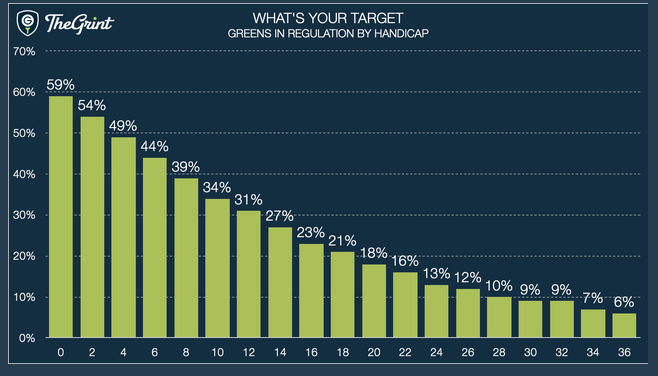
Lou Stagner, well known for his tweets on Arccos data really wants golfers to focus on “strokes gained” but for those that don’t want to get sensors for their clubs (or can’t afford them) he stated that GIR is the one traditional stat that is valuable because he said, “There is a very strong relationship between handicap and GIR%.” And Stagner has a great newsletter article with stats on different handicaps and GIR from various distances; and from the fairway versus rough. His charts have incredible detail and frankly more data than I need for my goals; also are too large to share in screenshots for this blog post.

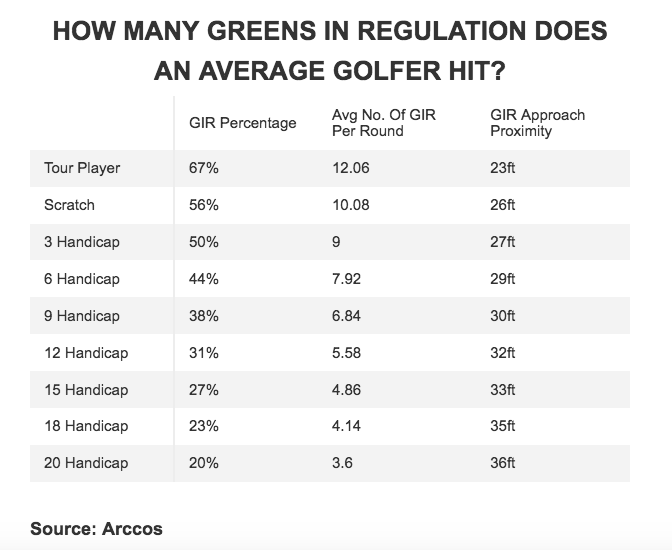
A Golf Digest article dated 12/23/2023 has an interesting chart (see below) which also includes GIR Poximity. The screenshot below of Arccos data was in the article. I found another source “TheGrint” which is a social media and golf scoring app (second image) and the numbers are a bit different (they do not have as large a database as Arccos) but I thought it was good to see two sources.

This is the first time I found a chart that has GIR %, avg. # GIR per round, and GIR approach proximity all in one view. So for example, a 15 handicap when they get on the green in regulation they (on average) are 33 feet from the hole for their birdie putt.

Source: Golf Digest Article with Arccos Data

Putting and Three-Putt Avoidance

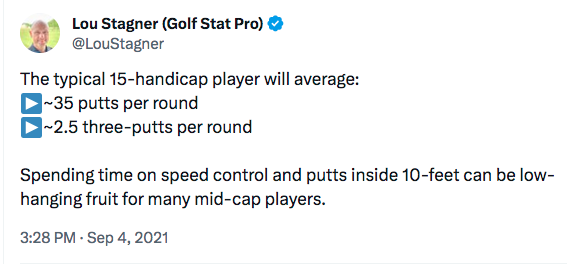
There’s no shortage of online content regarding putting. In 2021, Lou Stagner tweeted a 15 handicap will average 35 putts, (see below) which was a surprise to me because that was my 2023 average and I felt my putting really sucked.

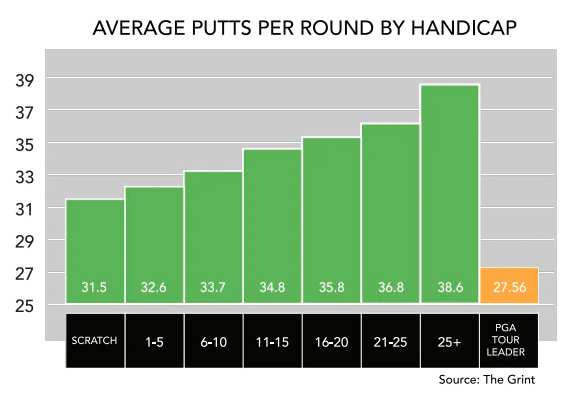
Another data chart from The Grint shows 33 putts a round as the average for a 10 handicap.

Another app for golfers that shares data is SwingU. They shared an interesting chart (below) in an October 2023 article, “Understanding Stats: Key Putting Stats by Handicap.”

Source: SwingU data on Putting

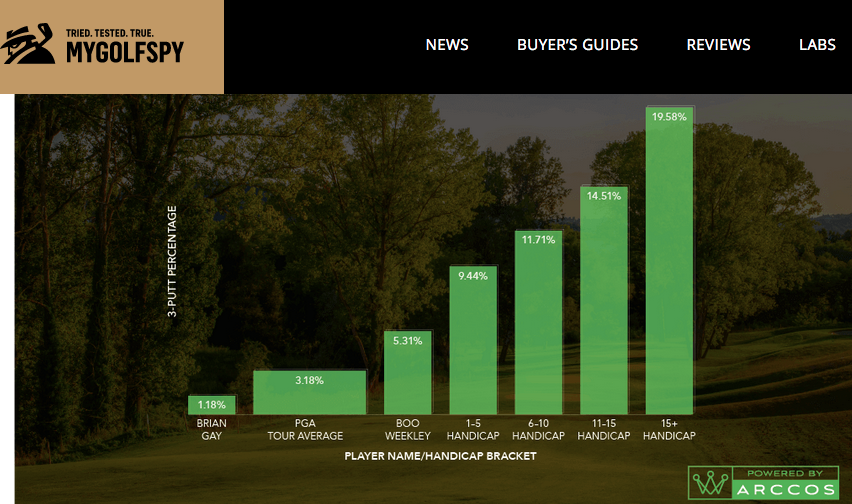
A new term I learned was “Three-Putt Avoidance” which is the PGA Tour putting statistic. It’s a percentage; so count the number of holes that you have played, work out the number of times you three-putted, and then determine the percentage. I found a 2017 My GolfSpy article with Arccos data for three-putt avoidance ( or percentage) percentages. Screenshot below:

Source: My Golf Spy (Article from 2017)

Of course, you also need to consider distance from hole and common sense will tell us that the farther way the more likely a golfer will three-putt. I’m not sure three-putt avoidance is really how I want to track my putting but it was interesting.

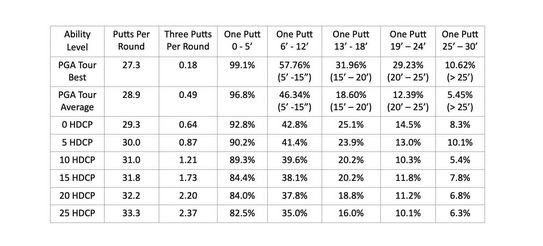
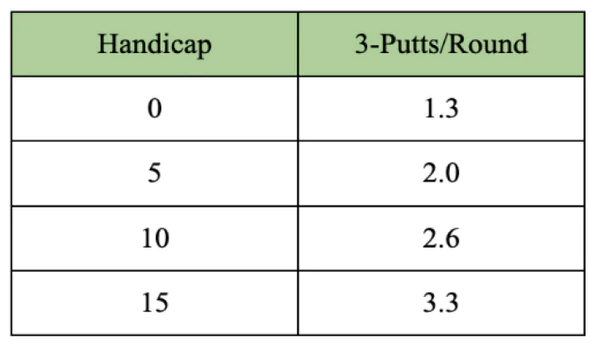
Another diagram (below) from Golf.com article June 2023 shows 3-putts per round which to me is easier to translate to your game. I noticed that that Log Stagner’s tweet in 2021 had a 15 handicap at 2.5 three-putts per round vs 3.3 in the 2023 Arccos chart below. So I guess 15 handicaps using Arccos are either different golfers from 2021 data or perhaps the database in 2023 is so large that the data is actually more representative of the larger golf population.

Source: Arccos Golf Data, June 2023

Scrambling (Up & Down)

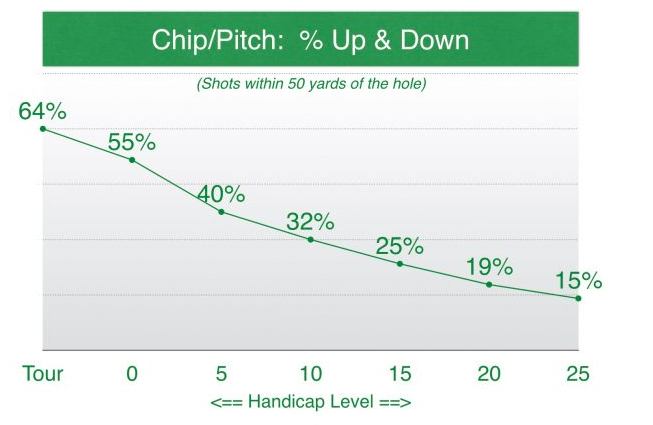
I really could not find any useful data on scrambling. There was an article from SwingU with Up and Down data (from 50 yards) but my GHIN app doesn’t really get that specific. Here is the chart direct from the original 2018 data.

Score specific Data

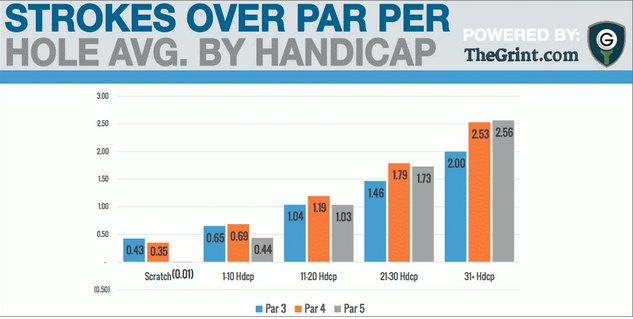
I found articles that talked about the importance of reducing big numbers and strokes over par but I could not find 2023 data. I did find some interesting charts. The photo gallery below has data from two different MyGolfSpy Articles (one with TheGrint.com data from 2014 and one with ShotScope data from 2020 . I wanted to capture these charts (even thought they are a few years old) because the GHIN app captures birdies, pars, bogeys; and average score to par stat.

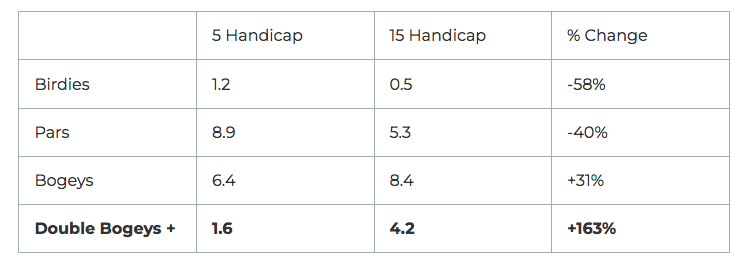
I also found another Arccos article from Oct 2023 titled, “Stats That Prove You’re Not That Bad At Golf” which compares a 5 Handicap to a 15 Handicap (chart below). The article also has an embedded Golf Monthly Youtube Video that is fun to watch. What surprised me is a 15 handicap only makes a birdie once every two rounds based on this data.

Source: Arccos Blog Article chart

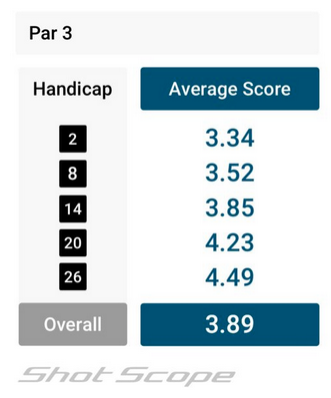
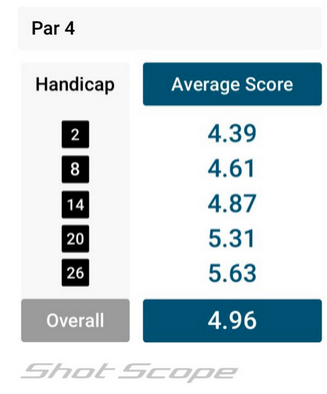
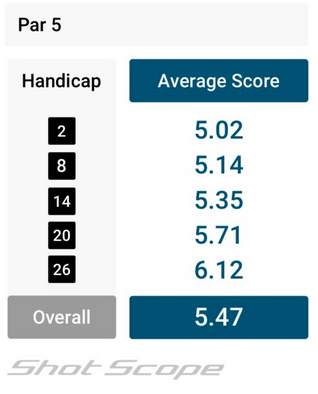
Again, Lou Stagner has a newsletter focused on “Performance by Hole Handicap” and for perspective he stated that “For scratch players, par 3s have a much higher scoring average (in relation to par) than par 5s….As handicap increases, this starts to shift, and eventually par 5s have a higher scoring average (in relation to par) than par 3s.”

My 2024 Goals

Overall Goal: I mentioned in my 2023 year-end review that my “big picture goal” for 2024 is to score more in the 80s (get myself off the 91 average score).

Goal #1 Greens In Regulation: Target average of 4.86 (15 Handicap stat) which is a good challenge given my 3.78 avg (21%) from last year. At a minimum I want to maintain my 2023 stat.

Goal #2 Putting: Targets are 33 putts or less per round and two or fewer three-putts per round. These were my targets last year. Based on the data above these are definitely stretch goals since these translate to a 10 handicap golfer. Always good to have “stretch goals.”

Goal #3 Scrambling: My “Up & Down” was 1.9 per round and as I mentioned about the data above is for 50 yards in and my stat from GHIN is not that specific. So if covert my 1.9 to a percentage (to relate to the chart above) then if I averaged four GIR in a round that would mean I would have 14 holes that provide an opportunity to up and down. So 1.9 of 14 is 13.57%.

I could use the chart above that shows a 15 handicap gets Up & Down from 50 yards 25% of the time. So again, if I only hit the green four times in a round, 25% of 14 greens missed would be 3.5 Up & Down goal for that round. As much as I want to improve my 2023 Up & Down stat I’m not sure is 25% is a the correct goal; but I’ll go with it. Of course, hopefully, I’ll hit more GIRs than four each round reducing the need to get up & down.

In some ways, I think I’m more interested in how close I get to the hole from a chip shot since proximity has a big impact on putting.

Goal #4 Fewer Blowup Holes: I was listening to a Mark Immelman podcast and he told a fascinating story about Jason Day. When Jason Day was the number one player in the world he “had a goal to average three on par 3s” and “for the season he averaged 3.01.” So a pro on tour had a goal to par all the par threes. I would have expected a very different goal. Fascinating!

I did see a nice reduction in double bogeys in 2023 (from 26% to 22%); and looking at the Arccos data feel pretty good about my number; but clearly I really want to continue reducing double bogeys or higher on the scorecard in a round. And of course, fewer blow up holes will hopefully lead to more pars!

Mental Game Goals

As I mentioned in my 2023 review there were a few months last year when I was definitely a head case chipping and putting. I worked on technique in September before my Pinehurst trip which helped give me a bit more confidence.

Last year I did listen to a golf podcast by Kathy Hart Wood, Above Par which was a big help in dealing with slow play or nerves in competition but since I love to learn, it’s time to see what other metal game process might be right for me. Of course, I will still listen to her podcast!

So my mental game goal is to find a “mental game process” (and there are plenty of books and videos on the mental game) and implement some of the tools suggested. Hopefully, I will find a process that also provides a way to track progress with the mental game. Of course, I’m sure I will blog about this once I decide on my plan.

I know one thing for sure, I’m not going to worry about goals when I play. These are strictly for after round evaluation so I can target my practice each week.

Favorite Golf Podcasts

Yes, I am a golf junkie and besides playing golf, watching golf on TV (and recently YouTube) and reading golf articles; I also listen to Golf Podcasts.

My favorites right now are (in no particular order):

  1. Above Par (Kathy Hart Wood) – focused on the mental game. Tip: Start listening with episode one.
  2. Tee Time (Tori Totlis) – the content is tailored for women golfers but many topics are good for all golfers.
  3. Hack It Out Golf (Saturday Morning Stat) – Focused on helping golfers get better. Saturday Morning Stat episodes with a focus on one stat from Lou Stagner (Arccos) is my favorite.
  4. College Golf Talk – from Golf Channel with Steve Burkowski (my favorite college expert on Golf Channel).

A bit more about each Podcast

Above Par: Kathy Hart Wood is a certified life coach and a top 50 LPGA Golf Teacher (2017-2022); and she has played golf most of her life. Her website gives you access to her coaching program but you get so much free advice from her podcast, Above Par which you can access from her website or your favorite podcast app.

Kathy talks fast and her podcasts are 15 to 20 mins long. She gives useful tips, tools, strategies. For example, I used to feel bad for friends getting upset when they were playing bad. In her podcast “How to Deal with Negative Golfers” Kathy explains its not your responsibility to make them feel better and it will only hurt your game by wasting your energy on trying to change them. And if that person is your partner, she gives a strategy to say at the beginning of the round “Let’s agree not to be negative. Let’s agree not to apologize for missed shots there’s no upside to it and we are all going to have our share of missed shots.”

Tee Time: The podcast is hosted by Tori Totlis an Arizona golfer who created a program (website) called Complete Confidence Golf and has a passion for helping women get into and enjoy the game of golf. The blog page of her website has links to all her podcasts (or you can search for Tee Time on whatever app you use to listen to your favorite podcasts).

Tee Time podcasts run about an hour because Tori goes in-depth on the topic she is discussing. Tori has had Lou Stagner and other experts on her podcast. I also enjoy when she has other golfers on the show; particularly golfers that have played in USGA Amateur events.

Hack It Out Golf – This podcast has three guys talking about how to improve your game. I like the episodes that are released on Saturday called “Saturday Morning Stat” and are about 10-15 mins. long with Lou Stagner from Arccos focusing on a single golf stat. Lou Stagner has a newsletter and you can signup at his website. He is also very active on Twitter or you can search for Hack It Out Golf on your favorite podcast app.

I plan to write a blog post about Golf Stats because learning stats from Lou Stanger has helped me put my game in perspective!

Here is one interesting statistic from Lou Stagner – Tiger Woods only made 80% of greens from a 110 yards out. Or he missed the green 20% of the time from 110 yards. The stats he shares are all about setting expectations for amateur golfers. If Tiger only hits greens 80% then why do we, as amateurs, get upset when we miss a green.

College Golf Talk – If you enjoy watching college golf on Golf Channel then you may enjoy this podcast hosted by Steve Burkowski and Brentley Romine from the Golf Channel. Full disclosure I do not listen to this podcast every week (like I do my other favorites) but I’ll listen before big events like the NCAAs or The Augusta Women’s Amateur.

I’ve been following college golf for a few years and love the fact that you can watch a college golfer and then see them transition to the professional ranks. In 2018, I remember watching the NCAA Division 1 golf on Golf Channel and Jennifer Kupcho won the individual title. In 2019, I cheered for Jennifer Kupcho to win the first Augusta National Women’s Amateur; which she won. Then I became vested in watching her on the LPGA and seeing Kupcho win her first LPGA Major (The Chevron, formally ANA, formally DIana Shore) in 2022 was exciting. Unfortunately as I’m writing this blog post, Kupcho (as the defending champion of the Chevron) missed the cut.

Do you have a favorite golf podcast? Let me now in the comments so I can check it out!