Your Handicap Index — the Score Differential is the Key Number

Have you ever played with a golfer that is perplexed by their handicap index? They may say something like, “I feel like my handicap doesn’t really reflect my scores or my game.” Your first thought might be that the golfer is delusional about their game. My first thought is that they do not understand how their handicap is calculated.

So for the player that doesn’t think their handicap reflects their scores, they need to understand two things:

(1) The handicap index is about potential. That is why it is based on the most recent eight “best scores” of all the scores you post. Lou Stagner (golf stat guru) has stated in podcasts that you will only shoot your handicap 20% of the time and your scoring average will be about 3 strokes over your handicap. However, you can shoot better than your handicap too; and Stagner has tweeted “If your handicap is legit, you should beat it about once every five rounds.”

(2) Scores are not all equal. What? That’s right the difficulty of the course and the tees you play, as well as playing conditions for that day are part of the equation for an important number called a “score differential.” And it is the score differential that is used to calculate your handicap Index. In other words, two scores of 90 will not necessarily have the same differential and therefore they will affect the handicap index differently.

In general, the goal of the handicap system is to determine which scores are the best scores, considering the course difficulty and that is why course rating and slope are so important in calculating the score differential and ultimately the golfer’s handicap index.

And, yes, I am going to get geeky now and give you a formula. Below is the score differential which takes the overall rating for a course (represented by two numbers: course rating and slope), adjusted gross score, and PCC (playing condition calculation) to determine a score differential for the score posted by the player that day.

Score Differential = (113 / Slope Rating) x (Adjusted Gross Score – Course Rating – PCC adjustment)

For Example: A golfer shoots a 90 on two courses (both from the forward tees). Course “Easy” has a rating of 65.2/107 and course “Hard” has a rating of 68.6/122.

Course “Easy” differential formula = (113/107)x(90-65.2) = 26.2

Course “Hard: differential formula = (113/122)x(90-68.2) = 18.9

(if you really want to geek out – See the “Additional Information” at the end of the blog for in-depth details on adjusted gross score and playing condition calculations used in the formula.)

The golfer’s handicap is an average of the 8 lowest “score differentials” from the last 20 scores posted. The two calculations above show how shooting a 90 is not the key number that makes your handicap index move up or down. The Differentials of 26.2 or 18.9 are what will increase or decrease your handicap index.

It should be noted that a slope of 113 (in the formula) is used as a “course standard of relative difficulty.” In golf, slope is basically a mathematical representation of how difficult a course is for a bogey golfer compared to a scratch golfer.

Golfers use the overall rating to interpret the difficulty of a course. Looking at a rating of 65.2/122 we would say the course is easier for a scratch golfer than it is for a bogey golfer. Here is how to break it down…

(1) The first number (65.2) is easy to interpret because it is based on strokes and is the rating created for scratch golfers. Therefore, a course rating of 65.2 indicates the course should be easy for a scratch golfer since 65.2 is below the course par of 72. In other words, a scratch golfer has the potential to score a 65 on the course for the tees they are playing.

(2) The second number is slope and is a mathematical representation (think a line on a graph) of how difficult the course is for a bogey golfer compared to a scratch golfer. The higher the number the harder the course. And, 113 is the mathematical average used to “represent” an “average” slope rating for an “average” course which means a rating below 113 is assumed to be “easier” than the “average” course and a rating above 113 is assumed to be “harder” than the “average” course.

Now that you know the course rating/slope has such an important role in calculating a handicap index, you may be wondering (1) how is an overall course rating determined and (2) how do we know the rating truly reflects the difficulty of the course.

There is a whole process for how golf courses get their ratings and the process has 26 evaluations made for each set of tees on each hole for a course — that’s a lot of data! State golf associations oversee the golf course rating process. Most courses are reviewed or re-rated every 10 years. If during the 10-year review gap the course has made major changes, it’s the owner’s responsibility to notify the state golf association and ask for a course review.

Are overall course ratings accurate or “fair”? That’s an interesting topic for another blog post because I guarantee almost every golfer has walked away from a course saying that the course played harder (or easier) than they expected based on the rating on the scorecard.

ADDITIONAL INFORMATION

If you choose to calculate your score differential, besides course rating/slope you will need two numbers (1) the adjusted gross score and (2) the playing condition calculation (PCC). The handicap system (GHIN) will provide the PCC. You have two options for the adjusted gross score. You can manually calculate the adjusted gross score or have the GHIN system provide the number (if you enter your score hole-by-hole). Below is more detail on each number:

(1) Adjusted Gross Score – From the USGA website, “A score for handicap purposes should not be overly influenced by one or two bad hole scores that are not reflective of a player’s demonstrated ability. In addition, incomplete scores and/or scores where a player did not hole out on every hole can provide reasonable evidence of the player’s ability and can be used for handicap purposes.”

If you enter your score in GHIN hole-by-hole the system will automatically adjust your score to the maximum hole score based on par for the hole and your course handicap for that hole; otherwise, you must do a manual calculation, using the “Net Double Bogey” formula, to reduce your score before entering your total gross score into GHIN.

Also, if you don’t complete holes but want to enter a score in GHIN you need to figure out a hole score for each hole you don’t complete or play; and what you enter depends on the status of the hole:

Scenario I. If you started a hole but did not hole out (or complete it) then you enter a “most likely score.” For that hole you take: (a) number of strokes already taken plus (b) any penalty strokes already incurred plus (c) number of strokes most likely to complete the hole.

Scenario II. If you have holes you did not play at all (say due to darkness you only played 7 of 9 holes) then you add an “adjusted score” (basically the par plus any handicap strokes for the hole).

(2) Playing Condition Calculation: The PCC is based on all the scores entered for the day for a course and if the scores are unusually high (or low) the worldwide handicap system will make an adjustment (you will see a PPC number on the impacted score on your GHIN stats page). The score differential for that round will have been calculated with the PPC number included in the formula.

The assumption is that there is a reason (e.g., weather, course setup) causing scores to be higher or lower than normal for the course that day. The PCC range is -1 to +3. A negative (-) adjustment means the course played easier than expected and a positive (+) adjustment means the course played more difficult than expected.

The GHIN system updates your handicap at midnight the day after you post (versus the old method of updating handicaps on the 15th of the month); and that is why the USGA and R&A want golfers to enter their scores on the day they play; otherwise, the GHIN software won’t reflect a PCC accurately.

Favorite Golf Podcasts

Yes, I am a golf junkie and besides playing golf, watching golf on TV (and recently YouTube) and reading golf articles; I also listen to Golf Podcasts.

My favorites right now are (in no particular order):

  1. Above Par (Kathy Hart Wood) – focused on the mental game. Tip: Start listening with episode one.
  2. Tee Time (Tori Totlis) – the content is tailored for women golfers but many topics are good for all golfers.
  3. Hack It Out Golf (Saturday Morning Stat) – Focused on helping golfers get better. Saturday Morning Stat episodes with a focus on one stat from Lou Stagner (Arccos) is my favorite.
  4. College Golf Talk – from Golf Channel with Steve Burkowski (my favorite college expert on Golf Channel).

A bit more about each Podcast

Above Par: Kathy Hart Wood is a certified life coach and a top 50 LPGA Golf Teacher (2017-2022); and she has played golf most of her life. Her website gives you access to her coaching program but you get so much free advice from her podcast, Above Par which you can access from her website or your favorite podcast app.

Kathy talks fast and her podcasts are 15 to 20 mins long. She gives useful tips, tools, strategies. For example, I used to feel bad for friends getting upset when they were playing bad. In her podcast “How to Deal with Negative Golfers” Kathy explains its not your responsibility to make them feel better and it will only hurt your game by wasting your energy on trying to change them. And if that person is your partner, she gives a strategy to say at the beginning of the round “Let’s agree not to be negative. Let’s agree not to apologize for missed shots there’s no upside to it and we are all going to have our share of missed shots.”

Tee Time: The podcast is hosted by Tori Totlis an Arizona golfer who created a program (website) called Complete Confidence Golf and has a passion for helping women get into and enjoy the game of golf. The blog page of her website has links to all her podcasts (or you can search for Tee Time on whatever app you use to listen to your favorite podcasts).

Tee Time podcasts run about an hour because Tori goes in-depth on the topic she is discussing. Tori has had Lou Stagner and other experts on her podcast. I also enjoy when she has other golfers on the show; particularly golfers that have played in USGA Amateur events.

Hack It Out Golf – This podcast has three guys talking about how to improve your game. I like the episodes that are released on Saturday called “Saturday Morning Stat” and are about 10-15 mins. long with Lou Stagner from Arccos focusing on a single golf stat. Lou Stagner has a newsletter and you can signup at his website. He is also very active on Twitter or you can search for Hack It Out Golf on your favorite podcast app.

I plan to write a blog post about Golf Stats because learning stats from Lou Stanger has helped me put my game in perspective!

Here is one interesting statistic from Lou Stagner – Tiger Woods only made 80% of greens from a 110 yards out. Or he missed the green 20% of the time from 110 yards. The stats he shares are all about setting expectations for amateur golfers. If Tiger only hits greens 80% then why do we, as amateurs, get upset when we miss a green.

College Golf Talk – If you enjoy watching college golf on Golf Channel then you may enjoy this podcast hosted by Steve Burkowski and Brentley Romine from the Golf Channel. Full disclosure I do not listen to this podcast every week (like I do my other favorites) but I’ll listen before big events like the NCAAs or The Augusta Women’s Amateur.

I’ve been following college golf for a few years and love the fact that you can watch a college golfer and then see them transition to the professional ranks. In 2018, I remember watching the NCAA Division 1 golf on Golf Channel and Jennifer Kupcho won the individual title. In 2019, I cheered for Jennifer Kupcho to win the first Augusta National Women’s Amateur; which she won. Then I became vested in watching her on the LPGA and seeing Kupcho win her first LPGA Major (The Chevron, formally ANA, formally DIana Shore) in 2022 was exciting. Unfortunately as I’m writing this blog post, Kupcho (as the defending champion of the Chevron) missed the cut.

Do you have a favorite golf podcast? Let me now in the comments so I can check it out!

Results for LIV players at The Masters

First, congratulations to the 2023 Masters winner, John Rahm with a 12 under, final score of 276! First place prize money is $3.24 million but the green jacket is priceless.

I have not watched any LIV golf but like any golf junkie, I have seen all the social media chatter and I was curious if the assumptions about LIV golfers “letting their games go” by playing the limited 54-hole event tour might be true. So let’s look at the results.

I mentioned in my previous post, 18 LIV golfers qualified for The Masters. After two rounds. 12 made the cut, 4 missed the cut, and two withdrew from the championship. Or to put it another way – 67% of the LIV players in the championship made it to the weekend. I think anything over 50% should be viewed as a respectable outcome and probably much higher than many “golf analysts” would have predicted.

The four LIV players that missed the cut were: Sergio Garcia, Bubba Watson, Bryson DeChambeau, and Jason Kokrak. To be honest this does not surprise me. The only one that surprised me was Bryson. I thought his game was in better shape. The two LIV players that withdrew were Kevin Na and Louis Oosthuizen.

Brooks Koepka was leading after the cut and the third round. The final pairing was Brooks Koepka and John Rahm. Master’s history reveals in the last 25 years, 21 winners have come from the last group. Another golf statistic, prior to this Masters, Koepka had won every major championship in which he lead going into the final round. However, Koepka lost his 2 shot lead quickly and John Rahm never looked back while Koepka lost all momentum.

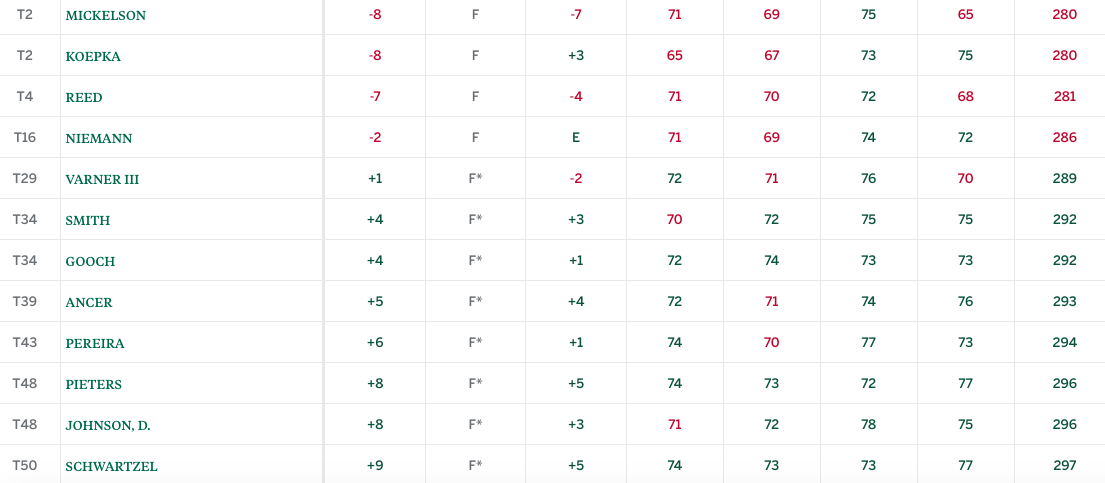
Biggest surprise of the Masters was Phi Mickelson shoots 65 in the final round and is the club house leader (as Rahm and Koepka start the back nine) with a final total score of 280. Phil’s round is the lowest round for a player over the age of 50 at the Masters.

Phil Mickelson and Brooks Koepka tied for 2nd place with each earning $1.594 million.

Here is the final scores and finishes for the 12 LIV players that made the cut:

LIV Golfers Playing in the 2023 Masters

It’s Masters week and always an exciting week for all golf fans! The media will focus on the usual topics; what is being served at the Champions dinner, changes to the course, who will win. This year, I am positive another focus will be on the LIV players; how are they treated (by other players, in the media room, and by fans), and what are the odds a LIV player could win the championship.

So it made me wonder which LIV players were invited. Looking at the official list of invitees on the Masters website it turns out 18 LIV players were sent invitations. The players qualified to play because of various reasons. Below are the players grouped by how they qualified for the 2023 Masters. Note: Some of the players fit more than one qualifying category so I list them under the more impressive category to me (e.g., Past Winners vs Top 50 player in the Official World Golf Ranking).

Past Masters Winners

  1. Sergio Garcia (won 2017)
  2. Dustin Johnson (won 2020)
  3. Patrick Reed (won 2018)
  4. Charles Schwartzel (won 2011)
  5. Phil Mickelson (Won 2004, 2006, 2010)
  6. Bubba Watson (Won 2012, 2014)

2022 Winner of The Open and Players Championship

  1. Cameron Smith

Won The U.S. Open or PGA Championship within the last 5 years

  1. Bryson DeChambeau
  2. Brooks Koepka

Qualified for 2022 Season Ending Tour Championship & in top 50 OWGR

  1. Joaquin Niemann
  2. Taylor Gooch

2022 PGA Championship – Top 4

  1. Mito Pereira

Ranked in the top 50 of OWGR for previous calendar year

  1. Abraham Ancer
  2. Jason Kokrak
  3. Kevin Na
  4. Louis Oosthuizen
  5. Thomas Pieters
  6. Harold Varner III

I believe once the championship begins play on Thursday that the chatter about LIV will fade away unless a LIV player is actually in contention.

Time to Review the Rules of Golf

How confident are you in the Rules of Golf? I am not an expert in the Rules of Golf so I make sure I review the most common rules at the start of each golf season to get my “golf brain” ready for golf league season.

I also want to know the rules that can help me! Plus, I don’t want a penalty because I didn’t know the governing bodies (USGA and R&A) changed a rule. For example, did you know the governing bodies announced five rules changes in 2023. The two changes that caught my eye are the “ball moved by natural forces” and the “back-on-the line” relief change.

Ball Moved by Natural Forces (or the Rick Fowler Rule)

A new exception provides that a ball at rest must be replaced if natural forces moves it to another area of the course or comes to rest out of bounds after being dropped, placed or replaced. Some call this the “Rick Flower Rule” because of what happened to him at the 2019 Waste Management. This exception is to protect the player from getting unfair penalties. Ricky had a five shot lead before the debacle on the 11th hole when Ricky had multiple penalties because a “natural force” (wind, water, gravity) kept moving his ball from the general area back into the penalty area. Here is the video of the event.

This 2023 change is an “exception” and doesn’t change the rule that if your ball is in the general area and moved by natural forces that there is no penalty and you play from the new spot. For example, you hit your ball in the fairway, a gust of wind moves your ball while you are deciding what club to hit, you now must hit from the new spot (no penalty). The other exception to ball moved by natural forces deals with the putting green (see Rule 9.3 Exception 1) which basically states that if you marked it, you own that spot and you replace the ball but remember, if it is not marked and it moves (even if it is off the green) you play from where it ends up.

It’s really important to know what to do when your ball moves (especially in the general area) because if you play from the wrong spot it is a 2-stroke penalty. Here is a good video from GUR LLC Golf on various situations when your ball moves in the general area (note: it does not include the new rule).

Back-on-the-line Relief Change

You must drop on the line now and the ball can roll within one-club length in any direction (basically, think of the relief area as a one club-length circle around the ball). What makes this interesting is that the ball could roll forward and come to rest closer to the hole; which is usually not allowed when taking relief. At first I thought this was so odd since, as golfers, it is drilled into us that the ball cannot be “closer to the hole” when taking relief. As I thought about the logic for this new rule, I rationalized it as follows – because the drop is “on a line” a golfer could have chosen to drop closer on the line so it’s not an advantage to have it roll closer to the hole. I have no idea if this is the reasoning but it was how I came to terms with the new rule.

I saw a video by GIR Golf LLC explains the difference between the new rule requiring you drop on the line versus the old procedure which let you drop within one club-length of the line. The old drop process gave you a bit more “wiggle room” to try and create a better out come. For example, you could perhaps have a better line to the green by being allowed to drop one club length to the left of the line. That’s not an option now. The ball must be dropped on the line.

Also, most golfers know if the ball rolls outside the penalty area, you re-drop the ball. With this new rule you must re-drop on the line but you don’t have to drop on the exact same spot on the line as the first drop, you can drop on a different location on the line (see definition of relief area for more detail).

Other Rules I Find Useful to Know

I am also always amused each year how many golfers I play with don’t use rules to their advantage. Sometimes they don’t know about the rule and most often times they use the rules incorrectly. Here are a few that come to mind…

Embedded Ball (Rule 16.3)

Basically, if your ball is embedded in its own pitch mark in the general area you can take free relief. To be “embedded” part of the ball must be below the level of the ground. If the ball is embedded you can remove the ball from the pitch mark, relief reference point is directly behind where the ball was embedded, determine relief area (one club-length, in general area, no nearer the hole) and drop the ball.

It can be very wet in Greenville so it always surprises me when I play with a golfer that doesn’t know this rule. They also don’t seem to know how to take relief, or know that they can clean their ball, and don’t know they can also substitute the ball.

Cleaning (Rule 14.1.c) or Substituting a Ball

Everyone knows you can clean your ball when you mark and lift it on the putting green but a lot of times I’ll be in a group and someone will ask, as they pick up their ball, “can I clean my ball?” One way to think about it is that you always can clean or substitute your ball when you are taking relief (free relief or for a penalty).

The surefire way to know when you can clean your ball is to know the four exceptions (or when you cannot clean your ball). You cannot clean your ball when:

  1. You are trying to Identify the ball – the exception here is you can clean it just enough to identify your ball.
  2. You are asked to mark your ball because it interferes with play of another golfer.
  3. You want to determine if your ball is damage (e.g., cracked or cut is the only time a ball is “damaged”).
  4. You want to see if your ball lies in a condition that allows relief. For example, to determine if a ball is embedded. If you determine you do get relief then you can clean your ball (but don’t clean it before you make the determination).

You can always substitute a ball when you are between holes but when else can you substitute a ball? It is tricky to find in the rules but the key is to look for the words “or another ball.” For example, if you read Rule 6.3 (ball used in play of hole), the language for taking relief reads “the player may use either the original ball or another ball (Rule 14.3a).

It is important to know that you cannot just decide to substitute a ball during the play of the hole. If your ball gets scuffed from hitting the cart path or you get a mud ball on a wet course that’s just bad luck. You must play the hole with that ball. You can put a new ball in play on your next hole.

What is a damaged ball? I play with many golfers that think a scuffed ball is a “damaged ball” – it is not. Per the Rules of Golf only a cut or crack in a ball qualifies as a damaged ball (Rule 4.2.c).

Restoring a “Worsened Condition” Rule 8.1.d

Rule 8 is “Course played as it is found.” Golfers all know they are to play the course as they find it but there is a clause that a lot of golfers don’t know. This clause is fascinating to me and you may never need it but it’s good to know (especially around the green). Rule 8.1.d addresses the situation when the course is not in the same condition as you found it. Specially, Rule 8.1.d says that if the course condition is worsened by another player (or animal, artificial object) after your ball comes to rest you can restore the “worsened condition.”

The most common example given is that your ball is at rest close to the green (but not on it) and another player hits their ball in front of your ball which makes a pitch mark right in front of your ball. So, the condition of the course was made worse in front of your ball and you can now restore the area back to it’s original condition (i.e. repair that pitch mark). However, if the pitch mark was already there when your ball came to rest that’s just bad luck.

Another example is if your ball is near a bunker and a player hits out of the bunker and sand lands on (or in front of) your ball. Assuming the sand was not on your ball when it came to rest, you can clean your ball and brush the sand off the ground in front of your ball.

You also can mark and clean your ball when you restore a worsened condition; and if you can’t restore the area, you get a one club-length relief area.

Abnormal Course Condition “Relief Area”

It drives me crazy when someone tells me I must take relief in the “same condition” when taking relief from an abnormal course condition. The clarification of the rule states “There is nothing in Rule 16.1 that requires them to maintain the identical condition.” You can read the full explanation in the clarifications for Rule 16.1. but basically your ball must stay in the same “area of the course” and there are five areas of the course: teeing area, putting area, penalty area, bunkers, and general area – so there is no distinction between rough and fairway in this instance because they are in the same general area. That’s why when you take free relief in a bunker for temporary water, or a dangerous animal you must drop in the bunker because you must be in the same “area” (not condition). If you take relief in a different “area” it comes with a penalty.

There are options that allow you to take relief in a different “area of the course” (remember there are five areas of the course) but you don’t get free relief. For example, using the bunker, let’s say you take free lateral relief (2-club lengths) in the bunker from a fire ant hill (dangerous animal condition, Rule 16.2) but you still don’t feel comfortable in the bunker with the ants. You want out of the bunker so your next option is basically to take “stroke and distance” relief with a one-stroke penalty to get out of the bunker or take a 2-stroke penalty (back-on-the-line) outside the bunker. There are four options for taking an unplayable ball in the bunker (see rule 19.3b which has a diagram of the options).

There’s a good video from GIR golf on YouTube that walks through various dangerous animal situations including when your ball lands in a penalty area and there is an alligator (watch at around 8 mins). Basically, if you determine you would play the ball as it lies in the penalty area (if the gator was not there) you can take free relief in another part of the penalty area (if you think it is safe); otherwise, you can take relief outside the penalty area for a one-stroke penalty (using one of the various options of the penalty relief procedure).

One Club Length Versus Two-Club Lengths When Taking Relief

“How many club lengths do I take?” There are only two instances when 2-club lengths are used to determine a drop area. They are unplayable ball and lateral relief. A bit more about each:

  1. Unplayable ball – A player can declare the ball unplayable any where on the course except penalty areas. The USGA has a good diagram for unplayable options in the general area in Rule 19.2 Some golfers I have played with do not realize you can declare you ball unplayable in a bunker which gives you four options . For example, did you know you can take stroke and distance for one penalty stroke? The USGA has a good unplayable ball video on YouTube and there is a good review from the USGA FAQ section.
  2. Lateral Relief – The red penalty relief procedure allows you to take 2-club lengths to determine the drop area. As a review, the penalty areas have the following relief options:
    • Yellow and Red: play the ball as it lies which has no penalty
    • Yellow and Red: stroke and distance for one penalty stroke
    • Yellow and Red: back-on-the-line for one penalty stroke
    • Red only: Lateral relief – 2-club lengths from where the ball last crossed the penalty area. One penalty stroke.

Relief from a Cart Path

We would all love to take relief from the side of the cart path that gives us the best shot but that isn’t how the rules works. It’s another procedure many golfers get wrong because they don’t take the nearest point of complete relief. The USGA video is a good refresher. And, You must also stay in the same “area” of the course so what happens when the relief area you think is correct is not in the same area. Jay Roberts has a great Cart Path Relief video with this situation (and Jay demonstrates it could be to your advantage). Jay Roberts also has a great video titled “4 Mistakes when Taking Free Relief from a Cart Path.” For example, don’t take your ball off the cart path until you make a decision on what you want to do!

Final Thoughts

You may have read this post and thought to yourself that you know all these rules so no need for a review. If yes, that’s great! I always seem to feel the need to review even simple rules at the start of golf season.

If you are looking for sources of rules reviews (other than the USGA and R&A), I usually learn about interesting Rules situations from following some of my favorite Rules guys on Instagram or YouTube. They include: Jay Roberts Golf, GolfRules Question, and GIR LLC Golf, Jay Roberts is really good at making rules simple and he is so good that the USGA recently hired him.

As I said I am not an expert, but I try to do my best. When playing with friends for fun I really don’t care how closely anyone follow the rules. In league or in competition, it gives me peace of mind to know rules so that I don’t get overly stressed when I find myself in a sticky situation on the course.

Happy golfing in 2023 and may the golf rules be kind to you!

Women of the Golf Channel (2023 Edition)

In 2012 I created a post titled Women of Golf Channel and it was my most popular post. The information became outdated so I did a Women of Golf Channel (2018 Edition). It’s time for another update.

In 2020, Golf Channel announced they were moving from Orlando, Florida to NBC Sports headquarters in Stamford, Connecticut which had a huge impact on their employees. A lot of familiar faces on the Golf Channel were gone including; Chantel McCabe (now with ESPN), Lisa Corwell (was very vocal about discrimination at Golf Channel and has a book coming out May 2023 called TroubleMaker), Bailey Mosier (TV personality and married to Brandel Chamblee so occasionally appears on Golf Channel), and Lauren Thompson (works for NBC sports NEXT – the technology division that includes GolfPass).

You would think that Golf Channel would list it’s TV personalities in the about section of their website but that would be to easy. If you want to find them go to NBC Sportsgroup Press Box for a list.

Here are the current women of the Golf Channel

Anna Jackson (formally Whiteley) – joined in 2019 as a co-host of Morning Drive (replacing Cara Banks-Robinson who was promoted to Golf Central. She came from England. Morning Drive was cancelled when Golf Channel moved to Connecticut but Anna remained and now co-hosts shows like Golf Central and Golf Today.

Cara Robinson – joined in 2015 as a co-host to Morning Drive (replacing Holly Saunders). In my opinion, she has become the “Kelly Tilghman” of Golf Channel and does the “Live from” broadcasts from all the important championships.

Paige Mackenzie – joined full-time in 2015 but has been doing on-air appearances since 2012. Her title on her bio page is “Analyst, LPGA Tour” but her role is much bigger with appearances on Golf Today as the analyst discussing PGA tour betting odds, analyst at PGA Tour Waste Management and LPGA tour events.

Morgan Pressel – joined in 2021 and officially took over Judy Rankin’s roll in the booth for LPGA tournaments when Rankin retired in 2022. Her first work was as an on-course analyst for LPGA events while she was still actively playing on the LPGA. Her first on-air TV work was at the 2015 USGA US Women’s Open.

Karen Stupples – joined in 2013 and is an on-air course reporter for the LPGA. She has occasionally been in the booth and I thought she may get to replace Judy Rankin but Pressel won the job. As a side note, she and her partner, Jerry Foltz (former LPGA on-course reporter) are a couple that became “social media” popular during the pandemic because of their amusing twitter feeds. Foltz has left the Golf Channel to join LIV as a golf analyst.

Kay Cockerill – joined in 1995 (since the start of Golf Channel). Her role now is mostly as an on-course reporter for LPGA events. She also does some women’s college events and NCAA golf championships that air on Golf Channel.

Kira Dixon – joined Golf Channel PGA tour coverage in 2021. Prior to her role interviewing players on-air, she was on the digital platform Golf Pass as a lifestyle reporter. She also did digital work for the USGA.

Amy Rogers – She fills-in for Anna Jackson on Golf Central and also is seen on LPGA coverage doing interviews. Amy is listed as a “contributor” on her Golf Channel profile. She is also listed as a contribution on the LPGA Network.

Henni Koyack – Not sure if she is an NBC employee but in 2023 she joined the Golf Channel Podcast “Beyond the Fairway.” Occasionally she appears on PGA Tour coverage on NBC/Golf Channel doing player interviews or special content segments. She also worked for the PGA Tour GolfTV and is most recognized for her exclusive interviews with Tiger Woods. She is from England and a former LET golfer.

Blair O’Neal – I don’t know if she is an employee of Golf Channel but she is the co-host of School of Golf so most people associate her with the Golf Channel. In 2010, she won the Big Break which was a wildly popular Golf Channel show.

As a side note, some people think that Dottie Pepper and Amanda Balionis-Renner work for the Golf Channel but they do not. Both women work for CBS Sports. They get to work The Masters and the AT&T Pebble Beach Pro-AM so if I had my choice of jobs of all the women highlighted in this post, I’d want Pepper or Renner’s job.

YouTube Golf – it’s a thing!

Do you know about the YouTube golf “community” comprised of channels where average Joe golfers publish videos of their on course adventures. There are a lot of average Joe YouTube channels with small subscriber numbers but then there are some of these “average Joe” YouTube golfers that make a living as “content developers” and are considered big “influencers” in golf. They are a self-described “community” because many do cross-channel content and there are even YouTube channels that just talk about what is going on in the YouTube golf space.

I pretty much stumbled across this whole YouTube golf thing. One day I went on YouTube to see if I could find a course review. I did not find a review but I did find a video of a guy playing the course I would be playing. His YouTube channel is Perfectly Average Golf. I found Alan, the golfer, to have a pleasant personality but I was really watching to see the layout of the golf course, not because I wanted to see him critique his game. After viewing that channel I started to get YouTube recommendations for other golf channels and it was crazy how many golfer “vlogs” exist on YouTube and now I have been watching a number of them and it is incredible how many channels have huge followers; and therefore they are making a living as YouTube Golfers.

Here are some of the most popular YouTube golfer channels. The information is from their “about section” on their channels on March 5, 2023.

  1. Rick Shiels Golf, 2.47 million subscribers, 650,669,633 views, joined YouTube in October 2011
  2. Good Good Golf, 1.14 million subscribers, 234,972,505 views, joined YouTube in July 2020
  3. GM Golf, 857,000 subscribers, 191,815,453 views, joined YouTube in April 2013
  4. Peter Finch Golf, 529,000 subscribers, 139,815,453 views, joined YouTube in October 2011
  5. Micah Morris Golf, 419,000 subscribers, 42,135,491 views, joined YouTube in October 2018
  6. Bob Does Sports, 390,000 subscribers, 47,603,737 views, joined YouTube September 2021
  7. Grant Horvat Golf, 345,000 subscribers, 28,328,887 views, joined YouTube April 2014
  8. Fore Play Golf, 297,000 subscribers, 94,279,403 views, joined YouTube January 2019
  9. Bryan Bros Golf, 198,000 subscribers, 24,611,743 views, joined YouTube March 2014
  10. Zac Radford, 122,000 subscribers, 56,679,596 views, joined YouTube April 2011
  11. Golficity, 81,300 subscribers, 24,818,435 views, joined YouTube September 2012
  12. Busta Jack, 79,600 subscribers, 5,342,020 views, joined YouTube October 2021

Rick Shiels it the “grand daddy” of them all. His numbers far exceed others with 2.47 million subscribers and total channel views of 650,669,633. He was a teaching professional and started years ago with teaching videos but expanded to other content, including matches. He doesn’t teach anymore and is solely focused on his YouTube Golfer job. His “Break 75” videos where he plays a course to see if he can break 75 is very popular. His last “Break 75” from Bay Hill (posted March 3rd, just five days prior to the writing of this post) has 618,767 views. I like watching the series because of the courses. My favorite is Royal Birkdale – Break 75 (again, to see a beautiful golf course I doubt I’ll ever visit myself). I actually ended up enjoying watching the golf because he had two other players with him trying to break specific scores.

If you’re not aware of the YouTube model it’s basically — reach 1,000 subscribers and 4,000 watch hours and you can join the YouTube partner program and monetize your channel. Basically, there is a YouTube algorithm, which embeds advertisements into every video and pays the creators depending on how many people watch the ads, and for how long. Also once your content is posted and it continues to get views you can potentially make money forever on the content (even if the video is five years old). Another revenue stream is that once you become popular, companies approach you for promotional deals. Many of these YouTube golfers have apparel deals. They even get deals for non-golf products. I’ve seem them promoting shaving products, alcohol (mostly beer and hard cider), food meal preparation kits, and (not surprising) sports betting companies.

In the last few months some of the channels have gotten so big that brands like Callaway and TaylorMade are sponsoring the YouTube Golfers. Think about it – A golf brand can spend marketing dollars on a Tour Pro that may or may not get TV time or spend money on a YouTube Golfer with over a million followers, posting content weekly, with half a million views per video. And these companies can use these YouTube channels to promote PGA and LPGA players. For example, Good Good and Callaway announced a deal on January 3, 2023. A few months later, on the “Good Good Extra” Channel a video, Knockout Bunker Challenge with LPGA Tour Winner Andrea Lee was posted. Lee is a Callaway Ambassador and gave the good good guys bunker tips and then they played a 5-bunker game. In the first hour on YouTube the video had over 11,000 views.

In general the golf “vlogs” follow familiar formats on each channel, golfers play a match or scramble and post two videos (front nine match video and back nine match video). Again, some of the channels are so popular that they have fans or golf industry contacts that invite them to play amazing courses (many private courses I’ll never play). The marketing impact for the golf courses can be significant too.

Also, adding legitimacy to these YouTube golfers is the fact that PGA tour players are guests on channels. Two fun matches to watch are Max Homa and Keegan Bradley on Bob Does Sports. Ricky Fowler has been on both Rick Sheils and Good Good Golf. Rory McIlroy and Tommy Fleetwood and others have been on Fore Play. Other players appearing on various channels are Bryson DeChambeau, Kevin Kisner, Scott Stallings, Beau Hossler, and Billy Horschel.

Cross-channel content is a common format. YouTube golfers will play together and post content from their matches on their respective channels (usually a nine-hole competition on each channel). As a community this appears to be a way they really help each other build followings. It’s how I found out about many of the channels I have highlighted in this post. For example, Good Good Golf members have stated that the playing series they filmed with Rick Shiels helped them passed the million subscriber mark on their channel. I assume Rick Shiels benefited too with the young audience Good Good Golf most likely brought to his channel.

Also once you start watching you realize how various channels are connected. Good Good Golf was founded by Garrett Clark (GM Golf), his cousin Micah Morris and three other guys (who also have their own channels). It is now a huge brand with a very popular apparel line. I found it fascinating that Garrett Clark said at age nine, he watched the Bryan Bros on YouTube and knew that is what he wanted to do – be a YouTuber. This year a “big drama” in the YouTube community developed because Micah Morris and Grant Horvat, who where part of Good Good Golf, left the group (channel) to do “their own thing.”

Rick Shiels and Good Good have great content but some of my favorite channels are currently Bob Does Sports, Busta Jack, and Golficity. Bob Does Sports has three unique guys (Bobby Fairways, Joey Coldcuts, and Fat Perez) with different golf skills and they can be very funny. And Bob Does Sports is a popular channel for Pros to go on and play a match (the pro against the three guys playing scramble). BustaJack is a newer channel and gaining popularity. They are pretty good golfers and have a series “Golfin’ Old Glory” where they are playing a course in every state. Golficity have played a lot of pretty courses in the the Northeast and one of the main reasons I watch the videos is to see courses I may never get to play (e.g., Sleepy Hollow). Every now and then the YouTube Golfers will have silly “challenges” which I think are gimmicky and not of interest to me but perhaps these “challenges” (like Bob Does Sports Taco eating on the course) appeal to their target audience.

I would be remiss if I did not mention the female YouTube golfers. Their presence on YouTube is small compared to the men. A few women female YouTube golfers are well known because they participate on popular channels (e.g., Hanna Cook on Barstool). In this post, I will just highlight the few female YouTube golfers I’m aware of that have their own channels and play matches. I did find a few female golfers with large subscribers but to me their content was more lifestyle brand focused (with little golf playing content) so I am not highlighting those channels.

  1. Paige Spiranac, 391,900 subscribers, 49,129,462 views, joined YouTube August 2016
  2. Claire Hogle, 103,000 subscribers, 16,155,935 views, joined YouTube January 2015
  3. Hailey Ostrom, 43,000 subscribers, 6,543,496 views, joined YouTube October 2019
  4. Mia Baker, 22,900 subscribers, 3,468,654 views, joined YouTube March 2020
  5. Gabby Golf Girl,12,400 subscribers, 413,495 views, joined YouTube January 2014

I’m not really a fan of Paige Spiranac’s social media presence overall since she does play up the “sexy golf girl” persona (especially on Twitter and Instagram) but it’s her way of marketing her brand and that is her choice. Regardless of how one might feel about her brand, you can’t ignore the numbers and she actually does post matches on her channel. Claire Hogle is a great golfer and has played with Garrett Clark and and other YouTube golfers. Mia Baker is a British golfer and more “average skills” but can be amusing.

Gabby Golf Girl is a 15 year old and has 125,000 Instagram followers and setup her “new” YouTube channel in February 2023 (even though YouTube has her joining in Jan 2014). She has game and she has done video matches with Bob Does Sports, Grant Horvat, and as of this writing, baseball star Johnny Damon. I think if she keeps creating the type of content she does that she will be big in the YouTube golf community given she’s only really been posting for a little over a month and with only six videos (and 14 shorts) she has 413,495 views. Her most recent video was Gabby playing a scramble format with Johnny Damon to see how low they could go with their scramble score; and pars were worth $100 and birdies $200. At the end of the video they went to a grocery store and paid people’s groceries up to “the money value of the final score.” Now that is unique content!

So I am now watching golf on YouTube more than on the golf channel. I still love to watch the Majors, a few PGA Tour events (e.g., Waste Management, The Players Championship), and the LPGA tour on TV. Honestly, I never thought I’d enjoy YouTube Golfers but I guess the saying “never say never” is true. I like to watch YouTube golf videos for three reasons. First, to see the beautiful golf courses. Second, I actually find some matches engaging while being entertained by some of the personalities. Third, I can get my golf watching fix when I want (and it’s what I choose to watch and not just whatever is available on TV).

Do you watch YouTube Golf and what is your favorite channel? Let me know in the comments below.

I’m Back – Motivated to Start Writing Again!

I don’t have a lot of folks that read my blog and that was never my reason for starting Golf Expectations. I just have a passion for the sport and enjoy writing so I thought it would be fun.

For those that do follow my blog, I’m sure you noticed I’ve been absent for awhile. No earth shattering reason but I guess I’ve just focused on other things in my life and also feeling that I didn’t want to really write about anything in golf. Not writing about golf seems crazy to me but last year (2022) the whole golf world was focused on the PGA Tour/LIV golf battle and I really got sick of it. The constant focus on the topic on Golf Channel even made me stop watching. But I did find a new way to get my fix watching golf and I’ll share it in my next post.

Another thing taking my focus in 2022 was rebuilding my swing and we all know how time consuming that can be for a golfer. I have always struggled with coming over the top in my swing and I found a new pro to help me work on finally fixing my swing flaw. It was very frustrating at times last year as I tried to take the new swing to the course. Seeing higher scores and my handicap going up was not fun but then I’d see a professional golfer struggle with a swing change and think why would the process be different for an amateur. Actually, a swing change for an amateur is probably even harder because we don’t start with the amazing skills of a professional golfer. They say patience is the most important skill in golf and so I hope all my patience building my new swing will show results in 2023.

Not sure what I will write about this year but I will probably post about my new goal this year which is to get more comfortable playing in golf competitions. I have never enjoyed competitive golf because I have always enjoyed the process of getting better versus beating another golfer. Since moving to South Carolina I am amazed how much the women’s golf scene involves competitions. The appeal of playing in the competitions are the courses. The competitions are often at private courses that I would otherwise not have the opportunity to play so that is a big motivation.

It will be interesting to see what motivates me to write this year. I’m not putting pressure on myself to write every week. I just want to get back to doing something that I enjoy – writing about golf.

PNC Championship: is it a glimpse of the future stars of golf?

Everyone I play golf with is talking about Tiger Woods playing in the PNC Championship this weekend with his son, Charlie. Of course, social media is very focused on Charlie Woods and comparing him to his dad with videos. The comparison of mannerisms of father and son are cute but it is way to early to assume Charlie will be the next “Tiger Woods.”

It got me thinking about other father/son or “related” golfers on tours. The earliest father/son I can think of is Old Tom and Young Tom Morris in the late 19th century. And, of course, because I live in Greenville, SC Jay and Bill Haas come to mind. But who else? So I googled and found a few lists and there are quite a few sons that followed in their father’s footsteps. Here is a link to the Golf Digest Gallery of “Celebrated Father-son duos.”

It did get me thinking about who are the next generation of golfers that might be on tour in 10 years that have father’s or mother’s that are famous golfers. Charlie Woods is obviously on everyone’s mind but the other two that came to my mind are John Daly, Jr. and Will McGee (Annika Sorenstam’s son). The Dalys are also playing in the PNC Championship this weekend. The Dalys have played before and their best finish was 2nd in 2018. John Daly, Jr. is a freshman at University of Arkansas (his Dad’s alma mater.) Annika Sorenstam’s son, Will, is 10 years old and her husband Mike McGee has been posting some of Will’s US Kids Golf Competition results on twitter sharing that Will won his first USKids Golf tournament in a playoff on Dec 4, 2021. There are other father son teams this year, Henrik Stenson and his son, Karl are notable because Karl, at age 10, is the youngest player in the field.

Anyway, John Daly Jr is 18, Charlie Woods is 12, and Will McGee is 10. Could we see a PGA Tour that has all three son’s competing in the same era? Who knows. They may have no interest in professional golf (although John Daly Jr has said he wants to be on the PGA Tour). And, of course, it is not an easy road to get on tour, let alone be a start on tour, even if you do have the pedigree. One example of how hard it is – Sam Saunders. He made it to the tour but never achieved greatness like his grandfather, Arnold Palmer. Based on his tour record, Saunders would probably not even be known more than as just another journeymen on tour expect for the fact he has a famous grandfather. Saunders still competes on the Korn Ferry Tour but it seems unlikely he will make it back to the PGA tour full-time.

Only time will tell if one of these famous golfers sons will be on tour in the future. One thing is for sure, if you love following golf, It will be interesting to see how the “golf lives” of these young men unfold.

Side Bar: I did try to find female children of golfers of LPGA or PGA Tour to highlight but I couldn’t find any in my searches. If you know any upcoming female golfer with a famous golf parent, leave me a comment.

Carmel Valley Ranch Golf Course

During a recent bucket list trip to play Pebble Beach and Spyglass Hill, we wanted to play a few other local courses. The caddie at Spyglass recommended Carmel Valley Ranch. It’s located in a resort community and is a beautiful and challenging course.

When you arrive at the gate the guard tells you to follow the road to the pyramid club house. It is a beautiful clubhouse and clearly an upscale resort. The carts have water and towels for your use and golf balls are provided on the driving range conveniently located by the club house.

We played from the Lavender tees (5230 yards) to challenge ourselves but the forward tees are 4433 and would be challenging and fun too! It’s interesting that the forward tees are white (not red), I think this is a very clever move on the part of the golf course. Red tees have such a “stigma” as “ladies tees.” We played with an older gentlemen who played from the white tees and had no issue with the tees being forward.

The photo slideshow below displays the view from the first tee, the cute “tree with swing” logo of the club, the 13th hole (downhill par 3), Vineyard views, deer watching us hit our drivers, wild turkeys ignoring us, and a view of the beautiful pyramid club house from the 18th tee box.

The golf rates on the website are high $210 for “outside guests” but go to GolfNow for a great deal. We booked with GolfNow for $98.00 (included cart, etc.). So if plan a trip to play golf in the Carmel area, look for the deals and play Carmel Valley Ranch.