I was looking at the USGA website to follow the Men’s Amateur Four-Ball championship and I was struck by the ages of the men; especially after following the Women’s Amateur Four-Ball earlier this year.
If you are not familiar with the USGA Four-Ball Amateur Championship, there are 128 sides (two golfers on a side or team) and 256 total competitors. They play two rounds of four-ball stroke play to get the field down to 64 sides (teams) that will participate in match play over three days. Day 1 has 64 sides (or 32 matches), Day 2 has 16 matches, and Day 3 is the semifinal matches and the final match for the championship.
The USGA Website lists the age breakdown of championship events and If you look at the Women’s field versus the Men’s field it is really striking but after thinking about it, not as surprising as I first thought.
So here is a quick comparison of ages for the 4-ball championships:
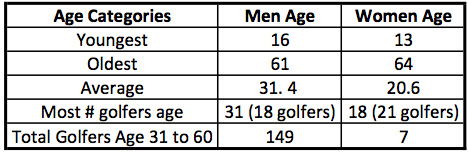
For me the striking comparison is the total players age 31 to 60 with 149 men playing in the 2026 Amateur 4-ball and only seven (yes, seven) women in the age range of 31-60 in the 2026 Women’s Amateur 4-ball.
After some thought I basically believe it is the cycle of life that represents the age difference; and you see this in professional golf too. If you are a fan of the LPGA you know that when the ladies get into their 30s many retire (or take a leave) to have children. Yes, the LPGA has great day care but I think it is still very difficult for women to be professional golfers and raise their children. But it can be done! Julie Inkster is famous for balancing her professional golf career and raising her two daughters.
I did google the topic and a number of other “reasons” were listed such as:
(1) Physical Development – I found it interesting that one point made was that young female golfers can achieve the driving distance of their older female counterparts sooner. While boys do not have the physical ability to achieve the same driving distance that is required in the power game of men’s golf (hitting drives over 300 yards). So you will see a thirteen year old girl driving it as far as an LPGA player but you won’t see a thirteen year old boy driving it as long as a PGA Tour player. Interesting premise.
(2) Women that have the skills to turn professional do it at a younger age then men turning professional. I think it is true that women turn professional sooner because they are aware that by 30 they may want to start a family. And of course there was the “Michelle Wei” effect on the LPGA. However, this may also be changing as you see players like Blades Brown turning pro at 16 and playing on the Korn Ferry tour. But what that doesn’t solve is the question as to why so many elite amateur female golfers that do not turn pro, also do not continue competing in elite amateur golf.
There are women that continue to play after college golf if you look at the USGA Mid-Amateur Championships which are for men or women 25 years or older. It is interesting to note that the field size is different. The men’s Mid-Am. has 264 competitors and the women’s Mid-Am field is 132 competitors.
Even in the amateur golf (casual leagues) I play in you see that most of the women are past child rearing age so it’s not just about having a job that keeps them from playing. But once the kids are off to college a lot of women find golf again and enjoy playing.
I will say it is nice to see more women in their 20 and 30s recognizing the importance of golf from a business/career perspective; and I do see more young couples playing on the weekends. But as far as serious amateur competition goes I do think we will continue to see the age gaps. However, with young girls being the fastest growing demographic in golf it would not surprise me if in the future more women find their way to elite competitive golf.
 Golf Expectations