Prior to the start of the NCAA D1 Men’s Golf Championship very few analysts were talking about OSU (Oklahoma State University). The consensus seemed to be that the battle would be between the number one ranked program, Auburn and FSU (because of their star Luke Clanton). OSU was ranked #2 in the country coming into the competition.
Surprises from stroke play: The most shocking outcome from stroke play was that FSU did not make it to the top eight so they never even had a sniff at match play. The other surprises were that Texas A&M (#11 in the rankings) and Ilinois (#12 in the rankings) did not make the top 15 cut.
The individual champion from stroke play came for Ole Miss, Michael La Sasso with a final score of 11 under par. Again, this was not a player getting press at the start of the championship. The big names really did not play well: Luke Clanton from FSU (+1, finished 22nd) and Jackson Koivun from Auburn (-6, finished 4th).
Surprises from Match Play:
Just like with the women’s championship we had a team that was not on the radar take down some big teams. Virginia (#11 ranked school) took down Auburn (#1) 3&2 in the first round of match play. Then Virginia took down the Florida Gators (#6) 4&1. The Gators took down Texas (#5 ranked) in the first round.
The Final day it was OSU against Virginia and at the start of the matches it looked like Virginia was going to take down the #2 program in the country; but momentum change as the matches got deeper into their rounds and OSU came out on top 4&1.
The most famous current PGA Tour golfers from OSU, Rickie Fowler and Victor Hovland, must be a very happy alumni!
If you enjoyed the Women’s NCAA golf championship now you can follow the best male golfers in college as the top schools vie for the national championship.
The format for the men’s NCAA is the same as the women. First, three rounds of stroke play to get into the top 15 and on Monday, May 26 the final round of stroke play to determine the final eight teams moving on to match play.
Match play will be on Tuesday May 27 and the Final Match Play Wednesday May 28. Golf Channel will televise the NCAA on Monday, Tuesday, and Wednesday. Or you can follow the championship on the college scoreboard site.
Top teams competing include: #1 Auburn, #2 Oklahoma State, #3 Ole Mis, #4 Texas, #5 Arizona State. FSU is ranked #9 but they have one of the best players in college, Luke Clanton who has already earned his PGA Tour Card via the PGA University program. Clanton has deferred going to the PGA tour because he wants to win a national title with FSU. Although Clanton is a junior, he will turn pro after the NCAA championships.
Auburn is the number #1 ranked team in men’s college golf and the NCAA defending champion. Auburn has a stellar player in junior, Jackson Koivun named the 2025 SEC player of the year. Of course, Arizona State has their own star in Josele Ballester, the 2024 U.S. Amateur ( and recently famous for peeing in the woods at The Masters).
It’s hard not to predict Auburn as the winner but I am going to pick FSU because they lost to Auburn in 2024 in the finals and so I think (1) FSU has a chip on their shoulder and (2) It is very hard to win back-to-back National Championships and that is what Auburn is attempting to achieve this week.
Of course, like the women’s competition, you never know if another team will surprise everyone and come out on top.
Northwestern Women’s Golf team, ranked #11 in the college golf rankings going into the NCAA championships, are the 2025 NCAA D1 Women’s Golf Champions.
It may seem odd to say that Northwestern was not on everyone’s radar or that they were an underdog; but when you look at the competition they really were not a team people were talking about this year.
Here is journey of Northwestern through the NCAA D1 Women’s Championship.
Stroke Play
Day1 in 8th place (score of +3), Day 2 in 2nd place (score of Even), Day 3 in 2nd place (score of 8 under par), fourth and final day of stroke play 3rd place (score of +2). First place was Stanford at 27 under par and second place at six under was Oregon.
It is interesting to note that the NCAA used to be a stroke play event. If that were true today; Standford would have run away with the championship. Some believe the change was for television and yes, it is easier for TV coverage with match play but that is not the true reason for the change. The championship went to a combination of stroke play and match play to mirror the major amateur events college golfers play.
So after stroke play Northwestern was the #3 seed in match play and would face University of Arkansas in round one.
Match Play
Northwestern golfers were tough competitors in match play.
Round One: I don’t think any analyst of college women’s golf picked them to beat the #2 ranked team in women’s golf, University of Arkansas. But they did! Northwestern won 3&2 (out of five matches they won three).
Round 2 (Semi-finals): Facing another top rated team in Oregon ranked third in the college golf rankings. Again, Northwestern won 3&2.
Final Round: Northwestern goes up against the #1 ranked college golf team, Stanford. To put this in perspective, Northwestern is ranked #11 in the college golf rankings so they really were considered the underdog; especially since Standford took down FSU (which has the #1 and #2 rank female golfers in the world) in the semi-final match. The match between Lottie Woad (FSU) and Megha Ganne (Stanford) was electric with birdies needed to win holes. And for Megha Ganne to beat Lottie Woad was a huge momentum builder for Standford going into the finals.
At first it looked like Stanford would have an easy time taking down Northwestern with Megha Ganne winning the first match 5&4; but midway through Northwestern was leading in three of the four other matches. Northwestern won Match 2 (1 Up), Match 3 (3&2). Next Stanford won the 4th Match (1 Up) and it all came down to the final match.
The final match came down to the final 18th hole and the final putt. Dianna Lee of Northwestern had a one up lead and only needed two putts to win but she loves to hit her putts firm and instead of giving herself an easy tap in on the second putt, she had a nerve wracking five footer to win.
I must admit when I saw Standford against Northwestern was going to be the final match I thought it would not be very exciting and it felt that way watching Megha Ganne take a 3 up lead right out of the gate; but Northwestern showed their toughness and made it a very competitive and exciting final match.
Side Bar: It was very shocking to see the top teams that did not play well at Nationals. Wake Forest did not even make the cut to the top 15 teams. South Carolina, #5 ranked team in the country, made it into the top 15 but did not make the final eight for match play.
Florida State (the team I thought would win) was taken down by Stanford in the semi-finals; thanks to the stunning upset of Megha Ganne beating world #1 Lottie Woad. And finally it was really shocking to see both Arkansas and Oregon fall to Northwestern. It just speaks to the heart of Northwestern to believe in their ability and their team.
Congratulations to the 2025 NCAA D1 Women’s Golf Champions – Northwestern University!
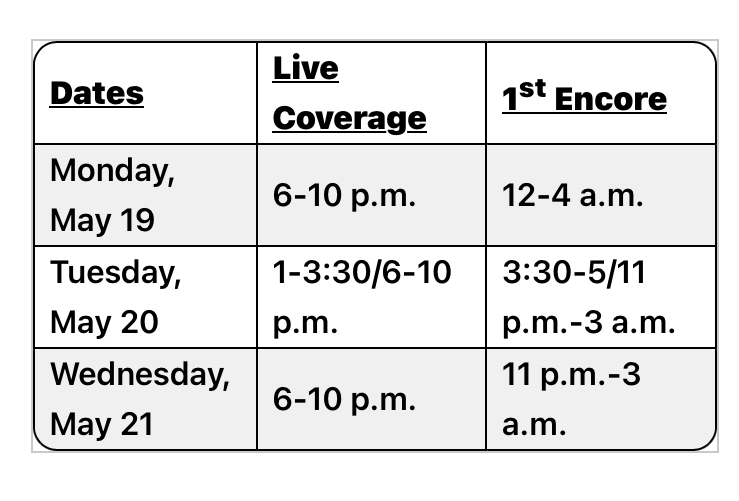
The regional championships where held May 5 -7 (see previous post for details). The top seeds in each region made it to the the NCAA championship to be held May 16-21 at Omni La Costa Resorts & Spa in Carlsbad, CA.; and televised on Golf Channel, ESPN, Peacock (check local listings). Monday TV coverage will be final day of stroke play; Tuesday and Wednesday will be match play. See screenshot below for Golf Channel coverage (time is EST).
Below is a list of the 5 teams and one individual from each region (not on a winning team) moving on to the championship.
Charlotte Region
Winner: South Carolina (won by 11 shots with a final team score of 2 under par). Rounding out the top 5 teams are: (2) Ole Miss, (3) Florida, (3) Virginia, and (5) UCLA. Individual Champion was Marie Madsen of NC State (she is also the individual moving on that was not on a winning team).
Columbus Region
Winner: Kansas (with a team score of 6 under par). Rounding out the top five teams are: (2) Arkansas, (3) Ohio State, (4) UNLV, and (5) LSU. Individual Champion was Lyla Louderbaugh of Kansas (with a winning score of 12 under par). The other low score individual advancing is Moa Svedenskilod of Houston. The one surprise was UNLV (7th seed) advancing.
Golf Canyon Region
Winner: Oregon (winning team score 12 under par). Rounding out the top five teams are: (2) Arizona State, (3) Oklahoma Sate, (4) Mississippi State, (5) Cal State Fullerton. The individual Champion was Kiara Romero (16 under par). The surprise team moving on is Cal State Fullerton which was the 10th seed out of 12 teams. The upset was that the third seed, Auburn, did not make the championship. However, Anna Davis of Auburn is the low individual moving forward from a team not advancing.
Lexington Region
Winner: Florida State (no surprise as the top seed). Rounding out the top five teams are: (2) Georgia Southern who were the sixth seed, (3) Kansas State, (4) Southern California, (5) Vanderbilt. The Individual winner was Carla Bernat of Kansas State. You may recall that name because she was the women that won this year’s Augusta National’s Women Amateur. What is really interesting is she beat the top two players in the world; Lottie Woad (#1) and Mirabel Ting (#2) both play for Florida State. The upset at the Lexington Region was that third seed, TCU, did not advance. However, Sofia Barroso Sa of TCU is the low individual on a non-advancing team moving forward.
Lubbock Regional
Winner: Wake Forest. The wind and rainy weather did not stop the #1 seed from winning the Region, Wake Forest advances and the individual champion from the region is from Wake Forest – Carolina Chacara. The other individual moving forward is Lousiane Gauthere from Florida Golf Coast.
The big surprise was that Arizona, #3 seed did not advance; and Tennessee (#6 seed) did advance. Also, the most exciting situation in all the regions was a playoff between Texas A&M (#4 seed) and Purdue (#7 seed). Purdue won the playoff to win the fifth slot from the Lubbock Region going to Nationals.
As expected most of the top seeds advanced to the NCAA national championship. I still believe that one of the following will win: Florida State, Wake Forest, or Stanford. If it were purely stroke play, Standford would probably win because they have not lost a stroke play event this year; but any team that can make it to match play has a chance. After all, Wake Forest took out Stanford at the ACC in the seim-final matches.
There could be a surprise winner! It’s hard not to put your money on Florida State since they won the ACC Championship where both Wake Forest and Standford competed. But I would not be surprised is South Carolina or Arkansas win because both teams have been playing stellar golf coming into the championship season. Who I want to win – South Carolina. Who I think will win and my final pick – Florida State wins it.
The women’s golf college conference championships are completed and now the focus is on NCAA D1 Regional competitions that will set the field for the 2025 NCAA D1 Championship to be held May 16 -21 in Carlsbad, CA at the Omni La Costa Resort and Spa.
Regionals are contended at six different sites with 12 teams at each regional; as well as 6 individual golfers from teams that did not qualify. The individuals are top players that qualified to compete for the Individual NCAA D1 title.
Regional qualifying is always very exciting because it seems like every year there is a team that no analyst is touting that catches fire and knocks out a top team. Only five of the 12 teams at each region will move on to Nationals. In other words, of the 72 teams competing for a spot only 30 teams will advance to the national championship. And the top individual golfer not on an advancing team will also go to the national championship.
If you want to see all the teams (and individual) seeding for the regions you can get all the details at the NCAA website. The top seed in each region are no surprise if you follow women’s college golf.
Charlottesville RegionalTop Seeds: #1 South Carolina, #2 Virginia, #3 Ole Miss, #4 Florida
Norman Regional Top Seeds: #1 Stanford University, #2 Northwestern, #3 North Carolina, #4 Michigan State
It will be interesting to see if where the teams play in regional competition impacts outcome. For example, Wake Forest plays in the Texas regional location so there will be lots of wind. Will the wind be an issue? Will teams like Texas and Texas A&M have an advantage because they are used to Texas wind?
Side Bar: Texas A&M fun fact – the coach, Gerrod Chadwell is married to LPGA star, Stacey Lewis.
Can’t wait to see who advances and what upsets may occur at the 2025 NCAA D1 Women’s Golf regional competitions.
Looking forward to the NCAA D1 Championship:
PastWinners: Stanford (2024), Wake Forest (2023), Stanford (2022), and Ole Miss (2021)
For me, one of the following teams will win the NCAA D1 Championship in 2025: Standford, Wake Forest, South Carolina or Florida State.
South Carolina won the 2025 SEC championship so are in great form for championship season. Wake Forest beat Stanford in the semi-finals of the ACC but lost to Florida State in the championship match play; but it was very close and came down to the last putt on the 18th hole of the last match. So just the fact that Wake Forest beat Stanford in match play gives them a lot of confidence going into the NCAA series. Florida state is a “no-brainer” as a pick to win it all with the #1 and #2 rank women golfers in the world on the Seminoles roster.
Unfortunately none of the regional competitions will be televised but you can keep track online and I will, of course, blog before the D1 Championships to give an overview of the teams that made it to the NCAA finals for women’s golf.
As I said in my preview of ANWA it could be a unknown (at least to the average golf fan) winning ANWA and that is exactly what happened. Carla Bernat Escuder of Spain wins with a score of 12 under par (204).
Who is Carla Bernat Escudar? Here are some facts:
(1) As mentioned above she is from Spain and her coach is Victor Garcia, the father of 2017 Masters winner Sergio Garcia. She has been coached by Garcia since she was 13 years old.
(2) She was not on my radar with a WAGR ranking of 29 and a DI College Rank of 24. She plays for Kansas State (transferred this year to K-State). I did know her name because her first two years of college golf was played at Tulane University.
(3) Really fun fact – Champions Gate Golf Course has their golf course dog “pick” (predict) the winner. The dog has not been accurate in previous years but this year (see Instagram post)
Congratulations to Cara Bernat Escudar!
Other Notable Players:
(1) Lottie Woad: Unfortunately for world #1, Lottie Woad, who was in first place at the start of the final round, she just did not have her game on the final day and finished solo third at 9 under par (207)
(2) Asterisk Talley – #1 Amateur in the world finished one back in second place with a final score of 11 under par (205). She played well but the highlight was when she holed her 2nd shot on #1 at August National for an opening eagle.
(3) Megha Ganne – The Stanford players from New Jersey who had a record setting first round at Champions Gate finished in seventh place with a score of 7 under par (209).
It’s that time of year when all golfers await The Masters but thanks to the Augusta National Women’s Amateur we get to now anticipate a new tradition. For those that don’t follow amateur women’s golf, the weekend prior to The Masters is the Augusta National Women’s Amateur (ANWA). This is the fifth contended championship although it was launched six years ago (started in 2019 but not played in 2020 because of Covid).
ANWA is a 54 hole competition. The first two rounds are at Champions Gate Golf Club and the final round is at Augusta National.
Side Bar: it’s going to be above normal for temperatures so it could be close to 90 degrees on championship Saturday at Augusta National.
How to Watch: Each day you can watch the competition lived streamed on the Augusta National Women’s Amateur Website, ANWAgolf..com or you can watch on Golf Channel and NBC (the final).
The first two days (Wednesday, April 2 and Thursday, April 3) are streamed and on Golf Channel from 1:30 p.m. to 3:00 p.m (EST). The final (Saturday, April 5) is streamed and on NBC from Noon to 3 p.m. Note: No coverage on Friday, April 4 because all participants are at practice rounds at Augusta National.
Past Champions in the Field:
There are three past champions in the field.
2024 Champion, Lottie Woad of England is the defending champion and the #1 female golfer in the world amateur golf rankings (see WAGR website). Woad beat Baily Shoemaker by one stroke after she birdie the last three holes at Augusta National. Woad plays her college golf at Florida State University. Golf England has a video overview of Lottie Woad’s golf journey.
2022 Champion, Anna Davis (also known for wearing the bucket hat when she won) is in the field. Davis plays her college golf at Auburn University and is ranked #17 on WAGR. Davis missed the cut the last few years so she’s not on the radar as a contender for 2025. However, Davis just came off a big individual win at the Charles Schwab Women’s Collegiate.
2021 Champion, Tsubasa Kajitani from Japan. She won in a playoff against a very popular American amateur, Emilia Migliaccio. She is now Emilia Migliaccio Doran and works for the Golf Channel. What most people remember is that a week later Japanese golfer, Hideki Matsuyama won The Masters; so it was the “year of Japan at Augusta National.” Kajitani doesn’t have any recent amateur golf competitions in the WAGR and she withdrew from ANWA last year so I doubt she is a contender in 2025.
#2 and #3 in the World behind Lottie Woad: The world amateur golf rankings are a great place to start and after world #1, next in line are:
Jasmine Koo (American), University of Southern California, WAGR #2, D1 College rank #2
Mirabel Ting (American), Florida State University, WAGR #3 and it should be noted that Ting is the #1 ranked player in the DI NCAA College Women’s Golf Rankings.
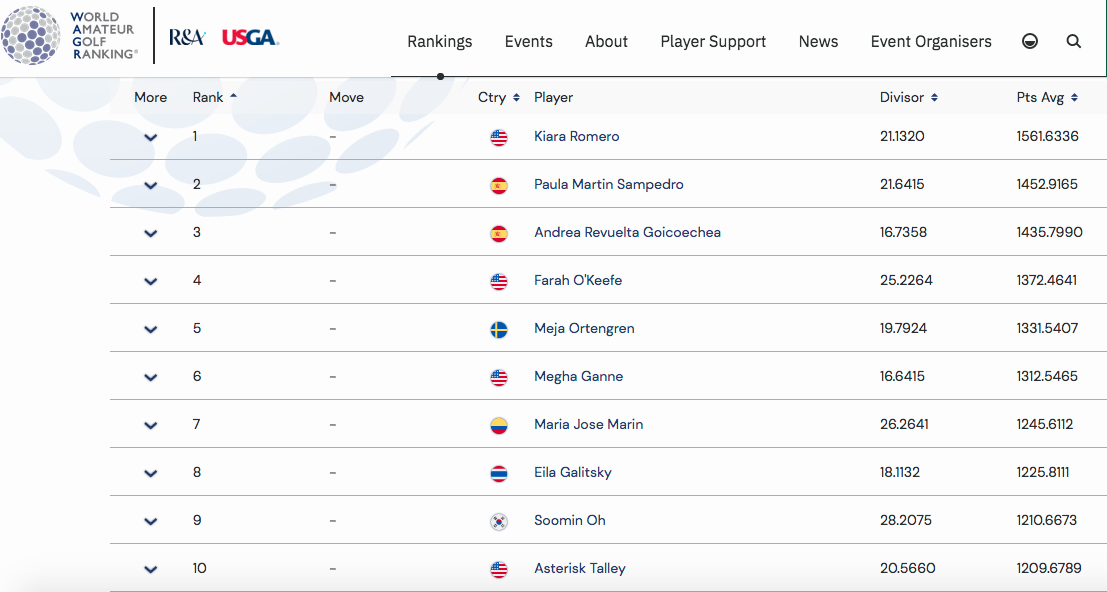
Division 1 NCAA Rankings: Any of the Top 10 college golfers (list below) could win at Augusta. Certainly the #1 ranked player, Mirabel Ting should be a favorite.
Here is a screenshot of the Division 1 College Ranking
NCAA D1 Women’s Ranking as of 3/29/2025
Other Standout College Players that are Well-Known or Trending before Augusta:
Louise Rydqvist (Sweden), University of South Carolina, WAGR Rank #9 – A standout for the Gamecocks and co-winner of the Darius Ruckers Invitational is playing well coming into Augusta. Her DI college rank is #14.
Hannah Darling (Scotland), University of South Carolina, WAGR #15 – A standout for the Gamecocks. DI college rank is #11. Last year had the low first round at Championships Retreat (where the first rounds of ANWA are played); and was T7 for the overall championship.
Kendall Todd (American), University of Arkansas, WAGR 30 – She may be ranked 30 in WAGR but she has been playing some great golf in 2025. She is ranked #12 in the D1 rankings. She is coming of a co-win at the Darius Rucker Invitational and she was 3rd in the 2024 U.S. Women’s Amateur last summer. And the weekend before this year’s ANWA she won the Clemson Invitational and became only the sixth player in NCAA history to score a 61 for a round.
Bailey Shoemaker (American), University of Southern California, WAGR #41 – Shoemaker came in 2nd last year and set the ANWA course record for the girls with a blistering 66. She lost by one to Woad. Her showings in her college starts in 2025 are not great; and has a DI rank of #89. I probably would not even highlight her if not for her stellar performance last year. I’m sure she has something to prove after coming so close last year.
Teen Phenoms in the Field:
Asterisk Talley (American), #1 junior golfer in the world and ranked #14 in WAGR.
Gianna Clemente (American), #2 junior golfer in the word and ranked #21 in WAGR.
Rianne Malixi (Philippines), WAGR #4 – She was on a tear last year when she won the U.S. Girls Junior and U.S. Women’s Amateur (beating Asterisk Talley in both). The 17 year old is committed to play golf at Duke. She is not listed in the AJGA junior rankings but I think that is because she plays so many big tournaments all over the world. Her WAGR ranking of four (#4) speaks for itself.
My Sentimental Favorites:
Rachel Heck is no longer in college but she played on the NCAA National Championship Stanford women’s golf team; and became a “great story” because she was also ROTC (Air Force) while at Stanford. Players in the top 30 in WAGR automatically qualify for ANWA. Heck is currently ranked 25 in WAGR but during her college days was as high as #13 in the world. She missed the cut last year so I don’t see Heck being a favorite to win; especially since she is in the Air Force (and admits she has not played much golf). It would certainly would be a great story if an active duty military woman won the ANWA. Golf.com released a video of Heck in uniform talking about her golf and the Air Force.
For me, a player that I will definitely want to see do well is Megha Ganne. I first saw Ganne during the Drive, Chip and Putt (DCP) competition and she caught my eye because she was from New Jersey (and I was living there at the time). She competed in the DCP competition four times and I have followed her career since DCP. Ganne plays college golf at Stanford and her D1 ranking is #10 and #12 in WAGR so she’s got the game to win the ANWA.
Predictions
UPDATE: 7p.m. 4/1/2025 – Rianne Malixi WD from field. I was planning on saying Rianne Malixi could be the one to surprise everyone with a win because she seems to just play well in big events; but she is reported to have back issues and may not play; which would be a real shame.
For the college golfers, Kendal Todd is high on everyone’s list because she has been playing so well. Also, it’s hard not to go with Mirabel Ting who is the #1 D1 NCAA golfer and #3 Women Amateur Golfer (WAGR). But I would love to see Bailey Shoemaker win just because she had such a heartbreak loss to Lottie Woad in 2024.
One thing that would not surprise me is if some complete unknown (to the general golf viewing public) wins. No one expected Anna Davis to win back 2022. Davis was a complete unknown to most but after winning ANWA everyone that follows women’s golf knows Anna Davis; if not by name by the “girl that wore the bucket hat at Augusta National.”
Unless you follow junior golf you may have never heard of the Junior Invitational at Sage Valley. It’s an elite (invitation only) golf tournament for the world’s best juniors. Sage Valley is an ultra exclusive club and only a few minutes from Augusta, Ga. This year a few “celebrity juniors” are in the field. I label them “celebrity” because I don’t consider Charlie Woods and Kia Trump (grand daughter of Donald Trump) as top junior golfers in the world. Don’t get me wrong they are skilled golfers but are not the “cream of the crop” of elite juniors.
The invitational started in 2011 and past boys champions of Sage Valley include Scott Scheffler and Joaquin Niemann. A girls division has only been part of the invitational since 2022. The most notable winner from 2023 is Anna Davis; the 2022 Augusta National Women’s Amateur Champion. All past winners and participants are listed in the “record book.”
If you do follow junior golf you will recognize names of the top players. For the boys, Miles Russell #1 junior in the world and at 15 years old played in a PGA Tour event this year. For the girls, Asterisk Talley #1 girls junior who played in the LPGA Hilton Grand Tournament of Champions and won the Amateur Division. Talley is the 2024 (defending) champion in the girls division at Sage Valley. She didn’t play her best this year. Another well known junior girl is Gianna Clemente who won the 2023 USGA U.S. Women’s Amateur Four-Ball and was named 2024 AJGA Girls Player of the Year. Both Talley and Clemente will be at the 2025 Augusta National Women’s Amateur April 2-5.
RANKING OF GOLFERS
I did a bit of research and looked at AJGA rankings and European Golf Rankings for the 36 boys and 24 girls in the field. What surprised me was not the fact that the top players were represented from all over the world; but what did surprise me was that both Charlie Woods’ ranking of 838 and Kia Trumps ranking of 815 were so far off from the other players. I get it but I feel bad for the elite players that missed out on this event because two spots were given to less skilled players.
Frankly I did not see any other player (in the field) lower than 156 in the AJGA (and if they had a AJGA ranking over 100 then their European rank was usually in the top 20 for European world rankings). This is obviously due to where they play the majority of their junior golf. In other words, what tournaments are used to calculate the rankings. For Example, Oscar Covilleau (from France has an AJGA ranking of 156 and a European Ranking of 10). But still Covilleau’s rank of 156 is certainly much better than Woods at 838.
One other caveat for rankings is that it could be that both Woods and Trump do not play many tournaments that contribute points to world golf rankings. So let’s compare; Russell Miles and has seven events listed on his AJGA recap (with a few wins, of course) and Charlie Woods has four events and his best placement was a T24. Looking at Astrisk Talley; she has eight events with four wins (of the eight); Kia Trump only has one event in her bio – the Dustin Johnson World Junior (two-day event) where she placed 29.
Based purely on junior world golf rankings, I would say that Charlie Woods and Kia Trump do not deserve to be playing in the event; but the reality is that it is an “invitational” and their names will provide additional publicity; even if Woods and Trump don’t play well.
HANDICAPS: One last fun comparison from GHIN are the handicaps. Miles Russell is a +6.6 and Charlie Woods a +4.1 Aphrodite Deng is a +7.1 and Kia Trump is a 0.3
RESULTS
I waited until the end of the invitational to publish this blog post to share results. And no surprise that both Woods and Trump did not finish in the top five or even top 10. In fact, Woods finished the four day tournament T25 (out of 36) with a score of +11 (299). See Screenshot below for Charlie woods.
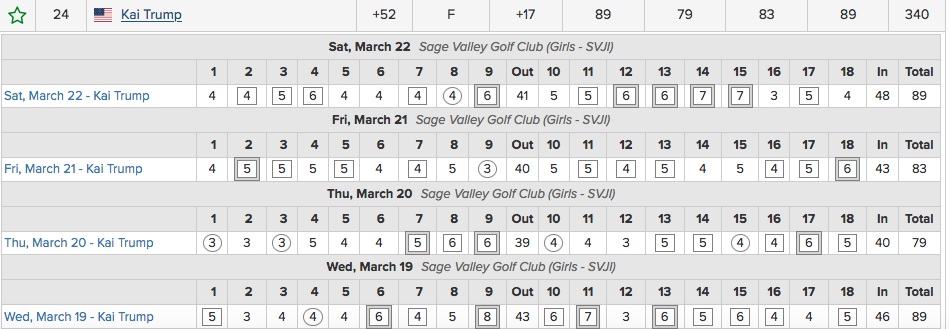
Unfortunately for Trump, she finished in last place (24) with a 4 day score of +52 (340). Trump is big into social media and has a YouTube channel focused on golf content. Her channel has 1.7 million subscribers (most of the growth has been in 2025). She has made a verbal commitment to the University of Miami Golf team. She’s going to have to get much better if she wants to actually play in college competitions. See screenshot of Kia Trump’s scorecard below.
THE CHAMPIONS
The 2025 Champion for the Boys division is Miles Russell (AJGA Rank #1 from the USA) with a score of -9 (279). It must have been exciting to watch because Jackson Byrd lead most of the day and then had a double bogey on 17. Boys champion, Miles Russell’s, scores below:
The 2025 Champion for the girls division is Aphrodite Deng (AJGA Rank #9 from Canada) with a score of -7 (281). Deng may be Canadian but she lives in Short Hills, New Jersey. Girls champion Aphrodite Deng’s scores below:
All results of the Junior Invitational can be seen on their Golf Genius website.
Both of the champions were interviewed and commented on the difficultly of the course and the wind (side note: it’s was gusting up to 30-40 mph in SC on Tuesday and Wednesday). Miles Russell was 2 behind with 3 holes to play and he said he just stayed patient. Aphrodite Deng said she just kept telling herself “par would be good today” which is very smart given her lead going into the final round. Deng’s 66 on Friday really set her apart from the field.
CLOSING
I’m looking forward to watching Clemente and Talley during the television coverage of the Augusta National Women’s Amateur. I’ll be curious to see if Aphrodite Deng is added to the field because she is not currently on the ANWA website players list.
I’m not sure which if any of the USGA amateur championships will be televised in 2025 but hopefully Golf Channel will show The Amateur because it is a the Olympic Club this year. Part of the fun of watching the USGA events is seeing the beautiful private courses that host the events.
I’ve always been interested in the best way to track improvements in my golf game. Yes, handicaps and scoring are results but they do not help me figure out what part of my game needs work. In the past I looked at fairways hit, greens in regulation (GIR), total putts, etc. However, after reading the latest and greatest suggestions from golf stat gurus (like Lou Stagner) I’m tracking my 2025 golf season with a different approach.
Most of the game improvement gurus online will tell you to get a game tracking app or program to track “strokes gained.” For example using Arccos or Shot Scope might be worthwhile; but I am not at a stage where I want to spend money to start tracking strokes gained. So, after reading many articles and books, it seems that there are a few interesting new stats (at least for me) that I can track without much fuss.
(1) Three-putt Avoidance – A golfers ability to avoid three-putts. You might think what’s wrong with the old school “total putts” statistic? I like the stat but there really isn’t any context and I have realized after tracking three-putts that it is a much better indicator of my putting overall. Focusing on this stat has made me much more aware of how far I am from the hole (proximity) on my first putt which has changed the way I practice my putting. I have become much more focused on speed control. I started tracking this stat in the summer last year and I have greatly improved my putting.
Below is a chart (by handicap) with the statistics (from Lou Stagner) to measure your three-putt avoidance. To calculate the percentage just figure out how many three putts per number of holes. The PGA Tour has been tracking this stat since 1992. For example, the number one player in the world, Scottie Scheffler during the 2024 golf season played 1,278 holes with 24 three-putts or a 3-putt avoidance of 1.88%. It’s interesting that Scheffler is not the best in this category.
Fun Golf Trivia about Three-Putting: Jack Nicklaus in 1962 won his first Major (U.S. Open at Oakmount) in an 18 hole playoff against Arnold Palmer. Jack’s putting was the key to winning. Nicklaus had only one three-putt in 90 holes compared to Palmer who had 10 three-putts that week.
(2) Greens In Regulation Plus One (GIR+1) – The golf articles I have read on game tracking seem to all agree that if you are going to track a traditional stat then track greens in regulation (GIR) because it’s the only traditional stat that correlates to lower scores.
In addition to GIR, I came across a stat to track GIR+1 and I love it. This was a concept I learned from Lou Stagner’s Newsletter (#86).
GIR+1 is a statistic that tracks how often you get on a green and give yourself a chance at a par with a one-putt. For me, I still have a GIR goal but I really like tracking GIR+1 for two reasons. First, I’m not the longest hitter and so I get frustrated with how few GIR I have in a round because of my lack of distance versus me hitting a bad shot (e.g., out of bounds, penalty area, lost ball). It doesn’t mean I’ve given up on working on distance but I’m not as obsessed with distance in 2025. I have now been working on my short game to get my proximity to the hole dialed-in from shots just off the green.
Second, GIR+1 is just a positive way for me to look at my post round results and my mental game on course is more positive. Now I find I’m telling myself I still have a chance at par with a one putt versus thinking it’s automatically a bogey because I will two-putt (which I hate to admit was my old mind set). I’m surprised how this different perspective has made the game more enjoyable for me the few times I have played in 2025.
Here is a chart with GIR+1 by Handicap (data from Lou Stagner). Basically, a 20 handicap is giving themselves 11 or 12 chances to save par with a one putt compared to a scratch golfer with 16 or 17 opportunities.
(3) Tracking “Double Bogey or Worse” Data – This may seem odd but I have started tracking double bogey or worse versus focusing on Pars and Birdies. Don’t get me wrong I’m very excited when I have Pars and Birdies but again data shows that even scratch golfers do not make that many birdies in a round. In fact, the experts say the key to good golf is fewer “blowup” holes. So instead of looking at my post round review and being frustrated if I didn’t have a birdie; I now look at my scores and I’m excited if I achieve my 2025 goal of four or less double bogeys (or worse) in my round.
Chart with Bogey and Double Bogey by Handicap (source: Lou Stagner)
So I guess this year the best way to express my personal golf data tracking journey is the focus is really on avoiding blow up holes. I know it makes sense but it is really a different mind set for me. Now I’m really excited to get on a green with a chance at a par with a one-putt. I am very focused on avoiding a three-putt, and try to make sure I’m walking off the green feeling good about a bogey on a hole.
I’ll be very interested to see if at the end of the year, this new approach makes a difference in the numbers every golfer is measured by – handicap and/or average score.
I never really thought much about golf ball design expect for the fact I knew about the different layers, coating, and of course they have dimples. And that dimples reduce drag which increases ball speed or velocity (thanks to my day at the USGA); but I assumed all golf balls had the same number of dimples and that is not true. Guess I forgot that information from the guys at the USGA test center.
So the size and shape of the dimple has a huge impact. For example, A Titleist Pro V1 golf ball has a 388 dimple design, while a Pro V1x has a 348 dimple design. From what I have learned that means the Pro V1 has a lower ball flight because it has less dimples.
And there is no limit to the number of dimples or the shape of the dimples so that is why golf ball companies can spend millions on research.
Below is a Titleist video on the subject:
If you really want to geek out, I found this video from the USGA.
Of course, I had to look up the specs for my golf ball. I play a Callaway Super Soft which has 332 dimples that are hexagonal in shape. I use to play the Wilson Duo Soft but it was really hard to find last year (I assume because it was a good ball and under $30) so I switch to back to Callaway.
I just read that Wilson introduced a redesigned Duo Soft this year and the 2025 ball has 302 dimples; could not find style but they look hexagonal. So 302 dimples seems to be one of the lower numbers I have found and from what I have read it reduces spin (to help get more distance) but Wilson also states that “With DUO Soft, we have to make up for what we lose in velocity….and we do this with getting more roll.”
After learning more about golf balls, the one thing I did not think about previously was that the firmer the golf ball, the more ball speed (velocity) you’ll get because with a low compression (softer ball) there is more “deformation” when the ball is hit with the club.
So this was a geeky blog post but I did enjoy learning (or relearning) about golf ball technology. It does make me wonder why more club fitting facilities don’t offer ball fitting at the same time? At least it’s not offered any where near me. Seems like a logical service to offer golfers. The only ball fitting I can think of is the one that Bridgestone Golf offers an online for their golf balls.