Stroke and Distance Relief – Putting Greens and Bunkers, Model Local Rule E-5

Ask the average golfer about “stroke and distance” and they will mostly likely tell you that stroke and distance is what you must take for a lost ball or a ball out of bounds; and you incur a one stroke penalty. And some golfers may explain that it is a relief option when your ball is in a penalty area (Rule 17) and a relief option when a golfer declares a ball unplayable (Rule 19). But not many golfers will cite Rule 18.1 which is a governing rule that states that the player can proceed under stroke-and-distance at any time.

Most golfers don’t realize when you take stroke and distance relief under Rules 17.1, 19.2 and 19.3 they could also be correct to say that Rule 18.1 applies. And, most golfers don’t realize how to take advantage of the rules when on a putting green or in a bunker.

Putting Green – Here is the basic scenario. You are on the putting green and you hit your putt which roles off the green and comes to rest perhaps by a tree, or in mud, or even in a penalty area at the back of the green. What is the stroke and distance option? You can declare you ball unplayable (Rule 19.2) any where on the course expect in a penalty area. Declaring your ball unplayable allows you to take stroke and distance with one penalty stroke. Technically if you were asked by another player to state the Rule you could state Rule 18.1 or Rule 19.2.

This rule is useful when you really don’t have a shot or don’t feel confident in the shot you would need to make, etc. So let’s say my ball rolls off the green and is by a tree behind a root; I don’t want to risk hurting my wrist so I declare my ball unplayable and go back on the green and hit from the previous location of the putt that I just hit. And yes, I have a one stroke penalty; but a second putt (with a one stroke penalty) in many cases is better than taking a drop by the tree (again with a one stroke penalty for lateral relief), and trying to get up and down.

Now if your putt roles off the green into a penalty area, you again have the stroke and distance option as one of your relief options for a one penalty stroke under Rule 17.1. Or again, if asked you could state Rule 18.1. But in general, most golfers state they that they are taking relief under Rule 17 (penalty areas) although it is the same option as an unplayable (but remember, you can’t declare your ball unplayable in a penalty area).

I know, the rules can seem overly complicated when you are taking the same action and different rules can be stated but that is just one of the nuances of the Rules of golf; where Rules often repeat instructions.

For me, if I am not confident in making the next stroke from off the green, I’m taking stroke and distance every time and putting again (with the knowledge of what I learned when I hit the previous putt).

If you would like to watch a video on stroke and distance and the putting green, view this Golf Rules YouTube Video.

Some interesting golf trivia – Tiger Woods used stroke and distance at The Masters after a putt rolled off the green into Rae’s Creek. People thought he was wrong but he knew that stroke and distance was an option!

Bunkers – When the Golf of Rules were revised in 2019, the USGA and R&A added a relief option for golfers when they declare the ball unplayable (Rule 19.3). The additional option was to take “back-on-the-line” relief outside the bunker for two penalty strokes. But don’t jump to this option to get the ball out of the bunker; consider the stroke and distance option.

If you declare you ball unplayable in the bunker, for one stroke you can take stroke and distance. Or again you could also state Rule 18.1. Again, you are going back to where you last played the ball but it saves one penalty stroke (versus the back-on-the line option outside the bunker).

I think most golfers would be worried about irritating the other golfers in their group if they take stroke and distance (and have to walk back 100 or more yards). I get it and in general casual play maybe take the two stroke option; but if you are in a competition you should do what is best for you. Personally, if I take an unplayable in the bunker and I can get a decent lie with lateral relief that is what I do. However, if I had no shot at all, I would seriously consider stroke and distance.

I have been asked by a high-handicap player what to do (usually they really have trouble getting out of bunkers even with a good lie). Frankly I tell them in casual play, just take the two stroke option. In league play or a competition; if they are already struggling and 2 strokes won’t impact the outcome then just take the back-on-the-line two strokes; but if they are playing well and think a stroke will make a difference then they have the right to take stroke and distance. It’s a personal decision. I remind them, when they enter their hole-by-hole in GHIN, it will adjust to their max score. Also, if they are new to a league, I tell them to ask if there is a max score for pace of play because that may impact their choice too.

One scenario that always surprises me is when a golfer is a short distance from the green (maybe 5 or 10 yards) and they chunk a shot into the bunker guarding the green. Then they take the back-on-line outside the bunker with two penalty strokes; without even a thought about going back the 5 or 10 yards to where they last hit the ball.

If you’d like to watch a video, you can view this from the USGA. For those that like diagrams, below is the USGA diagram for the relief options for an unplayable ball in a bunker:

Bottom line: It’s never a great feeling to take a penalty stroke but sometimes stroke and distance can be your friend on the golf course.

Model Local Rule E-5

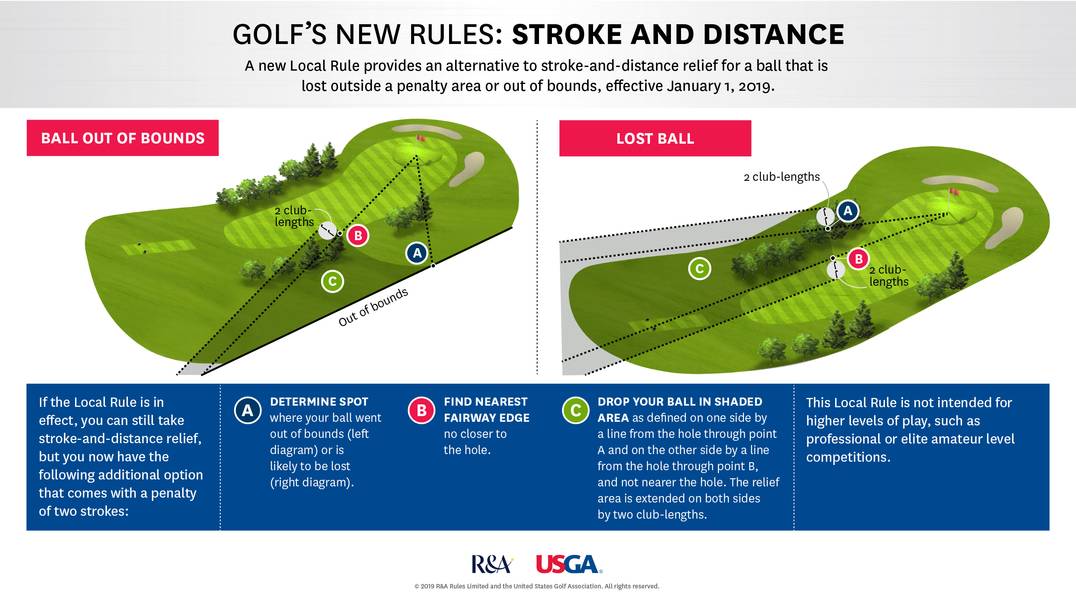
A Model Local Rule is a modification to a rule that “the committee adopts for general play or a particular competition.” The new stroke and distance model local rule is MLR E-5. This is an alternative to stroke and distance for a ball that goes out of bounds or a lost ball. You cannot use this rule if you played a provisional or your ball is lost in a penalty area.

Basically, when you are OB or have a lost ball, in stead of going back to where you last played your ball, you figure out where your ball came to rest (and imagine a line to the flag) and then you find the nearest fairway edge (imagine a line to the flag); from the edge of the fairway you get two-club lengths (along with the imaginary lines from the flag) to create your relief area. This model local rule comes with a 2-stroke penalty.

I believe courses implement MLR -E5 hoping it will help with pace of play. Of course whether or not golfers will use it is debatable because it does have a two stroke penalty. In a casual round I think many golfers would be open to using MLR E-5 but in competition I would guess no one would want to use it unless they were already feeling they were out of the money.

You can watch the USGA video or below is a diagram of the Rule:

Bonus Info:

Lost Ball in Abnormal Course Condition: Some golfers think you must take stroke and distance for ALL lost balls but remember that if it is known or virtual certain that you lost your ball in an abnormal course condition (the abnormal course condition must be in bounds and not in a penalty area); including animal hole, ground under repair, immovable obstruction or temporary water, you get free relief under Rule 16; you do not have to take stroke and distance.

For example, there is a pile of storm debris (in the general area, not OB or in a penalty area) that you know the maintenance crew will be removing from the course. The pile of debris is considered ground under repair even if not mark. So, if you are virtually certain (95% likely) you ball is in the pile of debris but you can’t find it, you can take free relief.

Ball in Water in a Bunker: Another example when it’s good to know the rules. It rained the night before and there is temporary water in a bunker. You hit your ball in the bunker and find it in the temporary water. Some golfers will think they need to take an unplayable but that is not correct. Under Rule 16 (Relief from Abnormal Course Conditions) you get free relief from the water but you must stay in the bunker taking free relief (one club length from nearest point of complete relief). So, again, if you want out of the bunker then you can use Rule 18.1 (stroke and distance) or Rule 19.3 (unplayable).

Water on the Green but Ball is Off the Green: Sorry, you don’t get free relief if you want to putt your ball from off the green and there is water on your line on the green. To get free relief from temporary water on the green your ball must also be on the green. Here is a great short video from Jay Roberts.

Do you know how to properly find the nearest point of complete relief? If you want a refresher there is a good video from the USGA.

Fall Golf – Do you love it? I Do, I Do, I Do!!!

Obviously in South Carolina “fall golf” or “sweater weather golf” comes a bit later than up north. I absolutely love fall golf and my unscientific poll of my fellow league players were unanimously excited for the fall season. Perhaps this is because we suffer through 90+ degree heat with ridiculous humidity in the south all summer and fall is such an amazing reprieve; but for me it’s not just about the temperatures, it’s about the vibe.

I think part of the reason is that by the fall many of the women I play golf with have found their groove so they just “play happy” (as Nancy Lopez would say). Looking back at my scoring history, I also see my scores trending lower in the fall. But that is not the only thing that makes me love fall golf.

These are the things that make the vibe of fall golf so awesome:

(1) The beauty of fall golf: I don’t care if I loose a ball in the leaves! The beauty of golf courses in the fall can be breathtaking. I have so many memories of just looking down a fairway and saying to myself, “How luck am I to be health, happy and able to play a game I love.”

(2) The crisp air and perfect temperatures: Yes, I have to mention it again. Even as a person that moved to the south for warmer weather, I just love sweater weather. You take a deep breath and breath in crisp air that just feels cleaner and healthier. The chill in the air wakes you up and if there is a breeze you might see colorful leaves falling from the trees.

(3) A great time for golf trips: Many of my golf trips have been in the fall. There is nothing better than the anticipation of a golf trip! Three terrific trips I have had in the fall with my best golf buddy, Donna, were Primland Golf Resort (in Virginia’s blue ridge mountains). And, of course, the bucket list trips to Pebble Beach where I got to celebrate my birthday (2021) and Pinehurst (2023)!

(4) The golf courses are in great shape: Most of the courses have completed green aeration (late July/early August seem to be the time for aerating here in the Upstate of SC). The fairways are lush (the summer heat that can burnout the grass is gone). The courses just seem to be saying “I’m in peak condition so come play me!”

(5) Less busy courses: I’m not sure if it is tied to school being back in session or people just get busy with other activities but the courses are not as crowded and pace of play always seems much better. For example, our league finished our round in just under 4 hours and we really did not wait on any hole…that was amazing!

So I’ve listed my reasons for why fall golf have such a great vibe. Did I miss any reasons that make fall golf your favorite time of year? Or is another season your favorite?

Olympic Golf Course: How It Played, Day One – Men’s vs Women’s Events

One of the interesting things about golf is that the same course can play so differently day to day due to weather, which tees you play, and pin placement. The Olympics are a great example of the how differently a course can play and how important course setup (by the tournament officials) is to the competition. Course setup this week is the responsibility of Kerry Haigh (who’s regular day job is PGA of America’s Chief Championships Officer, setting up courses for the PGA Championship and Ryder Cup).

Another unique aspect with back-to-back men’s and women’s competitions is the added issue of “comparison.” It’s only natural that viewers will compare how the men and women play and so course setup is critical. As a female golfer and fan of women’s golf, the last thing I want to see is viewers assuming the men “are better” than the women because they don’t understand course conditions or course setup.

The course was setup for the men as a Par 71 (at 7,174 yards) and for the women a Par 72 (at 6,374 yards). Obviously the difference is to take into consideration the differences between the men and women. The general difference (stated by many experts in the golf world) is that the men’s game has more power and distance and the women are more accurate . However, some would argue the 6,374 is still a bit long for women. Why? Because on some holes the yardage difference is not enough to allow the women to hit the same club for their approach shot as the men. After a practice round, one of the women French golfer’s said that the male golfer for her country hit an iron into a green and she hit a 3-wood. It is much harder to make a 3-wood land and stop on a green.

I’m sure Haigh wants to make the setup a fair test for both events; but there were a few decisions I found very odd. First, he lowered the rough in the third cut (or the rough well off the fairways) and he did not lower the rough in the first and second cuts. Given that the statistics show the women are more accurate off the tee and less likely to have wild misses, this change makes no sense especially when the argument for lowering the rough is that the women do not have the same wrist strength as the men which is why rough is often cut differently. That logic would say the length should have been changed in all three levels of rough.

The other odd decision (made for the atmosphere of the opening hole) was a last minute decision (the day before the start of the tournament) to have the women play off the same tees as the men did for the opening hole. The first hole (originally) for the women was stated as 386 yards (then men’s tee set up for 419 yards). As expected having the women play from the men’s tees (419 yards) did now help the women. As one reporter noted for the women golfers, the opening hole “played as the most difficult hole of the first round, averaging more than 0.4 strokes over par and yielding just seven birdies against 24 bogeys or worse.” I understand the desire of the Olympic planners to have a “stadium vibe” but the first tee decision to move the ladies back to the men’s tees clearly hurt the women on day one.

The week the men played, the course was “soft” because it rained every night and that meant the men could go pin seeking (the ball would hit the green and not roll out excessively). There was barely any wind (a major defense of the course) and the air temperature was also relatively mild and it was humid during the week the men played. That made the course “easier” because the men did not face the ball rolling out on the fairway into the rough. There were many holes where the men could just hit a fairway wood to get in a good position in the fairway. This was a big advantage given the men have much greater dispersion (missing the fairway into the deep third rough cut) with driver.

Comparatively the course is playing very differently for the women. Round one the women faced a much firmer course due to no rain, no humidity, and lots of sun shine; plus the wind was starting to become a factor. So when the men could hit 3-woods, the women golfers needed to hit drivers to put themselves in the same position in the fairway for a good approach shot. The result of using drivers meant the women were seeing good shots roll out of the fairway into the rough. They also had fewer opportunities to go pin seeking having to play for the roll out of a long iron (or wood) onto a green. The weather forecast for Saturday (the day of medal play) is 90 plus degrees which will make the course even firmer.

After day one, there are statistics that show the course was harder for the women. For example, the number of players under par on day one were significantly different: Men under par was 41 and women under par was 12. Also the scoring average on day one for the men was 69 and the scoring average for the women was 74. This is not about skill but about how the course was presented to the players (soft vs firm, no wind vs windy, humid vs no humidity in the air, speed of greens, etc.). One analyst, during the broadcast, noted her surprise of many pin placements given the changes in the weather conditions for the women’s event.

These differences made the course more challenging for the women and more challenging for the course setup director Kerry Haigh. It will be interesting to see if Haigh (and other’s involved in course setup) make changes after day one. Will they cut the rough? Will they go back to the original tee selection for the opening hole? Will they change pin locations if the wind picks up? I don’t want to see the setup be so easy it’s a birdie fest but I want the women to have the same approach shot opportunities as the men did last week.

Winter Golf in the Upstate Region of South Carolina

First, for those of you not familiar with South Carolina, there are four regions in SC (map below) referred to as: the Upstate (green), the Midlands (yellow), the Peedee (tangerine), and Low Country (blue). I live in the Upstate which boarders North Carolina (near Hendersonville and Asheville).

Side note: I was curious where the Peedee region got it’s name and it comes from the river Pee Dee which was named after the native American Pee Dee Indians that lived in the region.

Map from South Carolina government website sc.gov.

A crazy storm is crossing the United States today (January 9, 2024) and for us that means a month of rain (four to five inches) in one day with winds gusting up to 50-55 miles an hour. Anyway, sitting here watching the local news has made me reflect on my winter golf the last few years.

Our golf courses are open all year and we can post scores to GHIN for handicap purposes all year. However, after living here for a few years I have realized that playing golf in the winter is limited, not because of the cold but because of the rain in the winter.

It does get cold which does create frost delays at golf courses so most days we teed off around 10 am. And last year we had a number of days were it was too cold (high in 30s) for me to play. On good days it warmed up into the high 40s or 50s (sometimes 60s but often times a day in the 60s came with rain). So it really wasn’t the temperature that limited my golf last winter.

Moving to the south I expected the typical southern summer rain (heat creating thunderstorms in the last afternoons) but I didn’t realized how much it rained in the winter or in general. Turns out the Upstate averages 50.24 inches of rain a year. Someone told me we get more rain than Seattle (that shocked me) but I think the difference is Seattle has dreary light rain for days on end and we can get a day with significant rain often making courses unplayable.

Actually I think my first two years the rain wasn’t as big as impact as the last few years. In 2023 (based on scores posted in GHIN) I posted a score once in January, twice in February and really it wasn’t until late April that regular weekly golf was in my schedule. I remember last year being so frustrated when a warm day would come and it would rain all day, then a cold front would come and it would be too cold to play for a few days, then it would warm up and yes, rain.

So I have realized that I’m not going to play as much golf in January and February as I thought (when I originally moved to SC) but it has turned out that it probably is a good thing because it gives my body a bit of a break; and I get excited when I do play. It’s also a good time to practice (putting inside) or going to the driving range (my choice to practice a half-hour versus playing a 4 hour round when the high is below 40 degrees); and thinking about what goals I need to set for the new year.

My final thought on this issue is that perhaps it’s time to think about a winter golf trip to Arizona. I have never played golf in Arizona so time to do some research.

PGA Tour and LPGA Tour Pros team up at the Grant Thornton Invitational

This weekend I watched the inaugural event of the Grant Thornton Invitational which was a joint PGA Tour and LPGA Tour event with 16 teams. I really enjoyed the format of the event and seeing the camaraderie within and among the teams. Not to mention the fact that there was some great golf played.

The format was three days of golf. Day one was a scramble, day two were foursomes (alternate shot), and the final day was a modified four-ball where both players tee off, and then they switch balls for their second shots and play that same ball until it is holed. The lower score of the partners is then counted as the team score for the hole.

There were low scores and great shots. After day one the team of Nelly Korda and Tony Finau were leading, day two Lydia Ko and Jason Day shot 66 to take the lead and although other teams came on strong Lydia Ko made a clutch birdie putt on the 18th hole to win the event for team Ko/Day with a 26 under par.

The Canadian team of Brooke Henderson and Corey Conners finished second moving up the leader board by shooting an impressive 9 under, 63 total. And the Swedish team of Madelene Sagström and Ludvig Åberg shot 12 under to move up six places to finish third.

There were teams that every golf fan could get excited about whether it was because they were representing a fan’s country or whether it was a team with two of the most popular pros on each tour; and they did not disappoint. For example, the team of Lexi Thompson and Rickie Fowler gave the crowd a fun moment at the Par 3, 16th when Lexi made a hole-in-one.

I used to watch a ton of golf on TV but this year I just got turned off by the PGA tour/LIV news and really spend more time watching the LPGA, the Majors, Amateur golf (including college golf); and as I mentioned in a previous post YouTube golfers. I really don’t miss watching the weekly PGA tour events.

This mixed tour event is exactly what professional golf needs and I hope that the Grant Thornton Invitational continues for many years. For me, next year, it will be a must watch golf event.

Tis’ the Season of Match Play

If you love to watch match play then this is the time for you to make excuses to watch a lot of golf on TV. However to watch live you better be an early riser since all the events are in Europe in 2023. I assume the Golf Channel will have plenty of coverage leading up to the actual match play days but below is information on how to watch the actual match days (USA information only).

September 2 & 3: The Walker Cup

The Walker Cup is the amateur match play event with the top males amateur golfers from the United States and Great Britain & Ireland. It is organized by the USGA (the governing body of golf in the United States) and the R&A (the governing body of golf for the rest of the world and headquartered in St. Andrews, Scotland).

You can view the Walker Cup on the Golf Channel. The event is being contended at The Old Course at St. Andrews so that is a treat to see as a golf fan.

Day 1: Saturday, September 2 starting at 8 am (est) Also, it will be rebroadcasted Saturday night at 9 pm est.

Day 2: Sunday, September 3, starting at 8 am (est) to 2 pm on Golf Channel.

September 22 to 24: The Solheim Cup

The ladies take the stage at Finca Cortesín in Andalucía, Spain. The USA and Europe both have stellar teams so it should be an exiting event. The Solheim cup record is 10 USA and Europe 7 but Europe has won the last two meetings (2019 at Gleneagles in Scotland and 2021 at The Inverness Club in Ohio).

When to watch the coverage live on the Golf Channel

Day 1, Friday: 2 am to 1 pm (est)

Day 2, Saturday: 2 am to 1 pm (est)

Day 3, Sunday: 5 to 11 am (est)

My bet is that there will be replays later in the day if you don’t care about seeing it live.

September 29 to October 1: Ryder Cup

The Ryder Cup is being contested at Marco Simone Golf and Country Club, Rome, Italy. This will be the 44th event with the USA leading in the series (27-14-2) but Europe has won nine of the last 13 editions of the Ryder Cup. The first 39 years the matches were between the USA and GB&I (Great Britain and Ireland) but in 1979 the GB&I team was expanded to include all of Europe; thus making the matches more competitive.

It is early to confirm but here is the broadcast schedule I found online:

Friday, September 29 – USA Network, 1:30 am to Noon (est)

Saturday, September 30 – USA Network, 1:30 to 3 am (est) and NBC 3 am to Noon (est)

Sunday, October 1 – 5:30 am to 1 PM (est) on NBC

Side Bar: There is also the Junior Solheim Cup and Junior Ryder Cup but they are not televised. You can follow the scoring online at the respective websites for the events.

Rose Zhang and Sam Bennett make their Professional Debuts

After the completion of the NCAA D1 Championships, two notable amateur golfers turned professional. Rose Zhang the #1 female amateur golfer in the world and Sam Bennett the #5 ranked male golfer in the World Amateur Golf Rankings.

Rose Zhang

You cannot call yourself a golf fan if you do not know about Rose Zhang. She won the 2023 Augusta National Women’s Amateur, she has been ranked the #1 female golfer in the world for a record 141 weeks, she has won the D1 Individual NCAA Championship title back-to-back (2022 and 2023). Other notable wins in her amateur career include the U.S. Girls Junior (2021) and the U.S. Women’s Amateur (2020). Her other amateur accomplishments are too long to list.

She had all eyes on her at the LPGA’s Mizuho American Open (at Liberty National in New Jersey where the President’s Cup was held in 2017). How did she do? She WON!!!

It’s incredible that Rose Zhang won her 1st LPGA professional event. Her scores were:

Round One: Tied 12th at 2-under par

Round Two: Tied 4th at 5-under par

Round Three: Leader at 11-under par

Round Four: Tied 1st at 9-under. Won in playoff.

It was an exciting ending for fans (probably very stressful for Zhang) because she was in a playoff against Jennifer Kupcho. Zhang won on the 2nd playoff hole.

It really is remarkable what she has accomplished. The last player to win in her debut on the LPGA was in 1951.

Sam Bennett

Although Sam Bennett was not the #1 amateur in the world; he became an amateur darling with his stellar performance at the 2023 Masters taking home the low amateur honors but more impressive was his T16 (2-under) finish. Of course, he was invited to the Masters as the reigning U.S. Amateur.

Bennett made his professional debut at the Memorial Tournament (notable for being hosted by Jack Nicklaus at his course at Muirfield Village in Ohio). So how did Bennett fare:

Round One: 1-under

Round Two: Even

Round Three: Even

Round Four: Tied 63rd, +12 (an 84 on the last day was not a great finish)

Final Thoughts

Sam Bennett had a very respectable showing for his first PGA Tour event. Just making the cut in your debut on tour would be considered a major accomplishment.

As for Rose Zhang – she has once again shown the golf world what a special golfer she truly is by winning her first professional tournament. Keep an eye on her at the U.S. Women’s Open because she holds the course record (63) at Pebble Beach. And even better is that she is now eligible for The Solheim Cup this fall. I would bet my house on Zhang being a captain’s pick by Stacey Lewis.

2023 NCAA Men’s Golf Championship on Golf Channel

Last week was the Women’s NCAA championship and Wake Forest won. This week the men compete for the national title. The competition began on Friday with rounds determining the cut for individual stroke play and also the final teams for match play.

Days and Format of Play:

Same format as the women. Below is the stroke play and match play information:

  • Friday, May 26 | Stroke play (All 156 participants)
  • Saturday, May 27 | Stroke play (All 156 participants)
  • Sunday, May 28 | Stroke play ( All 156 participants)
  • Monday, May 29 | Stroke play (Top 15 teams, top nine individuals)
  • Tuesday, May 30 | Match play (Top eight teams, Individual champion crowned)
  • Wednesday, May 31 | Match play (Team champion crowned)

How to Watch:

Same timeline as the women’s last week. The Golf Channel Broadcast times (in the USA):

May 29 (Monday) at 5 pm: Final Round Individual Stroke Play
May 30 (Tuesday) at Noon: Quarter Finals, Team Matches
May 30 (Tuesday) at 5 p.m.: Semi-Finals, Team Matches
May 31 (Wednesday) at 5 p.m.: Final Team Match
streaming is also available on Peacock

You can follow the live scoring online at Golf Stats website

Defending Champions:

Individual Stroke Play: Gordon Sargent, Vanderbilt University

Team Match Play: Texas University

Top 5 Individuals (going into the final round of Stroke Play)

  • Ross Steelman (-9), Georgia Tech
  • Neal Shipley (-5), Ohio State
  • Dylan Menante (-5), North Carolina
  • Barclay Brown (-4), Stanford
  • Fred Biondi (-4), Florida

You may be wondering about Gordon Sargent #1 ranked college player. Sargent is currently T59 at 7 over par. In fact, none of the top five ranked college players have played well in the first few rounds so they have work to do to win the national championship.

For those that remember Sam Bennett from his wonderful performance at The Masters, he sites T89 at +10.

Top Five Teams of the 15 remaining in stroke play

Note: Of the 15 the top 8 will move to match play.

  • University of Illinois
  • Pepperdine
  • Florida
  • North Carolina
  • Georgia Tech

The big shock was that Texas Tech, with Ludvig Aberg did not make the 15 teams for Monday. They were tied 15 with Ohio State and Ohio advanced.

Background on Team and Players

Rankings of the College Teams

You can check out all the rankings for college golf teams on the GolfWeek website but the top teams are currently:

  1. Vanderbilt University
  2. North Carolina
  3. University of Illinois
  4. Arizona State University
  5. Texas Tech
  6. Stanford University

Rankings of College Players

These rankings are college rankings which are different from the WAGR (World Amatuer Golf Rankings). I have listed the WAGR rankings below.

  1. Gordon Sargent, Vanderbilt
  2. Ludvig Aberg, Texas Tech
  3. Michael Thornbjorsen, Stanford
  4. Adrian Dumont de Chassart, Illinois
  5. Preston Summerhays, Arizona State

World Amateur Golf Rankings

  1. Ludvig Aberg
  2. Gordon Sargent
  3. Michael Thornbjorsen
  4. David Ford
  5. Sam Bennett

YouTube Golf – it’s a thing!

Do you know about the YouTube golf “community” comprised of channels where average Joe golfers publish videos of their on course adventures. There are a lot of average Joe YouTube channels with small subscriber numbers but then there are some of these “average Joe” YouTube golfers that make a living as “content developers” and are considered big “influencers” in golf. They are a self-described “community” because many do cross-channel content and there are even YouTube channels that just talk about what is going on in the YouTube golf space.

I pretty much stumbled across this whole YouTube golf thing. One day I went on YouTube to see if I could find a course review. I did not find a review but I did find a video of a guy playing the course I would be playing. His YouTube channel is Perfectly Average Golf. I found Alan, the golfer, to have a pleasant personality but I was really watching to see the layout of the golf course, not because I wanted to see him critique his game. After viewing that channel I started to get YouTube recommendations for other golf channels and it was crazy how many golfer “vlogs” exist on YouTube and now I have been watching a number of them and it is incredible how many channels have huge followers; and therefore they are making a living as YouTube Golfers.

Here are some of the most popular YouTube golfer channels. The information is from their “about section” on their channels on March 5, 2023.

  1. Rick Shiels Golf, 2.47 million subscribers, 650,669,633 views, joined YouTube in October 2011
  2. Good Good Golf, 1.14 million subscribers, 234,972,505 views, joined YouTube in July 2020
  3. GM Golf, 857,000 subscribers, 191,815,453 views, joined YouTube in April 2013
  4. Peter Finch Golf, 529,000 subscribers, 139,815,453 views, joined YouTube in October 2011
  5. Micah Morris Golf, 419,000 subscribers, 42,135,491 views, joined YouTube in October 2018
  6. Bob Does Sports, 390,000 subscribers, 47,603,737 views, joined YouTube September 2021
  7. Grant Horvat Golf, 345,000 subscribers, 28,328,887 views, joined YouTube April 2014
  8. Fore Play Golf, 297,000 subscribers, 94,279,403 views, joined YouTube January 2019
  9. Bryan Bros Golf, 198,000 subscribers, 24,611,743 views, joined YouTube March 2014
  10. Zac Radford, 122,000 subscribers, 56,679,596 views, joined YouTube April 2011
  11. Golficity, 81,300 subscribers, 24,818,435 views, joined YouTube September 2012
  12. Busta Jack, 79,600 subscribers, 5,342,020 views, joined YouTube October 2021

Rick Shiels it the “grand daddy” of them all. His numbers far exceed others with 2.47 million subscribers and total channel views of 650,669,633. He was a teaching professional and started years ago with teaching videos but expanded to other content, including matches. He doesn’t teach anymore and is solely focused on his YouTube Golfer job. His “Break 75” videos where he plays a course to see if he can break 75 is very popular. His last “Break 75” from Bay Hill (posted March 3rd, just five days prior to the writing of this post) has 618,767 views. I like watching the series because of the courses. My favorite is Royal Birkdale – Break 75 (again, to see a beautiful golf course I doubt I’ll ever visit myself). I actually ended up enjoying watching the golf because he had two other players with him trying to break specific scores.

If you’re not aware of the YouTube model it’s basically — reach 1,000 subscribers and 4,000 watch hours and you can join the YouTube partner program and monetize your channel. Basically, there is a YouTube algorithm, which embeds advertisements into every video and pays the creators depending on how many people watch the ads, and for how long. Also once your content is posted and it continues to get views you can potentially make money forever on the content (even if the video is five years old). Another revenue stream is that once you become popular, companies approach you for promotional deals. Many of these YouTube golfers have apparel deals. They even get deals for non-golf products. I’ve seem them promoting shaving products, alcohol (mostly beer and hard cider), food meal preparation kits, and (not surprising) sports betting companies.

In the last few months some of the channels have gotten so big that brands like Callaway and TaylorMade are sponsoring the YouTube Golfers. Think about it – A golf brand can spend marketing dollars on a Tour Pro that may or may not get TV time or spend money on a YouTube Golfer with over a million followers, posting content weekly, with half a million views per video. And these companies can use these YouTube channels to promote PGA and LPGA players. For example, Good Good and Callaway announced a deal on January 3, 2023. A few months later, on the “Good Good Extra” Channel a video, Knockout Bunker Challenge with LPGA Tour Winner Andrea Lee was posted. Lee is a Callaway Ambassador and gave the good good guys bunker tips and then they played a 5-bunker game. In the first hour on YouTube the video had over 11,000 views.

In general the golf “vlogs” follow familiar formats on each channel, golfers play a match or scramble and post two videos (front nine match video and back nine match video). Again, some of the channels are so popular that they have fans or golf industry contacts that invite them to play amazing courses (many private courses I’ll never play). The marketing impact for the golf courses can be significant too.

Also, adding legitimacy to these YouTube golfers is the fact that PGA tour players are guests on channels. Two fun matches to watch are Max Homa and Keegan Bradley on Bob Does Sports. Ricky Fowler has been on both Rick Sheils and Good Good Golf. Rory McIlroy and Tommy Fleetwood and others have been on Fore Play. Other players appearing on various channels are Bryson DeChambeau, Kevin Kisner, Scott Stallings, Beau Hossler, and Billy Horschel.

Cross-channel content is a common format. YouTube golfers will play together and post content from their matches on their respective channels (usually a nine-hole competition on each channel). As a community this appears to be a way they really help each other build followings. It’s how I found out about many of the channels I have highlighted in this post. For example, Good Good Golf members have stated that the playing series they filmed with Rick Shiels helped them passed the million subscriber mark on their channel. I assume Rick Shiels benefited too with the young audience Good Good Golf most likely brought to his channel.

Also once you start watching you realize how various channels are connected. Good Good Golf was founded by Garrett Clark (GM Golf), his cousin Micah Morris and three other guys (who also have their own channels). It is now a huge brand with a very popular apparel line. I found it fascinating that Garrett Clark said at age nine, he watched the Bryan Bros on YouTube and knew that is what he wanted to do – be a YouTuber. This year a “big drama” in the YouTube community developed because Micah Morris and Grant Horvat, who where part of Good Good Golf, left the group (channel) to do “their own thing.”

Rick Shiels and Good Good have great content but some of my favorite channels are currently Bob Does Sports, Busta Jack, and Golficity. Bob Does Sports has three unique guys (Bobby Fairways, Joey Coldcuts, and Fat Perez) with different golf skills and they can be very funny. And Bob Does Sports is a popular channel for Pros to go on and play a match (the pro against the three guys playing scramble). BustaJack is a newer channel and gaining popularity. They are pretty good golfers and have a series “Golfin’ Old Glory” where they are playing a course in every state. Golficity have played a lot of pretty courses in the the Northeast and one of the main reasons I watch the videos is to see courses I may never get to play (e.g., Sleepy Hollow). Every now and then the YouTube Golfers will have silly “challenges” which I think are gimmicky and not of interest to me but perhaps these “challenges” (like Bob Does Sports Taco eating on the course) appeal to their target audience.

I would be remiss if I did not mention the female YouTube golfers. Their presence on YouTube is small compared to the men. A few women female YouTube golfers are well known because they participate on popular channels (e.g., Hanna Cook on Barstool). In this post, I will just highlight the few female YouTube golfers I’m aware of that have their own channels and play matches. I did find a few female golfers with large subscribers but to me their content was more lifestyle brand focused (with little golf playing content) so I am not highlighting those channels.

  1. Paige Spiranac, 391,900 subscribers, 49,129,462 views, joined YouTube August 2016
  2. Claire Hogle, 103,000 subscribers, 16,155,935 views, joined YouTube January 2015
  3. Hailey Ostrom, 43,000 subscribers, 6,543,496 views, joined YouTube October 2019
  4. Mia Baker, 22,900 subscribers, 3,468,654 views, joined YouTube March 2020
  5. Gabby Golf Girl,12,400 subscribers, 413,495 views, joined YouTube January 2014

I’m not really a fan of Paige Spiranac’s social media presence overall since she does play up the “sexy golf girl” persona (especially on Twitter and Instagram) but it’s her way of marketing her brand and that is her choice. Regardless of how one might feel about her brand, you can’t ignore the numbers and she actually does post matches on her channel. Claire Hogle is a great golfer and has played with Garrett Clark and and other YouTube golfers. Mia Baker is a British golfer and more “average skills” but can be amusing.

Gabby Golf Girl is a 15 year old and has 125,000 Instagram followers and setup her “new” YouTube channel in February 2023 (even though YouTube has her joining in Jan 2014). She has game and she has done video matches with Bob Does Sports, Grant Horvat, and as of this writing, baseball star Johnny Damon. I think if she keeps creating the type of content she does that she will be big in the YouTube golf community given she’s only really been posting for a little over a month and with only six videos (and 14 shorts) she has 413,495 views. Her most recent video was Gabby playing a scramble format with Johnny Damon to see how low they could go with their scramble score; and pars were worth $100 and birdies $200. At the end of the video they went to a grocery store and paid people’s groceries up to “the money value of the final score.” Now that is unique content!

So I am now watching golf on YouTube more than on the golf channel. I still love to watch the Majors, a few PGA Tour events (e.g., Waste Management, The Players Championship), and the LPGA tour on TV. Honestly, I never thought I’d enjoy YouTube Golfers but I guess the saying “never say never” is true. I like to watch YouTube golf videos for three reasons. First, to see the beautiful golf courses. Second, I actually find some matches engaging while being entertained by some of the personalities. Third, I can get my golf watching fix when I want (and it’s what I choose to watch and not just whatever is available on TV).

Do you watch YouTube Golf and what is your favorite channel? Let me know in the comments below.

PNC Championship: is it a glimpse of the future stars of golf?

Everyone I play golf with is talking about Tiger Woods playing in the PNC Championship this weekend with his son, Charlie. Of course, social media is very focused on Charlie Woods and comparing him to his dad with videos. The comparison of mannerisms of father and son are cute but it is way to early to assume Charlie will be the next “Tiger Woods.”

It got me thinking about other father/son or “related” golfers on tours. The earliest father/son I can think of is Old Tom and Young Tom Morris in the late 19th century. And, of course, because I live in Greenville, SC Jay and Bill Haas come to mind. But who else? So I googled and found a few lists and there are quite a few sons that followed in their father’s footsteps. Here is a link to the Golf Digest Gallery of “Celebrated Father-son duos.”

It did get me thinking about who are the next generation of golfers that might be on tour in 10 years that have father’s or mother’s that are famous golfers. Charlie Woods is obviously on everyone’s mind but the other two that came to my mind are John Daly, Jr. and Will McGee (Annika Sorenstam’s son). The Dalys are also playing in the PNC Championship this weekend. The Dalys have played before and their best finish was 2nd in 2018. John Daly, Jr. is a freshman at University of Arkansas (his Dad’s alma mater.) Annika Sorenstam’s son, Will, is 10 years old and her husband Mike McGee has been posting some of Will’s US Kids Golf Competition results on twitter sharing that Will won his first USKids Golf tournament in a playoff on Dec 4, 2021. There are other father son teams this year, Henrik Stenson and his son, Karl are notable because Karl, at age 10, is the youngest player in the field.

Anyway, John Daly Jr is 18, Charlie Woods is 12, and Will McGee is 10. Could we see a PGA Tour that has all three son’s competing in the same era? Who knows. They may have no interest in professional golf (although John Daly Jr has said he wants to be on the PGA Tour). And, of course, it is not an easy road to get on tour, let alone be a start on tour, even if you do have the pedigree. One example of how hard it is – Sam Saunders. He made it to the tour but never achieved greatness like his grandfather, Arnold Palmer. Based on his tour record, Saunders would probably not even be known more than as just another journeymen on tour expect for the fact he has a famous grandfather. Saunders still competes on the Korn Ferry Tour but it seems unlikely he will make it back to the PGA tour full-time.

Only time will tell if one of these famous golfers sons will be on tour in the future. One thing is for sure, if you love following golf, It will be interesting to see how the “golf lives” of these young men unfold.

Side Bar: I did try to find female children of golfers of LPGA or PGA Tour to highlight but I couldn’t find any in my searches. If you know any upcoming female golfer with a famous golf parent, leave me a comment.