Fall Golf – Do you love it? I Do, I Do, I Do!!!

Obviously in South Carolina “fall golf” or “sweater weather golf” comes a bit later than up north. I absolutely love fall golf and my unscientific poll of my fellow league players were unanimously excited for the fall season. Perhaps this is because we suffer through 90+ degree heat with ridiculous humidity in the south all summer and fall is such an amazing reprieve; but for me it’s not just about the temperatures, it’s about the vibe.

I think part of the reason is that by the fall many of the women I play golf with have found their groove so they just “play happy” (as Nancy Lopez would say). Looking back at my scoring history, I also see my scores trending lower in the fall. But that is not the only thing that makes me love fall golf.

These are the things that make the vibe of fall golf so awesome:

(1) The beauty of fall golf: I don’t care if I loose a ball in the leaves! The beauty of golf courses in the fall can be breathtaking. I have so many memories of just looking down a fairway and saying to myself, “How luck am I to be health, happy and able to play a game I love.”

(2) The crisp air and perfect temperatures: Yes, I have to mention it again. Even as a person that moved to the south for warmer weather, I just love sweater weather. You take a deep breath and breath in crisp air that just feels cleaner and healthier. The chill in the air wakes you up and if there is a breeze you might see colorful leaves falling from the trees.

(3) A great time for golf trips: Many of my golf trips have been in the fall. There is nothing better than the anticipation of a golf trip! Three terrific trips I have had in the fall with my best golf buddy, Donna, were Primland Golf Resort (in Virginia’s blue ridge mountains). And, of course, the bucket list trips to Pebble Beach where I got to celebrate my birthday (2021) and Pinehurst (2023)!

(4) The golf courses are in great shape: Most of the courses have completed green aeration (late July/early August seem to be the time for aerating here in the Upstate of SC). The fairways are lush (the summer heat that can burnout the grass is gone). The courses just seem to be saying “I’m in peak condition so come play me!”

(5) Less busy courses: I’m not sure if it is tied to school being back in session or people just get busy with other activities but the courses are not as crowded and pace of play always seems much better. For example, our league finished our round in just under 4 hours and we really did not wait on any hole…that was amazing!

So I’ve listed my reasons for why fall golf have such a great vibe. Did I miss any reasons that make fall golf your favorite time of year? Or is another season your favorite?

Olympic Golf Course: How It Played, Day One – Men’s vs Women’s Events

One of the interesting things about golf is that the same course can play so differently day to day due to weather, which tees you play, and pin placement. The Olympics are a great example of the how differently a course can play and how important course setup (by the tournament officials) is to the competition. Course setup this week is the responsibility of Kerry Haigh (who’s regular day job is PGA of America’s Chief Championships Officer, setting up courses for the PGA Championship and Ryder Cup).

Another unique aspect with back-to-back men’s and women’s competitions is the added issue of “comparison.” It’s only natural that viewers will compare how the men and women play and so course setup is critical. As a female golfer and fan of women’s golf, the last thing I want to see is viewers assuming the men “are better” than the women because they don’t understand course conditions or course setup.

The course was setup for the men as a Par 71 (at 7,174 yards) and for the women a Par 72 (at 6,374 yards). Obviously the difference is to take into consideration the differences between the men and women. The general difference (stated by many experts in the golf world) is that the men’s game has more power and distance and the women are more accurate . However, some would argue the 6,374 is still a bit long for women. Why? Because on some holes the yardage difference is not enough to allow the women to hit the same club for their approach shot as the men. After a practice round, one of the women French golfer’s said that the male golfer for her country hit an iron into a green and she hit a 3-wood. It is much harder to make a 3-wood land and stop on a green.

I’m sure Haigh wants to make the setup a fair test for both events; but there were a few decisions I found very odd. First, he lowered the rough in the third cut (or the rough well off the fairways) and he did not lower the rough in the first and second cuts. Given that the statistics show the women are more accurate off the tee and less likely to have wild misses, this change makes no sense especially when the argument for lowering the rough is that the women do not have the same wrist strength as the men which is why rough is often cut differently. That logic would say the length should have been changed in all three levels of rough.

The other odd decision (made for the atmosphere of the opening hole) was a last minute decision (the day before the start of the tournament) to have the women play off the same tees as the men did for the opening hole. The first hole (originally) for the women was stated as 386 yards (then men’s tee set up for 419 yards). As expected having the women play from the men’s tees (419 yards) did now help the women. As one reporter noted for the women golfers, the opening hole “played as the most difficult hole of the first round, averaging more than 0.4 strokes over par and yielding just seven birdies against 24 bogeys or worse.” I understand the desire of the Olympic planners to have a “stadium vibe” but the first tee decision to move the ladies back to the men’s tees clearly hurt the women on day one.

The week the men played, the course was “soft” because it rained every night and that meant the men could go pin seeking (the ball would hit the green and not roll out excessively). There was barely any wind (a major defense of the course) and the air temperature was also relatively mild and it was humid during the week the men played. That made the course “easier” because the men did not face the ball rolling out on the fairway into the rough. There were many holes where the men could just hit a fairway wood to get in a good position in the fairway. This was a big advantage given the men have much greater dispersion (missing the fairway into the deep third rough cut) with driver.

Comparatively the course is playing very differently for the women. Round one the women faced a much firmer course due to no rain, no humidity, and lots of sun shine; plus the wind was starting to become a factor. So when the men could hit 3-woods, the women golfers needed to hit drivers to put themselves in the same position in the fairway for a good approach shot. The result of using drivers meant the women were seeing good shots roll out of the fairway into the rough. They also had fewer opportunities to go pin seeking having to play for the roll out of a long iron (or wood) onto a green. The weather forecast for Saturday (the day of medal play) is 90 plus degrees which will make the course even firmer.

After day one, there are statistics that show the course was harder for the women. For example, the number of players under par on day one were significantly different: Men under par was 41 and women under par was 12. Also the scoring average on day one for the men was 69 and the scoring average for the women was 74. This is not about skill but about how the course was presented to the players (soft vs firm, no wind vs windy, humid vs no humidity in the air, speed of greens, etc.). One analyst, during the broadcast, noted her surprise of many pin placements given the changes in the weather conditions for the women’s event.

These differences made the course more challenging for the women and more challenging for the course setup director Kerry Haigh. It will be interesting to see if Haigh (and other’s involved in course setup) make changes after day one. Will they cut the rough? Will they go back to the original tee selection for the opening hole? Will they change pin locations if the wind picks up? I don’t want to see the setup be so easy it’s a birdie fest but I want the women to have the same approach shot opportunities as the men did last week.

It Takes a Team – Understanding Golf Course Ratings

In my last post I wrote about how important the rating of a golf course is to the calculation of a player’s handicap. So how do golf courses get rated?

I knew that state golf associations managed the process for rating golf courses but I did not know they have volunteers that do course ratings. Of course, it makes sense when you realize that golf associations depend on volunteers for so many activities. For example, they have volunteers as rules officials, scorers, and other various roles for golf competitions.

What do volunteer course rating teams do when they evaluate a course? If you want a quick understanding here is a great video called “Go Inside A Course Rating” from the USGA. If you want more insight, read on!

The state golf associations have programs to train volunteer golf course raters. Teams (4 to 6 members) rate a course. They do the following activities:

(1) Measurement – “Each hole is measured from every tee from the middle of the tee box to the middle of the green.” This is the number we see as the “permanent” distance on scorecards and on the tee box signs or plaque on the tee box. And of course measurement also includes the full yardage of the course from each tee box.

(2) Rate Obstacles – There is a rating manual but there is still a human “decision” to be made during the rating process.

(note: I don’t have access to the actual manual so I used information I found in various articles online)

Obstacles are rated on a scale of 0 to 10 with 0 being “non-existent” and 10 being “impossible to avoid.” For me zero is fairly obvious (there are no visible obstacles on the hole) and I assume 10 rating is fairly obvious (e.g. a forced carry). If you watch the USGA course rating video you will see that team members have a lot of discussions on what to rate various obstacles.

I read a number of state golf association articles and they all listed the obstacles in the same order. Also, it was noted in one article that the obstacles are evaluated from landing zones for both the scratch golfer and bogey golfer from each tee. The obstacles are:

Topography: “A player’s stance or lie in the landing zone, and whether the player has an uphill or downhill shot to the green.” This was the definition I found but I wonder (and would have assumed) that how the balls lands (rolls severely in one direction) would be an important part of topography.

Fairway: “The width of the fairway from which a scratch and bogey player will play his shots.”

Green Target: “The difficulty of hitting the green with the approach shot. The size of the green and the length of the approach shot are the primary factors.” I wonder if they use the same “landing area” for the male and female scratch and bogey golfers? This interests me as a female golfer because (as noted in many articles) women often have a longer club in their hand for an approach shot.

Recoverability” and Rough: “The difficulty of a shot from the rough measuring how difficult it is to recover.” I wonder how they really measure this? Do they measure the depth of the grass?

Bunkers: “The number of bunkers, depth of bunkers, and placement of bunkers.” I assume placement would be fairway bunkers vs greenside bunkers; as well as feet/yards from the green.

Crossing Obstacles : Basically I think of forced carries (water, waste areas, etc.) but various articles also mentioned out-of-bounds (which I found very odd) as crossing obstacles but perhaps OB would be used for a hole that has an actual road (not cart path) cutting across the fairway.

Lateral Obstacle: “Lateral Obstacles include penalty areas extreme rough and out of bounds that come into play laterally on the hole.” With respect to out of bounds (OB), I was surprised it didn’t have it’s own seperate category given that the Rules of Golf have different approaches to how they treat OB versus red stake (lateral) penalty areas; but I assume each obstacle within the “lateral obstacle” category is rated independently.

Trees: I found this definition interesting, “The rating for trees depends on the size, density and distance from the center of the landing zone and green. The probability of recovering from various locations within a group of trees is also considered.”

Green Surface: “The speed and contours of the putting surface.”

Psychological: “The mental effect on play based on the number and magnitude of above-average ratings in other obstacle categories.”

The obstacles are not all equal. Each obstacle has a weight factor applied for both the scratch and bogey golfer. I don’t have access to the weights but this makes sense given the variety of obstacles being considered in a course’s evaluation. Now, since so many articles listed the obstacles in the same order, I would assume that Topography is weighted significantly more than the psychological obstacle.

Of all the obstacles above the only one that surprised me was the “psychological” obstacle. We all know that “Golf is a mental game” but I had no idea the governing bodies (USGA and R&A) actually included the psychological aspect of a hole in the rating of a course.

I also found it interesting to learn the “landing zone” is used to determine difficulty which means the “assumptions” for how far golfers hit their drive is a significant factor. The governing bodies (USGA and R&A) released a distance study in 2020 and I assume the guidelines for the course rating teams come from the distance study (or years of data collected by the Handicap departments at the USGA and R&A).

Lastly, one area that is always open for debate is how many tees are rated for both genders. I often see tweets or other social posts from women (usually scratch players that hit it long) highlighting this issue. There is an FAQ on the USGA website that addresses what to do for tees not rated for your gender.

Researching information for this blog post has me pondering the idea of looking into becoming a volunteer. If I do, you know I will write a blog post.

Your Handicap Index — the Score Differential is the Key Number

Have you ever played with a golfer that is perplexed by their handicap index? They may say something like, “I feel like my handicap doesn’t really reflect my scores or my game.” Your first thought might be that the golfer is delusional about their game. My first thought is that they do not understand how their handicap is calculated.

So for the player that doesn’t think their handicap reflects their scores, they need to understand two things:

(1) The handicap index is about potential. That is why it is based on the most recent eight “best scores” of all the scores you post. Lou Stagner (golf stat guru) has stated in podcasts that you will only shoot your handicap 20% of the time and your scoring average will be about 3 strokes over your handicap. However, you can shoot better than your handicap too; and Stagner has tweeted “If your handicap is legit, you should beat it about once every five rounds.”

(2) Scores are not all equal. What? That’s right the difficulty of the course and the tees you play, as well as playing conditions for that day are part of the equation for an important number called a “score differential.” And it is the score differential that is used to calculate your handicap Index. In other words, two scores of 90 will not necessarily have the same differential and therefore they will affect the handicap index differently.

In general, the goal of the handicap system is to determine which scores are the best scores, considering the course difficulty and that is why course rating and slope are so important in calculating the score differential and ultimately the golfer’s handicap index.

And, yes, I am going to get geeky now and give you a formula. Below is the score differential which takes the overall rating for a course (represented by two numbers: course rating and slope), adjusted gross score, and PCC (playing condition calculation) to determine a score differential for the score posted by the player that day.

Score Differential = (113 / Slope Rating) x (Adjusted Gross Score – Course Rating – PCC adjustment)

For Example: A golfer shoots a 90 on two courses (both from the forward tees). Course “Easy” has a rating of 65.2/107 and course “Hard” has a rating of 68.6/122.

Course “Easy” differential formula = (113/107)x(90-65.2) = 26.2

Course “Hard: differential formula = (113/122)x(90-68.2) = 18.9

(if you really want to geek out – See the “Additional Information” at the end of the blog for in-depth details on adjusted gross score and playing condition calculations used in the formula.)

The golfer’s handicap is an average of the 8 lowest “score differentials” from the last 20 scores posted. The two calculations above show how shooting a 90 is not the key number that makes your handicap index move up or down. The Differentials of 26.2 or 18.9 are what will increase or decrease your handicap index.

It should be noted that a slope of 113 (in the formula) is used as a “course standard of relative difficulty.” In golf, slope is basically a mathematical representation of how difficult a course is for a bogey golfer compared to a scratch golfer.

Golfers use the overall rating to interpret the difficulty of a course. Looking at a rating of 65.2/122 we would say the course is easier for a scratch golfer than it is for a bogey golfer. Here is how to break it down…

(1) The first number (65.2) is easy to interpret because it is based on strokes and is the rating created for scratch golfers. Therefore, a course rating of 65.2 indicates the course should be easy for a scratch golfer since 65.2 is below the course par of 72. In other words, a scratch golfer has the potential to score a 65 on the course for the tees they are playing.

(2) The second number is slope and is a mathematical representation (think a line on a graph) of how difficult the course is for a bogey golfer compared to a scratch golfer. The higher the number the harder the course. And, 113 is the mathematical average used to “represent” an “average” slope rating for an “average” course which means a rating below 113 is assumed to be “easier” than the “average” course and a rating above 113 is assumed to be “harder” than the “average” course.

Now that you know the course rating/slope has such an important role in calculating a handicap index, you may be wondering (1) how is an overall course rating determined and (2) how do we know the rating truly reflects the difficulty of the course.

There is a whole process for how golf courses get their ratings and the process has 26 evaluations made for each set of tees on each hole for a course — that’s a lot of data! State golf associations oversee the golf course rating process. Most courses are reviewed or re-rated every 10 years. If during the 10-year review gap the course has made major changes, it’s the owner’s responsibility to notify the state golf association and ask for a course review.

Are overall course ratings accurate or “fair”? That’s an interesting topic for another blog post because I guarantee almost every golfer has walked away from a course saying that the course played harder (or easier) than they expected based on the rating on the scorecard.

ADDITIONAL INFORMATION

If you choose to calculate your score differential, besides course rating/slope you will need two numbers (1) the adjusted gross score and (2) the playing condition calculation (PCC). The handicap system (GHIN) will provide the PCC. You have two options for the adjusted gross score. You can manually calculate the adjusted gross score or have the GHIN system provide the number (if you enter your score hole-by-hole). Below is more detail on each number:

(1) Adjusted Gross Score – From the USGA website, “A score for handicap purposes should not be overly influenced by one or two bad hole scores that are not reflective of a player’s demonstrated ability. In addition, incomplete scores and/or scores where a player did not hole out on every hole can provide reasonable evidence of the player’s ability and can be used for handicap purposes.”

If you enter your score in GHIN hole-by-hole the system will automatically adjust your score to the maximum hole score based on par for the hole and your course handicap for that hole; otherwise, you must do a manual calculation, using the “Net Double Bogey” formula, to reduce your score before entering your total gross score into GHIN.

Also, if you don’t complete holes but want to enter a score in GHIN you need to figure out a hole score for each hole you don’t complete or play; and what you enter depends on the status of the hole:

Scenario I. If you started a hole but did not hole out (or complete it) then you enter a “most likely score.” For that hole you take: (a) number of strokes already taken plus (b) any penalty strokes already incurred plus (c) number of strokes most likely to complete the hole.

Scenario II. If you have holes you did not play at all (say due to darkness you only played 7 of 9 holes) then you add an “adjusted score” (basically the par plus any handicap strokes for the hole).

(2) Playing Condition Calculation: The PCC is based on all the scores entered for the day for a course and if the scores are unusually high (or low) the worldwide handicap system will make an adjustment (you will see a PPC number on the impacted score on your GHIN stats page). The score differential for that round will have been calculated with the PPC number included in the formula.

The assumption is that there is a reason (e.g., weather, course setup) causing scores to be higher or lower than normal for the course that day. The PCC range is -1 to +3. A negative (-) adjustment means the course played easier than expected and a positive (+) adjustment means the course played more difficult than expected.

The GHIN system updates your handicap at midnight the day after you post (versus the old method of updating handicaps on the 15th of the month); and that is why the USGA and R&A want golfers to enter their scores on the day they play; otherwise, the GHIN software won’t reflect a PCC accurately.
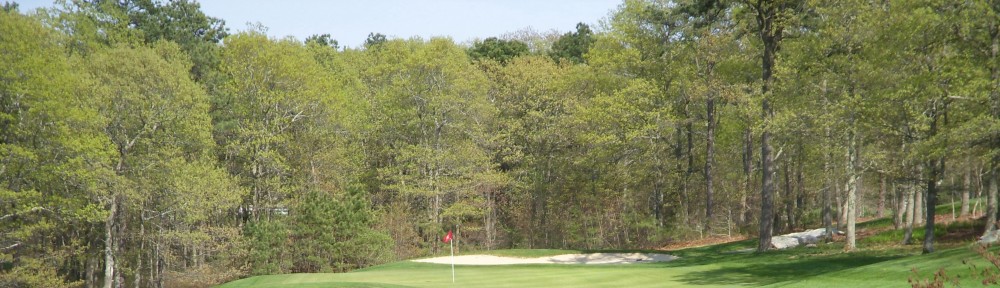
Carmel Valley Ranch Golf Course

During a recent bucket list trip to play Pebble Beach and Spyglass Hill, we wanted to play a few other local courses. The caddie at Spyglass recommended Carmel Valley Ranch. It’s located in a resort community and is a beautiful and challenging course.

When you arrive at the gate the guard tells you to follow the road to the pyramid club house. It is a beautiful clubhouse and clearly an upscale resort. The carts have water and towels for your use and golf balls are provided on the driving range conveniently located by the club house.

We played from the Lavender tees (5230 yards) to challenge ourselves but the forward tees are 4433 and would be challenging and fun too! It’s interesting that the forward tees are white (not red), I think this is a very clever move on the part of the golf course. Red tees have such a “stigma” as “ladies tees.” We played with an older gentlemen who played from the white tees and had no issue with the tees being forward.

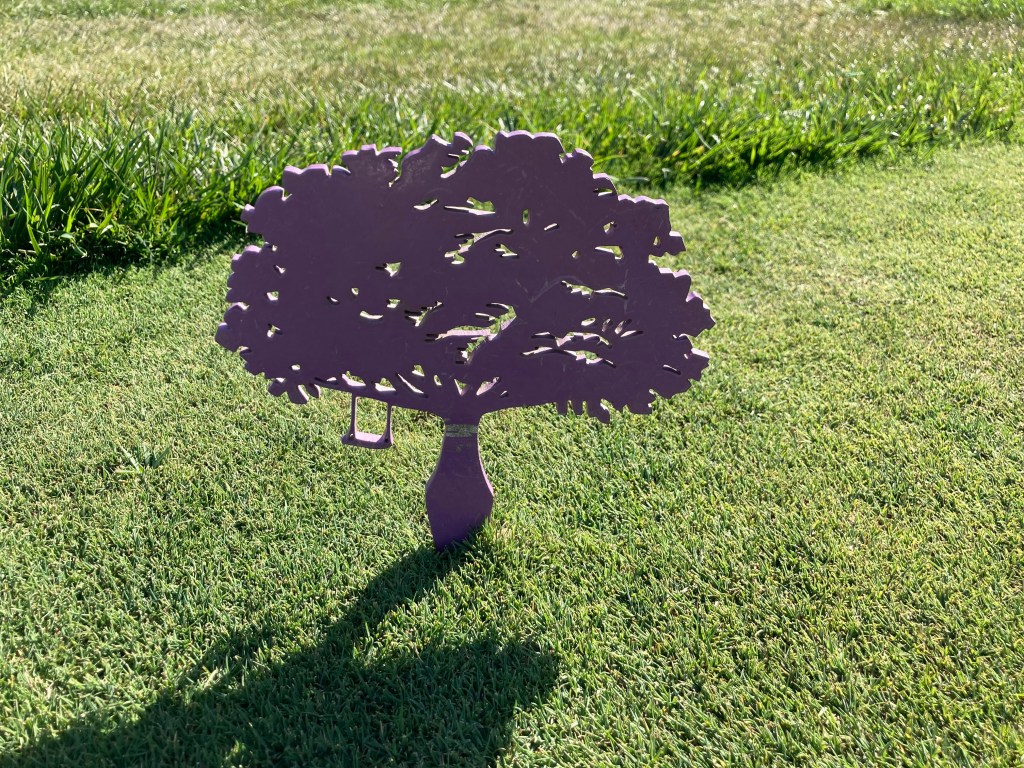
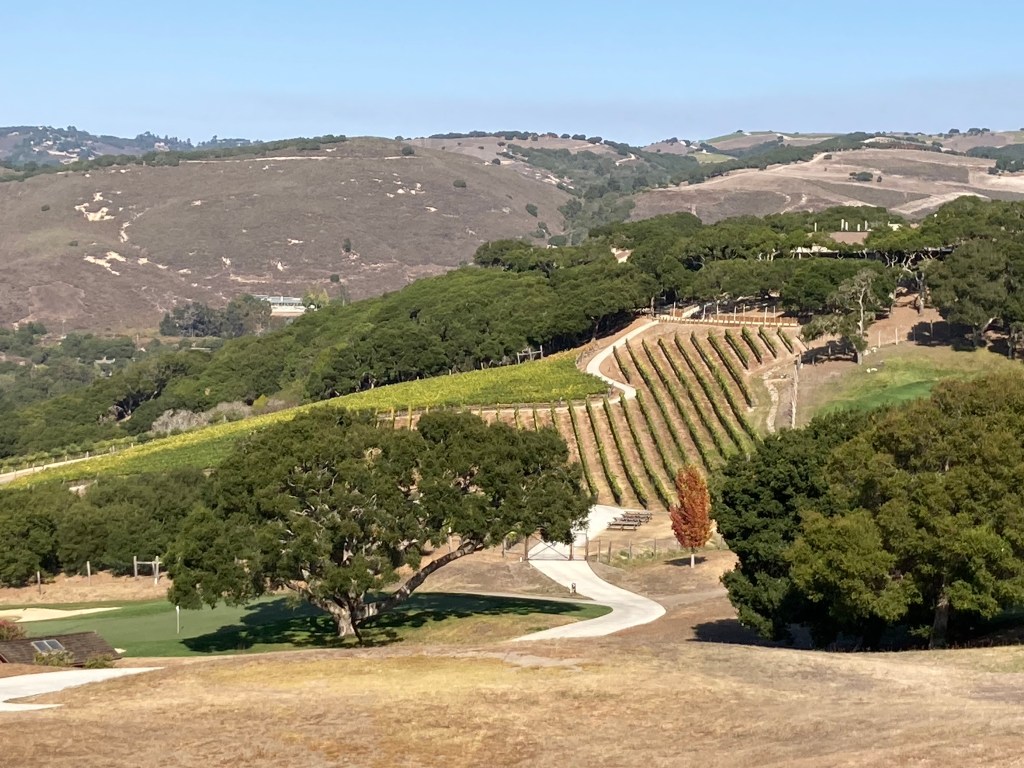
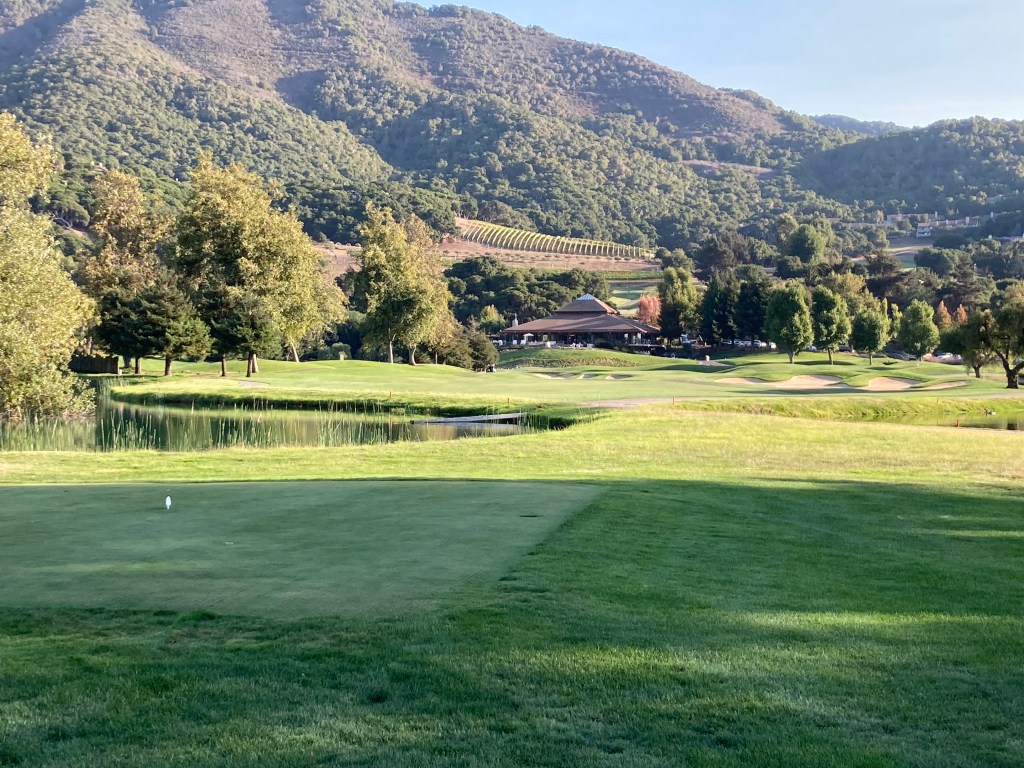
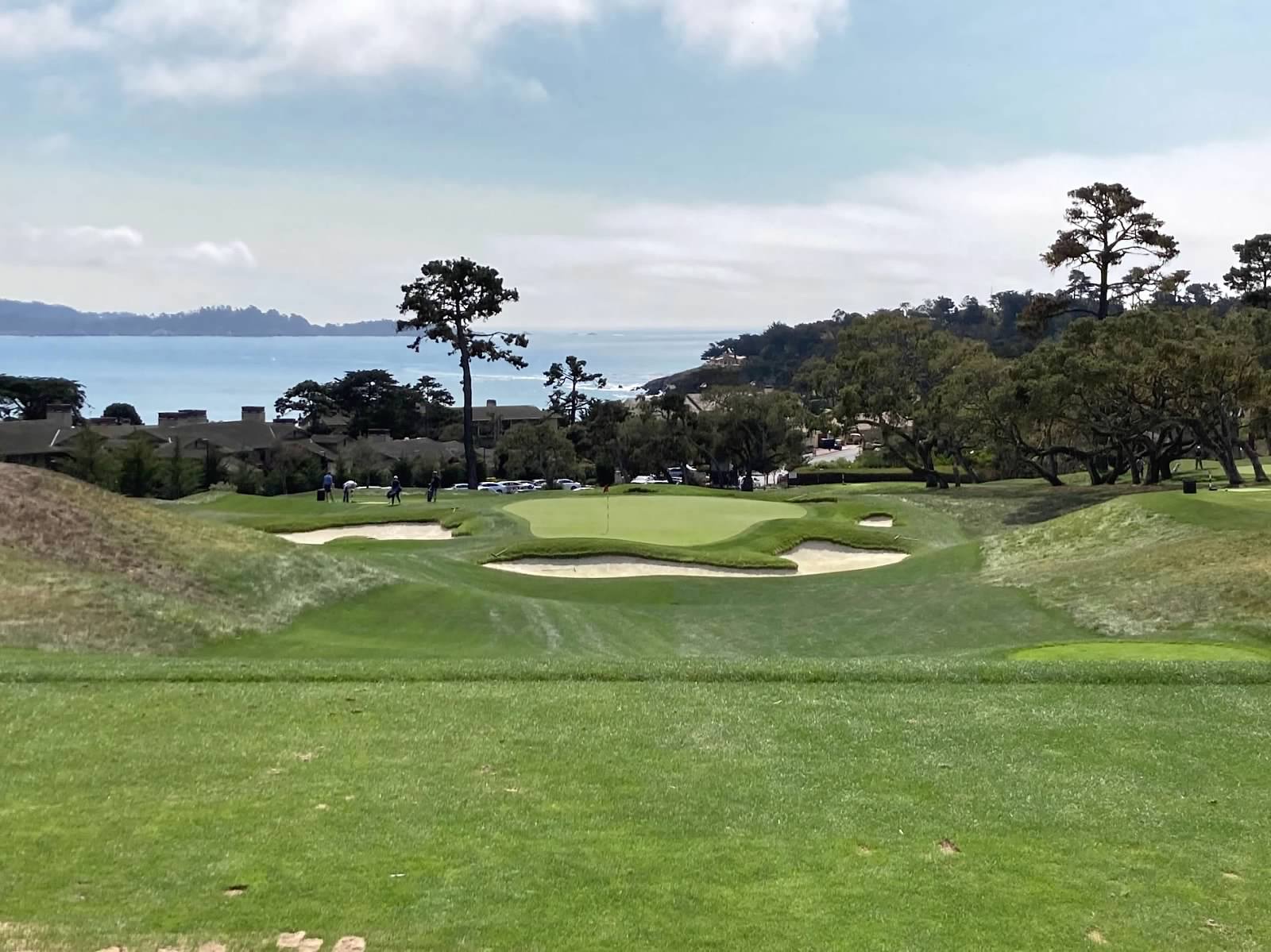
The photo slideshow below displays the view from the first tee, the cute “tree with swing” logo of the club, the 13th hole (downhill par 3), Vineyard views, deer watching us hit our drivers, wild turkeys ignoring us, and a view of the beautiful pyramid club house from the 18th tee box.

The golf rates on the website are high $210 for “outside guests” but go to GolfNow for a great deal. We booked with GolfNow for $98.00 (included cart, etc.). So if plan a trip to play golf in the Carmel area, look for the deals and play Carmel Valley Ranch.

Pacific Grove – “Poor Man’s Pebble” is a Great Value

Pacific Grove – Hole 16 Green – Wind Blowing, Waves Crashing on Rock in the Distance

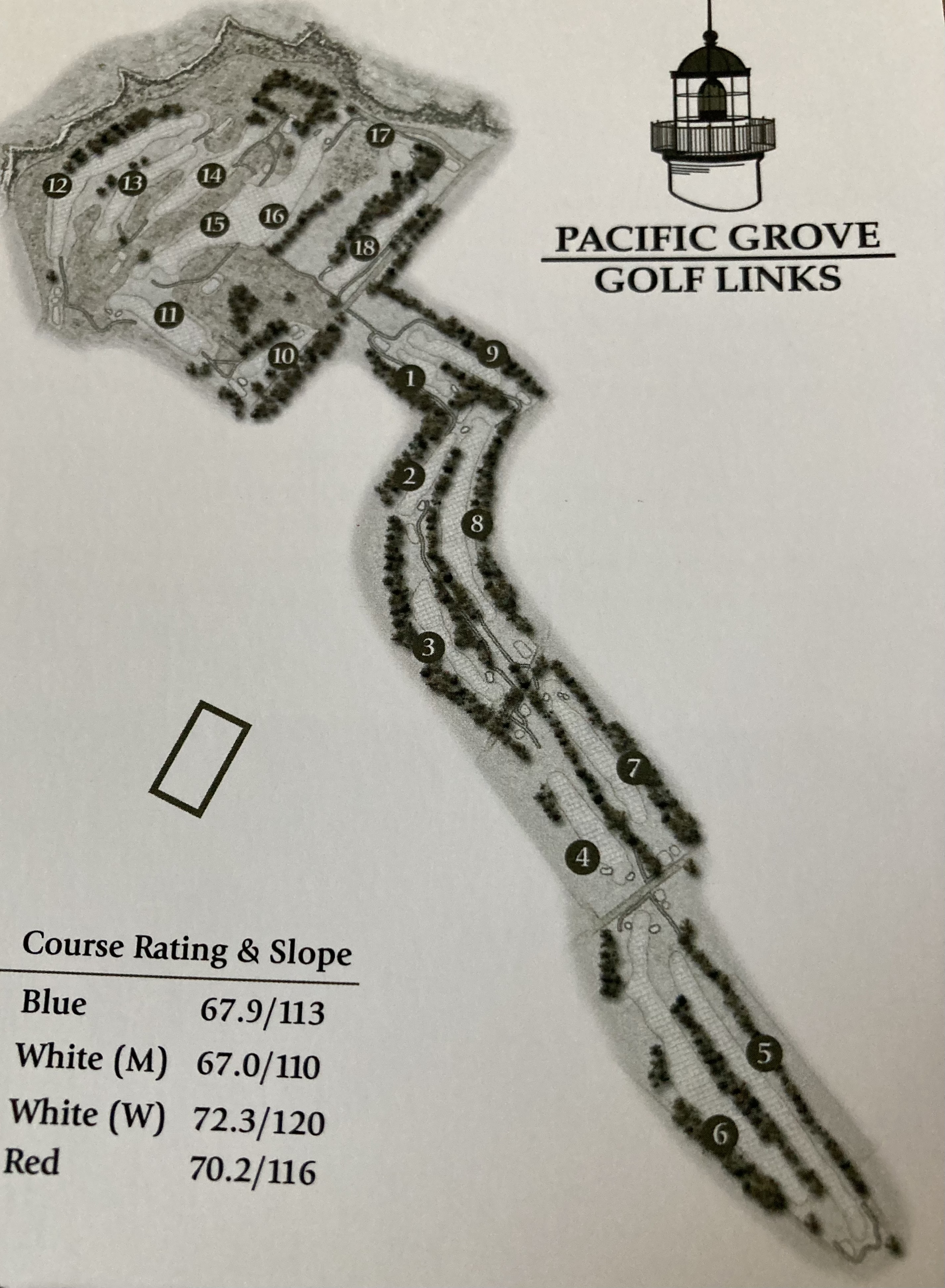
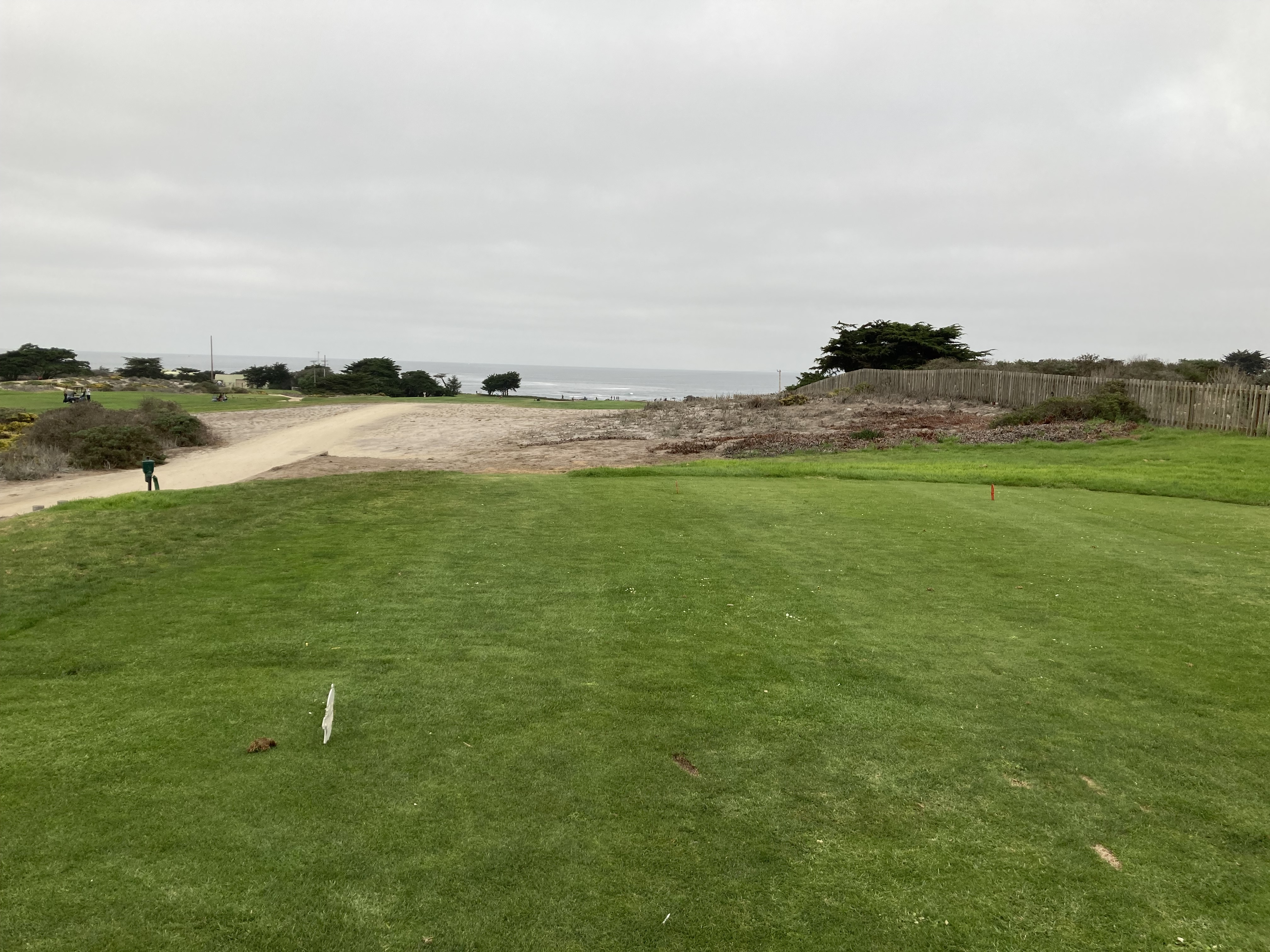
When you arrive at Pacific Grove it appears to be like any other municipal course. The Pro Shop staff if friendly, the driving range is actually pretty small and you hit off mats, the putting and chipping area is conveniently located by the first tee. It’s when you get on the course you realize what a great value it is to play because you have the front nine in the forest and the back nine on the ocean.

They call Pacific Grove “the poor man’s pebble” but I would say it is more like Spyglass Hill which has a portion of the course on the ocean and other holes in the forest. As of this writing the green fee (with cart) during the week is $56 and on the weekends/Holidays $70 (after 1 p.m $50).

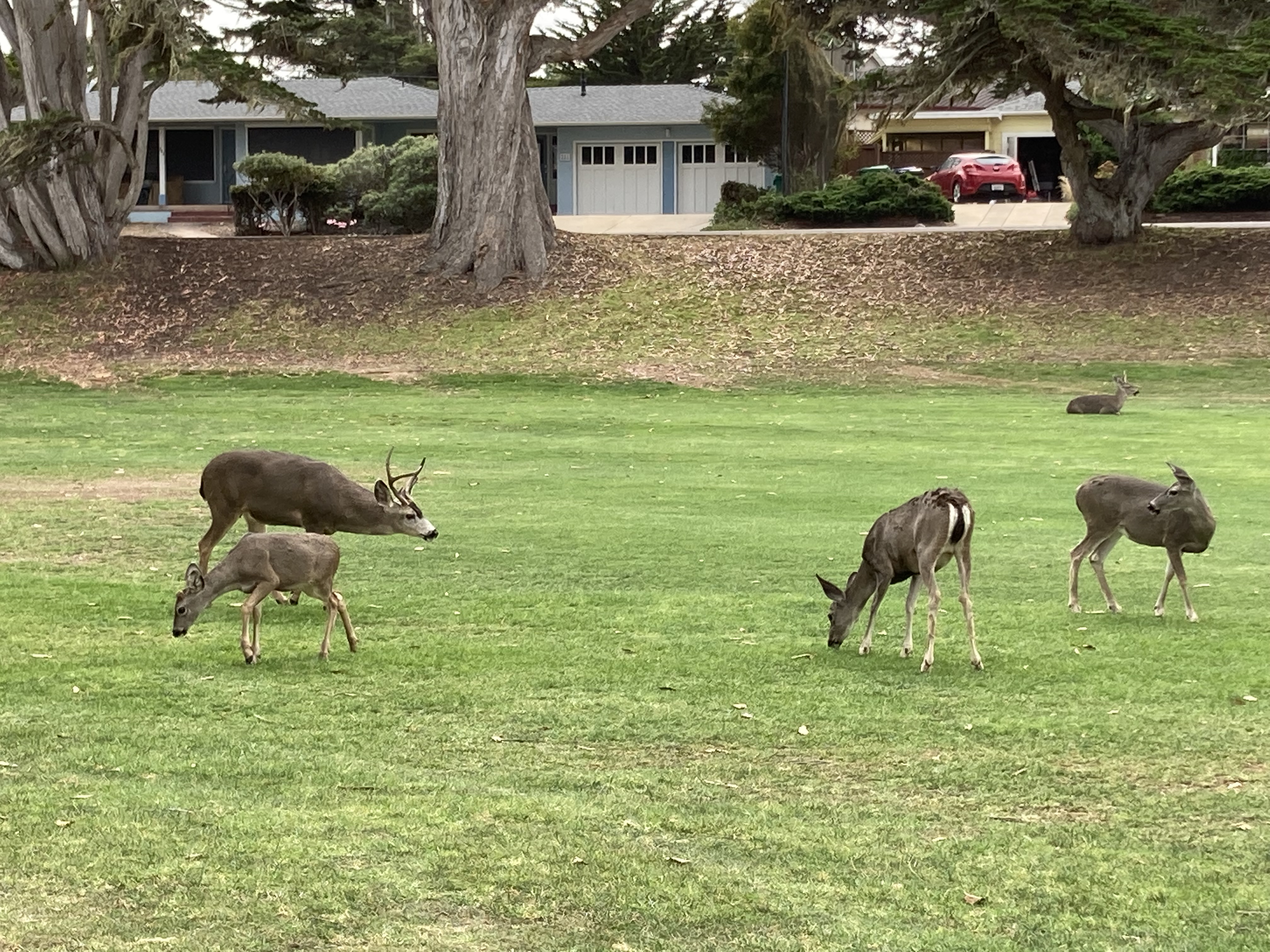
You will see a lot of deer on the front nine. They are clearly not worried about golfers and won’t move out of the way as you come up the fairway to hit your ball. I must admit that I did hit a deer with my approach shot on the fourth hole and the deer just hopped (because he was startled) and then just kept eating. I joked with my golf partner that I would have been on the green in regulation had the deer not interfered. (Note: click on images below to enlarge).

A few notes on holes: The front nine did not really have any tricky holes but there were some elevation changes (Hole 7 is 170 yards uphill off the tee) and fairways sloping left to right or visa versa. The back nine is more challenging with the wind off the ocean. I suppose if you spray you drives you would have more trouble on the front nine. A few specific points…

  • The fairway grass is Kikuyu. I have never played on this type of grass and noticed it was hard to delineate the fairway from the rough on many holes.
  • The grass on the greens is Poa Annua so they are spongy or a bit bumpy. If you are not used to playing on Poa Annua it will take a few holes to get use to the greens.
  • The course starts with two par 3 holes. They are long par 3 holes – 146 from back tees, 141 from forward tees. Hole 2 – 199 from back tees, 187 from forward tees. The holes are all named. The first two holes are “Little Tombstone” and “Big Tombstone” which refers to the old cemetery on the right side (of course, it’s out-of-bounds).
  • Two par 5 holes were over 500 yards from the forward tees – Hole 6 “Long Tom”, 521 yards, the longest – that’s just too long for shorter hitters to get on the green in regulation.
  • Pace of Play – It was slow (at first) they don’t appear to have a ranger. The issue for us was that they let a foursome out in front of us who were sharing clubs and it really slowed them down. One of the men in our group hit into them on the seventh hole (by accident) and so lucky for us on the next hole they let us play through otherwise it could have been a five hour plus round.
  • Also for anyone that misses their drives left, the main street is along the 18th fairway. One man in our foursome almost hit two cars and some pedestrians as his wayward shot went to the road and bounced on the pavement and on the sidewalk a few times.

The best compliment I can give Pacific Grove is that if I were a local I would be thrilled to have this course as an affordable place to play every week; and as a visitor, it is on my list next time I am back in the area.

Pebble Beach Lives Up to the Hype

My friend and I were both having a “milestone” birthday in 2021 so we decided a little over a year ago to plan a bucket list trip to Pebble Beach Golf Resorts. Lucky for us that we did early planning and were not impacted by the pandemic.

Spending a large sum of money on a bucket list trip brings on the feeling of “boy, I hope it is worth it.” I really wasn’t sure what to expect but it was an amazing trip. You must stay at the resort to play the courses but it is so much part of the experience that at the end of the trip you don’t mind. We played Pebble Beach, Spyglass and The Hay. We also played a few local courses, Pacific Grove, DeLaveaga Golf Course, and Carmel Valley Ranch. I will write seperate blog posts on the non-Pebble Beach courses.

We also took time to enjoy the surrounding area including Carmel-By-The-Sea, Pacific Grove, Monterey, and Big Sur. Our first day we arrived and traveled the 17 mile drive. So beautiful and lots of photo ops. The funny thing is we traveled the 17 mile drive many times during our stay at the resort going between The Inn at Spanish Bay and Pebble Beach Resort.

My first photo of the trip – 17 Mile Drive – Lone Cyprus Tree

So that is the only photo of me I will bore my readers with in this blog post. As I said it is a “milestone birthday” – O.K., I’ll share, I turned 60 the day this photo was taken of me. Now for the main event – our experience with the courses at Pebble Beach Resorts.

Pebble Beach

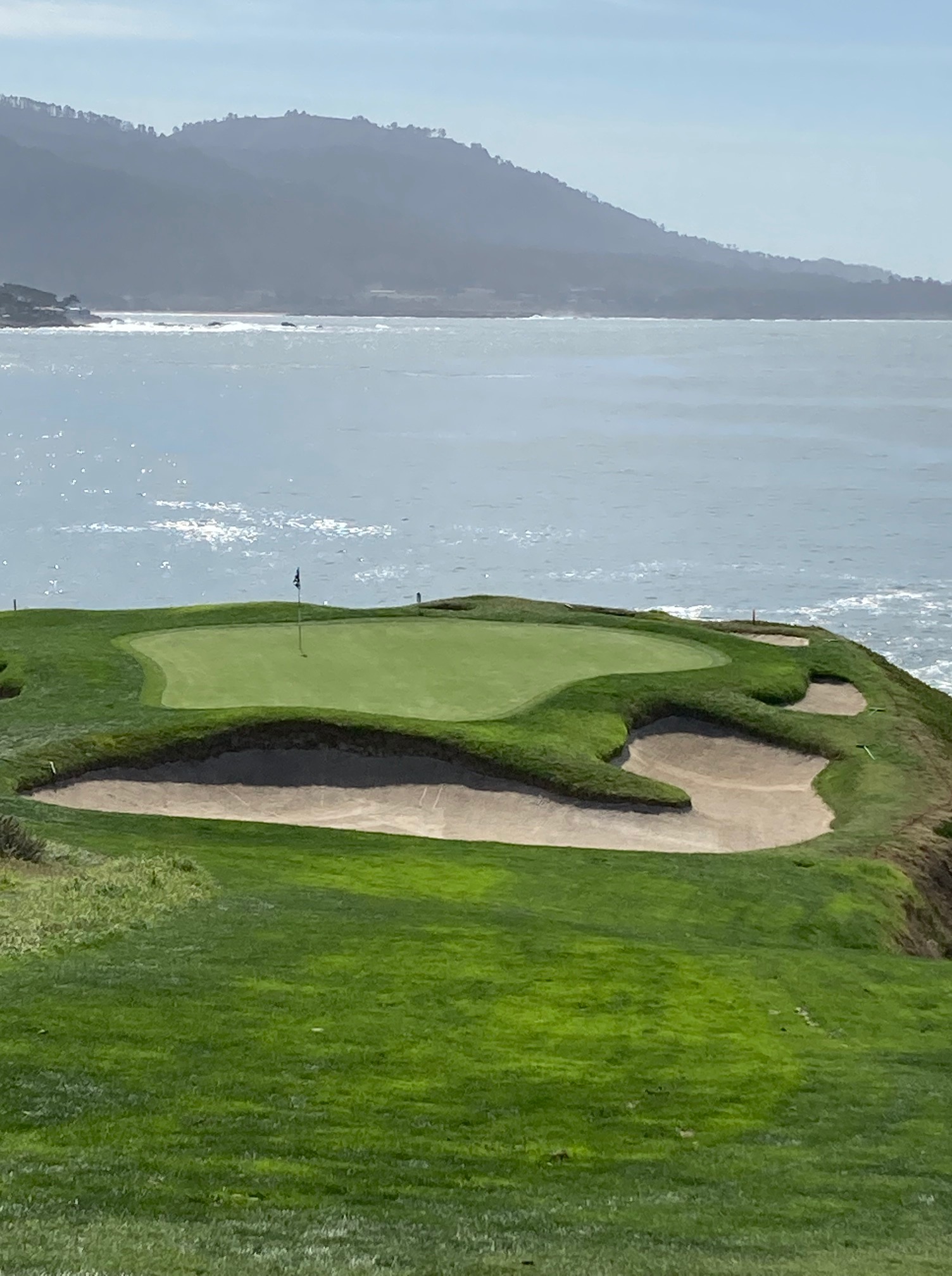
The iconic 7th Hole at Pebble Beach

The views are stunning and there are some hard holes (especially if the wind is up). I’m like everyone that visits and loved the 7th hole. Now mentally, for me, I found the most intimidating hole to be #6 because it is a crazy uphill hole. Here is the description – “The second shot of this iconic par five climbs nearly four stories to an elevated green.” I was thrilled to par the sixth hole.

The other hole that was a challenge because of the carry on the second shot was Hole 8, Par 4, 349 yards from the forward tees. It is the #2 handicap hole for women. The drive is easy with a big fairway, but you must be on the left side because the second shot is all carry and if you are on the right side of the fairway the carry is over the ocean. Even on the left side you have a lot of carry (over the hazard of rocks and bushes on the side of the cliff) but a better chance at hitting the fairway; and I’m happy to say I did hit the fairway!

So The holes that I felt were the most challenging were 6, (because of the uphill challenge), 7 (just because it’s in your head that you want a good score on the iconic hole), 8 (because of the forced carry, and 18 (because it seemed very long in the wind). I will say we were lucky with good weather, I can’t imagine how much harder it would be if the wind was really up or you had to play in dense fog.

We played the course the Tuesday after the PGA Champions Tour “Pure Insurance Championship” so the rough was really hard. I quickly learned that I had to really tighten my grip and use all the strength I had to advance the ball. Other than that and some wind on the back nine, we had amazing weather – sunny and in the 60s when we started and low 70s when we finished. Our round was a little over five hours. The caddies said it was a bit slower than normal but we were a foursome that got put in the middle of a “company outing.” My guess, we booked a year in advance and they had to fit the “outing” in around tee times; but we didn’t care because we really don’t want the round to end.

I would recommend a caddie for your first time at Pebble. They really can help with targets off the tees and placement of second shots on the par five holes to give you good approach shots. I also think some caddies are good at reading greens. I felt our caddie was a bit off on his reads (this is a reasonable comments after having a caddie at Spyglass that was awesome at green reading). And the greens were super fast!!

Later in the week, my golf buddy and I discussed the fact that we wished we had booked two rounds at Pebble Beach because after getting some course knowledge you really want to play again to see if you can better your first score. And because the views are amazing and it’s a beautiful walk. We actually did check to see if we could get another round but the only tee time was 2:40 p.m. and that meant we might not finish the round due to darkness.

I will share that while we were eating dinner at Stillwater (which overlooks the 18th green) you could see golfers finishing in the dark and a single light from a tree lit the green.

Spyglass Hill

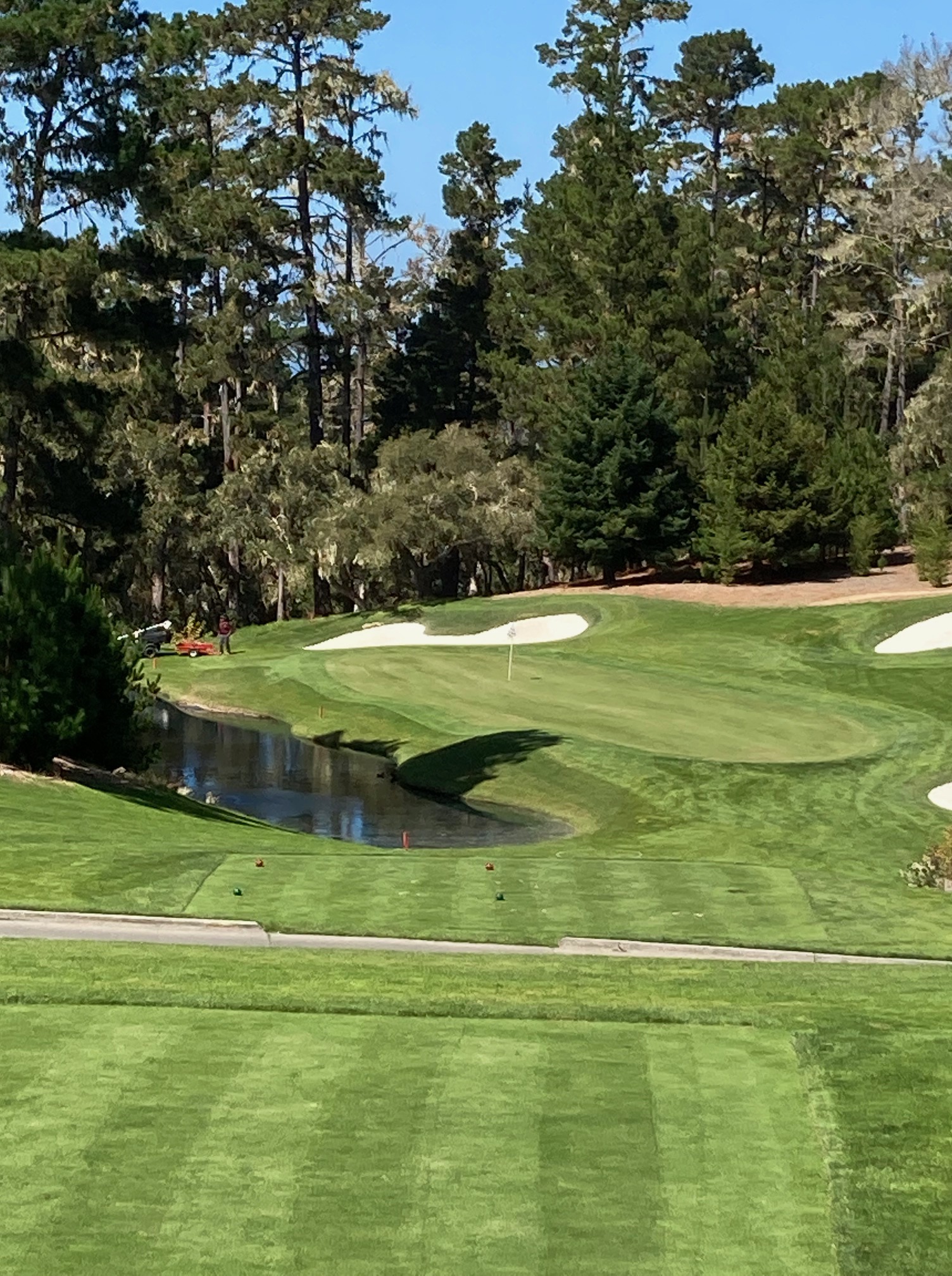
Spyglass Hill, Hole 12, Par 3

Everyone I spoke with before my trip said Spyglass was the harder course but their favorite course. Now, I loved Pebble for the uniqueness of the ocean views and I found Spyglass easier than Pebble Beach. I did notice that Pebble’s slope rating was a bit higher than Spyglass from the forward tees. I also wonder the men that said it was harder would all be hitting from the back tees so they would have a different experience with the course. Or it could be because, normally, I am a fairly straight hitter so I was in the fairway a large percent of the time at Spyglass (vs the day before at Pebble). Or I was just playing well that day. I’m not saying Spyglass is easy but for me it felt familiar (more like the courses I play back home — see Hole 12 in the photo, a par 3 with water on the side of the green — my golf eye was used to this type of hole) so I was relaxed and played well. Between the two courses, Spyglass was great but I would say Pebble is the course I want to play again because of it’s ocean views.

I will note that the men in our foursome at Spyglass, were really struggling with the tree lined part of the course (Holes 7 – 18).

How Did I play at Pebble Beach and Spyglass Hill? First let me share my handicap which is 18.5 right now. Course Handicap Calculator gave me “21” for both courses. So, Pebble Beach (71.7/132): Shot a 107. Spyglass Hill (72.6/130): Shot a 95. My GHIN Differential for Pebble was 30.3 and for Spyglass 19.5 which basically means I played Pebble Beach like a golfer with a 30 handicap and Spyglass like a golfer with a 19 handicap so you get the gist with a course handicap of 21 as the comparison. Bottom line, I was really happy with my Spyglass round.

The Hay (Tiger Woods Short Course)

The Hay Short Course, Hole 2 – the most scenic and interesting hole on The Hay

The Hay is located at the Pebble Beach Practice and Learning Center. The resort guests have free use of the practice center (expect for The Hay, you must pay to play). The Hay was a disappointment for both me and my golf buddy . The Hay was the only course that did not live up to the hype. It is a fine short course but it is not any nicer than the short practice courses at home. The two interesting holes were #2 which is “described” as a “replica” of the 7th at Pebble. And I thought the 4th was interesting because it was an uphill blind tee shot to the green.

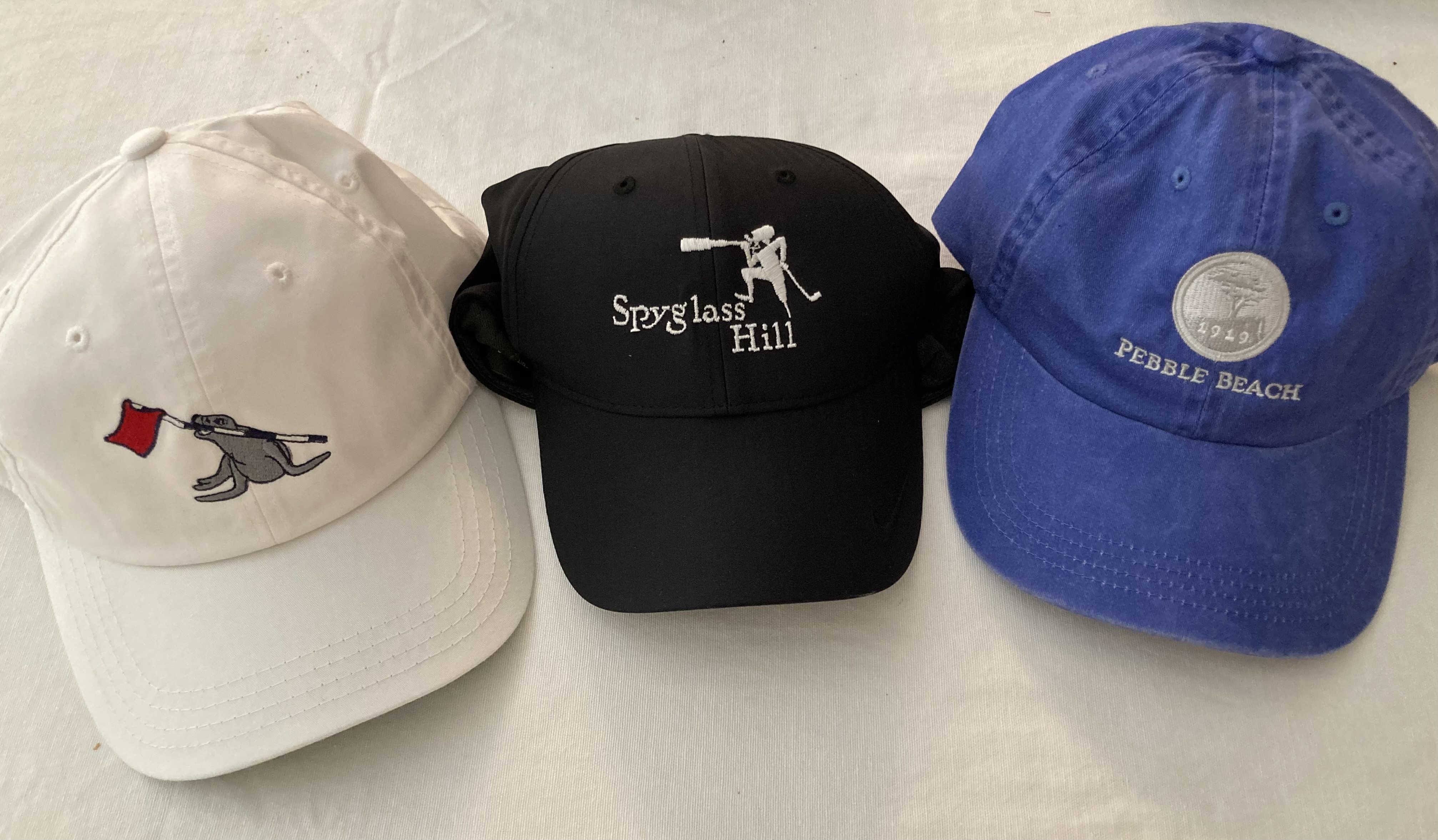
Bottom line, it’s not worth paying $65 to play. And a tip, don’t play on Monday – they make you hit off a mat because they are trying to save the tee boxes from those golfers (not me) that take big divots. We paid $65 to play off mats, really? It really was the only disappointing part of the Pebble Beach Resort experience. The one thing I loved was the cute logo of The Hay which is the sea lion Cynthia. So of course I did buy a golf cap.

Caps of All the Courses Played at Pebble Beach Resort

I could write pages about Pebble Beach but it would never give you the true feeling of experiencing it yourself. So if you have not gone to Pebble Beach Golf Resorts, save your money and go!

Mink Meadows Golf Course on Martha’s Vineyard is a Gem!

If you ask most people how many golf courses are on Martha’s Vineyard I think they would say one. And if they could name that course, it would most likely be “Farm Neck” because Presidents of the United States (Obama and Clinton) have played Farm Neck while vacationing on the vineyard.

There are, in fact, four golf courses on Martha’s Vineyard. They are: Farm Neck Golf Course (semi-private), Vineyard Golf Club (private), Edgartown Golf Course (Private), and Mink Meadows (semi-private).

I played Farm Neck last fall and it was a beautiful 18-hole golf course. It was what one would expect from an ocean course —  a challenging course with beautiful views of the ocean, windy on the ocean holes, relief from the wind on inward holes that are tree lined. The course had its fair share of water hazards and bunkers. The post-round 19th hole atmosphere is great with a wonderful bar and restaurant. If you are vacationing on the vineyard and love golf you must play Farm Neck.

So you may be thinking, isn’t this a course review of Mink Meadows? Yes, it is but I wanted to give a comparison with the more well-known course on the island.  So how is Mink Meadows like Farm Neck? Mink Meadows and Farm Neck are both semi-private and the courses are both in beautiful condition and fun to play but that is where the similarity ends.

Mink Meadow is a 9-hole course with two sets of tees (or alternate tees for a back nine that allows you to play a full 18-hole round). There are no water hazards at Mink Meadows and only one ocean view (but it is a beautiful view).

8th Hole Mink Meadlow

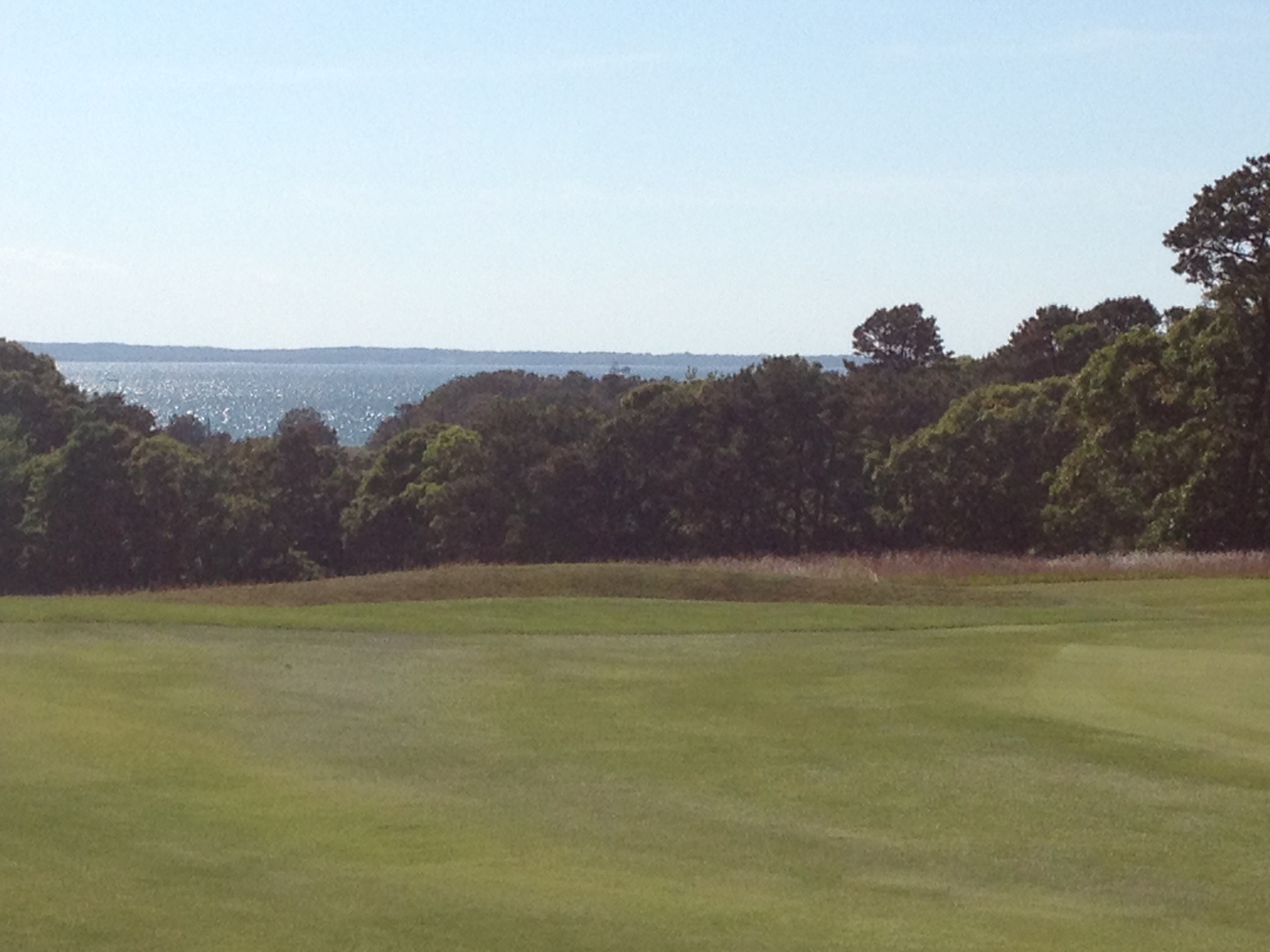
View of the Ocean from the green on hole eight at Mink Meadows

Don’t let the 9-hole setup and no water hazards on this course lull you into a state of ease. It is a challenging course! It can be very windy too! If you drive the ball straight you will have an advantage because the fairways are lined with trees or wispy grass. However, if you do find yourself off the fairway, the grass is not too tall (at least not in June) so you could actually find your ball. The bunkers are strategically place and make you think off the tee. The greens are particularly interesting and even a perfect shot will roll off the green if you don’t know the slope. If you have the pleasure of playing with a member, you can soak up local knowledge about the best approach shots/landing spot on the greens when you play the front nine. And then you have that knowledge for the back nine. Or make sure to ask the Golf Pro for a few tips before you tee off. One tip – on the 9th/18th hole everything rolls right (towards the ocean even though you don’t see the ocean).

The first nine holes are perfect for anyone! Expert golfers will enjoy the challenging greens and beginner/intermediate golfers won’t feel overwhelmed because it is a bit shorter than the back nine. And when you play the alternate tees on the back nine you really do feel like you are playing a different set of holes. It was really amazing to me how different the holes felt off the tees. I played two rounds of nine and two rounds of 18 and enjoyed the course more and more each time.

The atmosphere is another plus! It is relaxed and everyone I met was friendly and welcoming. There is a nice practice range at Mink Meadow but there is a distance limit (165 yards) so if you hit your driver a long way, you won’t be using a driver on the practice range.The pro shop has a nice collection of clothing and snacks (for the turn) but there is not a fancy bar or restaurant. Mink Meadows does have a nice porch so you and your friends could buy a soda and snack in the pro shop and sit outside on the porch, rehash your round or watch the golfers on the 9th hole.

So let’s talk fees. The green fee for 18-holes at Farm Neck (in season, between 6 a.m. and 4 p.m.) is $170 (includes cart and range balls). The green fee for 18-holes at Mink Meadow is $100; with “a la carte” fees for cart $18 and small bucket of balls $4.

My recommendation: If you are looking for value (a great course and price), play Mink Meadows. You will have a great time. And if you want a 19th hole “experience” — drive over to Farm Neck after your round and use the bucks you saved on green fees to paid for your meal.

Golf in the Catskills

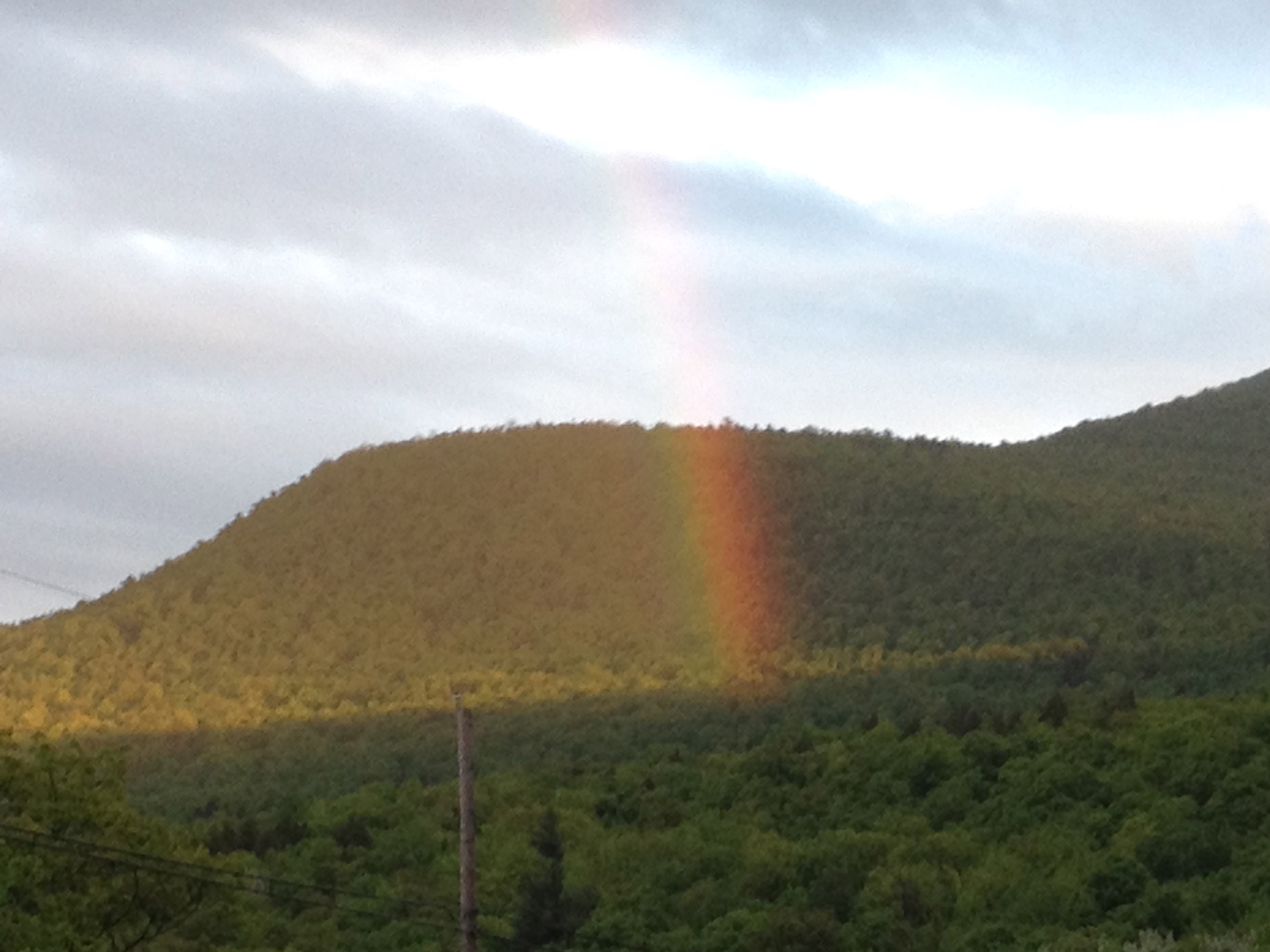
There is nothing better than meeting friends for a long weekend of golf. As I drove up Route 23 west, to meet my friends in the Catskills, it was raining and I wondered what the weather would hold for us over the next three days. Later that night a beautiful rainbow illuminated the mountain.

Rainbow in Windham NYI saw the rainbow as a good sign because the first course we were playing was the Rainbow Golf Club in Greenville, New York. The other courses we played were Colonial Country Club in Tannerville, New York and Windham Country Club in Windham New York.  One thing is for sure, the golf courses in the Catskills provide beautiful views of the spectacular mountain landscape.

My friends, who are great planners, emailed me a list of golf courses before our trip. I was the one that suggested we play the Rainbow Golf Club because the website had a photo of a beautiful island green. Well, it did have an island green but it certainly was not like the 17th at TPC Sawgrass. The Rainbow Club island green looked beautiful on the website but in reality the water surrounding the hole was cloudy and full of algae (or some green vegetation). Even though the hole was visually disappointing it was still an island green. I am happy to report we all made it over the water. Overall, the Rainbow course was fun and very reasonable in price ($35 w/cart). However, if I rank the courses we played, for me, I would put Rainbow in third place.

Colonial was a 9-hole course. As my friend described it, the course had “lots of moguls” (which seems fitting given the Catskills is famous for ski resorts.) My favorite hole was the 6th, par 3, 134 yards.  It was just a fun hole because it was an elevated tee (and I love elevated tees). We played the hole around six p.m. so it was very beautiful in the gloaming. I would rank Colonial second because of the beautiful views. I really didn’t mind the uneven lies in the fairway (probably because I wasn’t playing that well anyway so I wasn’t concerned about my score.)

6th Hole, Par 3, Colonial

6th Hole, Par 3, Colonial

The Windham Golf Club was the final course of the weekend. The course was a short drive from the Albergo Allegria Bed and Breakfast were we stayed for the weekend. If you go to the Catskills, I highly recommend you stay in Windham.

It was a beautiful day for golf and it was very exciting when we were told the owner of the course recently spend 2 million on improvements. It was a great course for women because if you were striking the ball well you could reach the greens in regulation. That is not always true with a lot of modern courses which can be very long for women. There was only one hole that was strangely long. The 8th hole was a 163 yard par 3 and given that the average women hits her driver in the air 150 yards, it seemed unfair to most women.

The big negative for the Windham was that the course had no signs. Yes, no signs. A well marked course is important to the enjoyment of the game from many reasons, including keeping players moving along because they know where to go and what yardage to play.  And with a course, like Windham, that is in a tourist town it seemed very odd for the course not to have signs. The young man in the Pro shop said the signs were coming but a groundsmen on a tractor told us the “owner doesn’t like the look of signs so he doubts there will ever be signs installed.” We managed to get around fairly well. Also, I guess we were just lucky that various grounds crew were working near by when we had a question on a hole location. The course was in great condition but they really do need to add signs to the holes.

My biggest pet peeve is slow play. My friends and I may be women but we play fast.  At the Windham course we were to tee off before a foursome of men but the scorecards they gave us did not have ladies yardage so one of my friends had to go back to the pro shop (it was the first time I have ever seen a separate scorecard for women).

To make a long story short the men went off the first tee while my friend got scorecards.  We did not mind because they said they played the course all the time. We thought “great, we can follow them since the course has no signs.” By the third hole were we so frustrated because the group in front was painfully slow. We were hitting to within 100 yards of the green and just watching them.  By the fourth hole they asked if we want to play through because “we were only three players.” We gratefully accepted. I am so glad we played through. By the 12th hole, they were two holes behind us. We were enjoying our lunch in the pub room when we saw the group behind us on the 18th green (40 minutes after we finished our round.)  The folks behind them must have been going crazy. If we were behind them the whole time, I might have actually stopped playing and asked for my money back at the pro shop. Here are my questions. Where was the ranger? Why were they allowed to fall so far behind our group? Yes, we played fast but still the group should have not fallen so far behind us. They were certainly playing much longer than what is acceptable for each hole. Anyway, I am thankful we played fast and enjoyed the final round of our golf weekend.

The courses we played would not be considered high-end. All were priced reasonably.  The only time I felt the price of something was too high was Mulligan’s Pub at the Windham country club. A burger was $12 (other burgers were $14 and some entrees went as high as $23.99) and they did not provide free refills on soda or ice tea. My guess, the owner has to recoup the $2 million in improvements somewhere. The food was good but skip the pub and go in town for lunch.

Even with “no signs” and an expensive food, I would rank the Windham course as the top course we played. It gets the top spot because of the fairness of the course for women, the great condition of the course, and the beautiful mountain views. However, if I had been behind the slow group for 18 holes, it might have been the down fall of the course. I hope they add signs and rangers to make sure pace of play does not impact the experience of golfers visiting Windham Country Club.

Perhaps there were other courses in the area that might be more high-end but high-end does not equate to fun. Playing with your best friends on a beautiful day on a course that is challenging but fair is what makes golf fun!

Next stop, North Carolina. Come back to my blog at the end of June to find out where I played!

La Cantera Glof Club, Resort Course – Long for the Ladies

San Antonio, Texas in April. I thought, how lucky can I be to get to go on a business trip (with golf) in April. I packed my bags and left behind the long cold winter of 2014 on the east coast. When I landed in San Antonio, Texas it was in the 50’s — what? The weather channel said mid-70’s to 80’s was normal. I was confident the next day would be better.  Boy, I was wrong. Cold and rainy for the first day of golf on the Palmer Course.

View of Palmer Course Club House from the 1st Hole Tee box.

View of Palmer Course club house and 18th hole from the 1st hole tee box

The starter said the Palmer Course was a hard course but my playing partners and I all felt it wasn’t bad considering it was rainy and cold. We played better than anticipated given it was the first round of the season. At the end of the day, we didn’t have a drink at the 19th hole to talk about how much fun we had during our round of golf. Nope. All anyone wanted to do was go back to their own hotel room and take a hot shower to try and warm their bones.

A few days later it was a bit warmer and The Resort Course, at La Cantera was the site of a 2-person scramble. By now I had a “wicked bad” (for all my New England friends) cold with a fever and sore throat. The morning was still cold by was sunny; and everyone said it would warm-up.

Again, the starter said The Resort Course was a hard course. The PGA Tour played the Texas Open on the Resort Course from 1995 to 2009. At the turn, there are stones engraved with winner’s names from the tournament.

At the Turn, there are a number of large rocks with the winners from the Texas Open

At the turn, Texas Open winner’s name on every large rock – Justin Leonard from 2000

All the women that I played with felt the course was very long for us (even from the forward tees) but it was also a very windy day and a lot of times we were hitting into the wind. I am not the longest hitter off the tee but my second shots and short game fit nicely with my partner, who did hit it long of the tee.

I love the internet today because you can see a whole course, hole by hole. The Resort Course has a good 360 view. There are two holes that I had memorable shots on — Number 5 and number 12. Hole 5 is a 432 Par 5 with a dogleg to the right for the approach shot (or over the trees to the green). My partner said she did not have “the shot in her bag to go over the trees” but I felt I could do it. My pro had shown me how to do that shot last summer. Well, I am proud to say I did it! I grabbed my 4 hybrid, put the ball slightly forward in my stance, a slight forward press in my hands and my swing thought was to swing down on the ball. I watched my ball sail over the trees. When we got to the green (130 yards away) there was my ball. All golfers know it takes just one great shot during a so/so or bad round that makes a golfer want to keep playing. That was the shot of the day for me. I was so excited I forgot to take a photo!

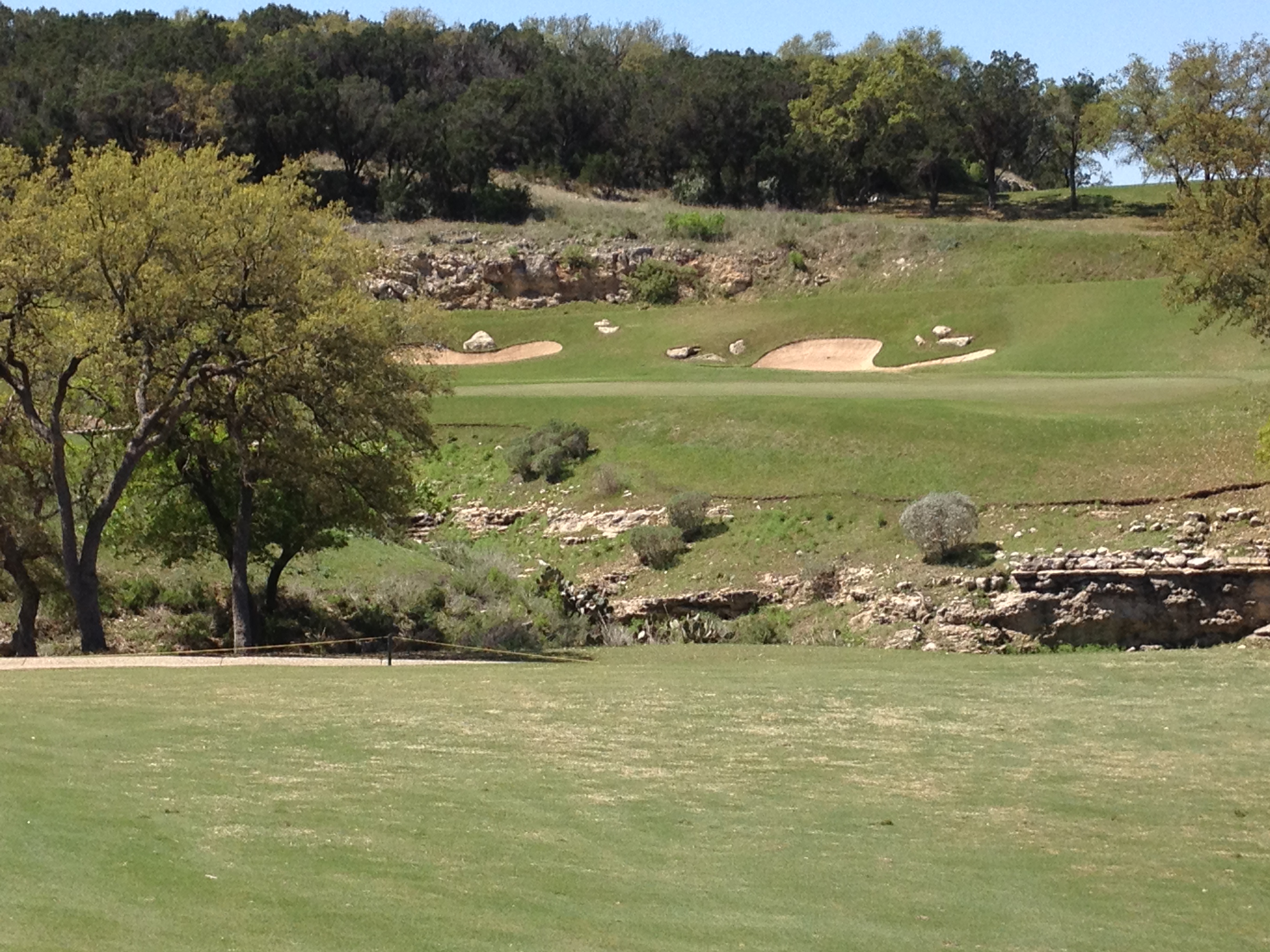
The other fun shot was on the 12th hole, a par 288 yard par 4. The approach shot onto the green is over a hazard. I think the course designer wanted a visual that would intimidate golfers (you know, get in your head — “ugh, I have to carry that stuff?”) Below is the view of the shot I had to make it onto the green. The flag is hard to see but sits just to the right of the trees in front of the bunker on the left.

La Cantera Resort Course, Hole 12,

La Cantera Resort Course, Hole 12, Par 4 – Approach Shot

All my playing partners missed the green (short and in the junk). It really surprised me because they all had great shots until this approach shot. I hit my ball onto the green and was very happy. My partner said that I was “smart” because I went for the shorter distance over the junk by going for the middle-right side of the green. They all went for the flag. Another shot that made me feel good about my game. That’s the trick, think only about your good shots.

We had a fun time and to my surprise my team came in 2nd place in the 2-person scramble, high handicap flight. Did I forget to mention I am a high handicap. It is hard to be a low handicap when you can’t drive the hole in regulation (but I am working on my length.) I learned something about my game in that scramble. I may be a high handicap but I am a great scramble partner because I have a good short game and sometimes hit great approach shots.

The bottom line — La Canter Resort is beautiful, the courses are hard but not so hard that you shouldn’t give them a try if you are in San Antonio.  The yardage on the scorecard is deceiving because the front tees seem to be reasonable.  But what makes it long for ladies is the wind and some of the carries. My only advice – just don’t get my luck and have the weather be cold and rainy because you might come away with another experience — a “wicked bad” cold.