I never really thought much about golf ball design expect for the fact I knew about the different layers, coating, and of course they have dimples. And that dimples reduce drag which increases ball speed or velocity (thanks to my day at the USGA); but I assumed all golf balls had the same number of dimples and that is not true. Guess I forgot that information from the guys at the USGA test center.
So the size and shape of the dimple has a huge impact. For example, A Titleist Pro V1 golf ball has a 388 dimple design, while a Pro V1x has a 348 dimple design. From what I have learned that means the Pro V1 has a lower ball flight because it has less dimples.
And there is no limit to the number of dimples or the shape of the dimples so that is why golf ball companies can spend millions on research.
Below is a Titleist video on the subject:
If you really want to geek out, I found this video from the USGA.
Of course, I had to look up the specs for my golf ball. I play a Callaway Super Soft which has 332 dimples that are hexagonal in shape. I use to play the Wilson Duo Soft but it was really hard to find last year (I assume because it was a good ball and under $30) so I switch to back to Callaway.
I just read that Wilson introduced a redesigned Duo Soft this year and the 2025 ball has 302 dimples; could not find style but they look hexagonal. So 302 dimples seems to be one of the lower numbers I have found and from what I have read it reduces spin (to help get more distance) but Wilson also states that “With DUO Soft, we have to make up for what we lose in velocity….and we do this with getting more roll.”
After learning more about golf balls, the one thing I did not think about previously was that the firmer the golf ball, the more ball speed (velocity) you’ll get because with a low compression (softer ball) there is more “deformation” when the ball is hit with the club.
So this was a geeky blog post but I did enjoy learning (or relearning) about golf ball technology. It does make me wonder why more club fitting facilities don’t offer ball fitting at the same time? At least it’s not offered any where near me. Seems like a logical service to offer golfers. The only ball fitting I can think of is the one that Bridgestone Golf offers an online for their golf balls.
Ask the average golfer about “stroke and distance” and they will mostly likely tell you that stroke and distance is what you must take for a lost ball or a ball out of bounds; and you incur a one stroke penalty. And some golfers may explain that it is a relief option when your ball is in a penalty area (Rule 17) and a relief option when a golfer declares a ball unplayable (Rule 19). But not many golfers will cite Rule 18.1 which is a governing rule that states that the player can proceed under stroke-and-distance at any time.
Most golfers don’t realize when you take stroke and distance relief under Rules 17.1, 19.2 and 19.3 they could also be correct to say that Rule 18.1 applies. And, most golfers don’t realize how to take advantage of the rules when on a putting green or in a bunker.
Putting Green – Here is the basic scenario. You are on the putting green and you hit your putt which roles off the green and comes to rest perhaps by a tree, or in mud, or even in a penalty area at the back of the green. What is the stroke and distance option? You can declare you ball unplayable (Rule 19.2) any where on the course expect in a penalty area. Declaring your ball unplayable allows you to take stroke and distance with one penalty stroke. Technically if you were asked by another player to state the Rule you could state Rule 18.1 or Rule 19.2.
This rule is useful when you really don’t have a shot or don’t feel confident in the shot you would need to make, etc. So let’s say my ball rolls off the green and is by a tree behind a root; I don’t want to risk hurting my wrist so I declare my ball unplayable and go back on the green and hit from the previous location of the putt that I just hit. And yes, I have a one stroke penalty; but a second putt (with a one stroke penalty) in many cases is better than taking a drop by the tree (again with a one stroke penalty for lateral relief), and trying to get up and down.
Now if your putt roles off the green into a penalty area, you again have the stroke and distance option as one of your relief options for a one penalty stroke under Rule 17.1. Or again, if asked you could state Rule 18.1. But in general, most golfers state they that they are taking relief under Rule 17 (penalty areas) although it is the same option as an unplayable (but remember, you can’t declare your ball unplayable in a penalty area).
I know, the rules can seem overly complicated when you are taking the same action and different rules can be stated but that is just one of the nuances of the Rules of golf; where Rules often repeat instructions.
For me, if I am not confident in making the next stroke from off the green, I’m taking stroke and distance every time and putting again (with the knowledge of what I learned when I hit the previous putt).
Some interesting golf trivia – Tiger Woods used stroke and distance at The Masters after a putt rolled off the green into Rae’s Creek. People thought he was wrong but he knew that stroke and distance was an option!
Bunkers – When the Golf of Rules were revised in 2019, the USGA and R&A added a relief option for golfers when they declare the ball unplayable (Rule 19.3). The additional option was to take “back-on-the-line” relief outside the bunker for two penalty strokes. But don’t jump to this option to get the ball out of the bunker; consider the stroke and distance option.
If you declare you ball unplayable in the bunker, for one stroke you can take stroke and distance. Or again you could also state Rule 18.1. Again, you are going back to where you last played the ball but it saves one penalty stroke (versus the back-on-the line option outside the bunker).
I think most golfers would be worried about irritating the other golfers in their group if they take stroke and distance (and have to walk back 100 or more yards). I get it and in general casual play maybe take the two stroke option; but if you are in a competition you should do what is best for you. Personally, if I take an unplayable in the bunker and I can get a decent lie with lateral relief that is what I do. However, if I had no shot at all, I would seriously consider stroke and distance.
I have been asked by a high-handicap player what to do (usually they really have trouble getting out of bunkers even with a good lie). Frankly I tell them in casual play, just take the two stroke option. In league play or a competition; if they are already struggling and 2 strokes won’t impact the outcome then just take the back-on-the-line two strokes; but if they are playing well and think a stroke will make a difference then they have the right to take stroke and distance. It’s a personal decision. I remind them, when they enter their hole-by-hole in GHIN, it will adjust to their max score. Also, if they are new to a league, I tell them to ask if there is a max score for pace of play because that may impact their choice too.
One scenario that always surprises me is when a golfer is a short distance from the green (maybe 5 or 10 yards) and they chunk a shot into the bunker guarding the green. Then they take the back-on-line outside the bunker with two penalty strokes; without even a thought about going back the 5 or 10 yards to where they last hit the ball.
If you’d like to watch a video, you can view this from the USGA. For those that like diagrams, below is the USGA diagram for the relief options for an unplayable ball in a bunker:
Bottom line: It’s never a great feeling to take a penalty stroke but sometimes stroke and distance can be your friend on the golf course.
Model Local Rule E-5
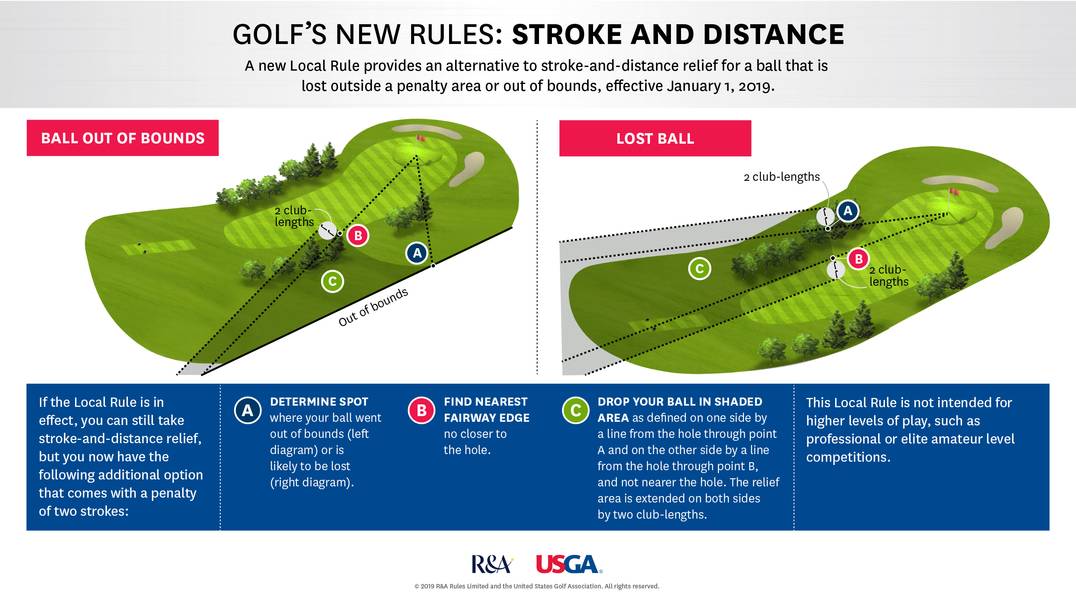
A Model Local Rule is a modification to a rule that “the committee adopts for general play or a particular competition.” The new stroke and distance model local rule is MLR E-5. This is an alternative to stroke and distance for a ball that goes out of bounds or a lost ball. You cannot use this rule if you played a provisional or your ball is lost in a penalty area.
Basically, when you are OB or have a lost ball, in stead of going back to where you last played your ball, you figure out where your ball came to rest (and imagine a line to the flag) and then you find the nearest fairway edge (imagine a line to the flag); from the edge of the fairway you get two-club lengths (along with the imaginary lines from the flag) to create your relief area. This model local rule comes with a 2-stroke penalty.
I believe courses implement MLR -E5 hoping it will help with pace of play. Of course whether or not golfers will use it is debatable because it does have a two stroke penalty. In a casual round I think many golfers would be open to using MLR E-5 but in competition I would guess no one would want to use it unless they were already feeling they were out of the money.
You can watch the USGA video or below is a diagram of the Rule:
Bonus Info:
Lost Ball in Abnormal Course Condition: Some golfers think you must take stroke and distance for ALL lost balls but remember that if it is known orvirtualcertain that you lost your ball in an abnormal course condition (the abnormal course condition must be in bounds and not in a penalty area); including animal hole, ground under repair, immovable obstruction or temporary water, you get free relief under Rule 16; you do not have to take stroke and distance.
For example, there is a pile of storm debris (in the general area, not OB or in a penalty area) that you know the maintenance crew will be removing from the course. The pile of debris is considered ground under repair even if not mark. So, if you are virtually certain (95% likely) you ball is in the pile of debris but you can’t find it, you can take free relief.
Ball in Water in a Bunker: Another example when it’s good to know the rules. It rained the night before and there is temporary water in a bunker. You hit your ball in the bunker and find it in the temporary water. Some golfers will think they need to take an unplayable but that is not correct. Under Rule 16 (Relief from Abnormal Course Conditions) you get free relief from the water but you must stay in the bunker taking free relief (one club length from nearest point of complete relief). So, again, if you want out of the bunker then you can use Rule 18.1 (stroke and distance) or Rule 19.3 (unplayable).
Water on the Green but Ball is Off the Green: Sorry, you don’t get free relief if you want to putt your ball from off the green and there is water on your line on the green. To get free relief from temporary water on the green your ball must also be on the green. Here is a great short video from Jay Roberts.
Do you know how to properly find the nearest point of complete relief? If you want a refresher there is a good video from the USGA.
If you are a fan of golf or like watching golf and you don’t watch the women play you are truly missing out on great entertainment.
Here are my top five for women’s golf in 2024
These players had big years and/or big events:
(1) Nelly Korda – The #1 player in the women’s world rankings had an incredible start to 2024. She won six out of her first seven starts on tour; five wins in a row and one won the first major of the year. And Korda, after not playing because of a “minor neck injury” comes back in November and wins the “The Annika driven by Gainbridge at Pelican.” Of note, no LPGA golfer has had six or more wins in a season since 2013 when Inbee Park had six wins.
So it is no surprise that Korda won player of the year in 2024.
(2) Lauren Caughlin – a journey woman on the LPGA tour had the year of her professional life in 2024. Caughlin is 31 years old and has been on tour since 2018. In July, winning the Canadian Women’s Open was her first tour win in 103rd starts on tour. One month later she won the ISPS Handa Women’s Scottish Open.
Caughlin with her excellent play met a personal goal to qualify for The Solheim Cup that was contested in her home state of Virginia just an hour from her home. The pressure of playing for a home town crowd and as a rookie on the biggest stage in women’s golf could have been too much for some golfers but not Caughlin. She showed up to the Solheim and once again had the “week of her professional life” winning all three of her team matches and garnering a tie for her singles match. This is a stellar record for a “rookie” Solheim Cup member.
(3) Lydia Ko
Ko had pressure all year with the golf analysts constantly asking will this be the tournament that Ko wins and get’s the one point she needs to enter the LPGA Hall of Fame. The LPGA Hall of Fame has the most difficult criteria of all sports hall of fame (it’s not voted on, it’s all points); requiring 27 points.
Per the LPGA website the criteria is:
1. Must have won/been awarded at least one of the following – an LPGA major championship, the Vare Trophy or Rolex Player of the Year honors; and2.
2.Must have accumulated a total of 27 points, which are awarded as follows – one point for each LPGA official tournament win, two points for each LPGA major tournament win and one point for each Vare Trophy or Rolex Player of the Year honor earned.3.
3. One point for an Olympic gold medal
Per Golf Digest, “Ko is a 15-time winner, including two majors and three season-ending awards. She earned 70 percent of her 20 points in two years—2019 and 2021.”
Her quest for the LPGA Hall of Fame was a storybook ending when she won the Gold Medal at the Olympics; and giving her the point she needed to be in the LPGA Hall of Fame.
(4) Rose Zhang – Zhang was the most decorated player in women’s amateur golf; including winning back-to-back NCAA Individual National Championships and winning the August National Women’s Amateur in April 2023. Zhang held the position of the #1 female amateur golfer in the world for over two-and-a-half years (or 141 weeks at #1).
In May 2023, Zhang turns Pro and she wins her first LPGA tour event at the Cognizant Founders Cup (she is the player that stopped Nelly Korda’s win streak of five wins in a row). After that 2023 was rather quiet and she did not perform well at the Solheim Cup in Spain with two ties and a loss.
In early 2024 she seemed to still be missing that spark but the spark caught on fire at the Solheim Cup in the USA. Zhang won all four matches. And she is the only player in Solheim history to win all four matches and never have to play the final holes (17 and 18). There have only been eight players to have a 4-0-0 record at a Solheim Cup and only two other American’s have achieved this accomplishment (Dottie Pepper in 1998 and Morgan Pressel in 2011). Zhang also won 28 holes only lost 8; no player has been that dominant in the last 20 years.
It’s worth noting the scores for Zhang’s four matches: She won 3&2, 3&2, 5&4, and her singles match was 6&4 (ending her match against Carlota Ciganda on the 14th hole).
(4) Soleim Cup Players – The 2024 Solheim Cup was everything a golf fan wants in a competition – great play and a competition that goes down to the end; which is stressful but fun to watch. The USA won 15 1/2 points to Europe 12 1/2 points.
The points don’t tell the whole story but for those that don’t normally follow match play. The current holder of the Solheim Cup (Europe) only needed 14 to maintain possession and the USA needed 14 1/2 points to win (take possession) of the cup. The last meeting (2023 in Spain) of the teams was heart braking because the teams tied (14 points each) therefore Europe “won” because they won the cup in the previous meeting in 2021 in Ohio at Inverness.
Along with Rose Zhang, Khang (3-0-0), Coughlin (3-0-1) and Andrea Lee (2-0-1) were the other Americans to go undefeated (since they tied and did not lose one match). It is the second time the U.S. team had that many undefeated players at one Solheim Cup.
So do yourself a favor and watch the LPGA in 2025.


 Golf Expectations